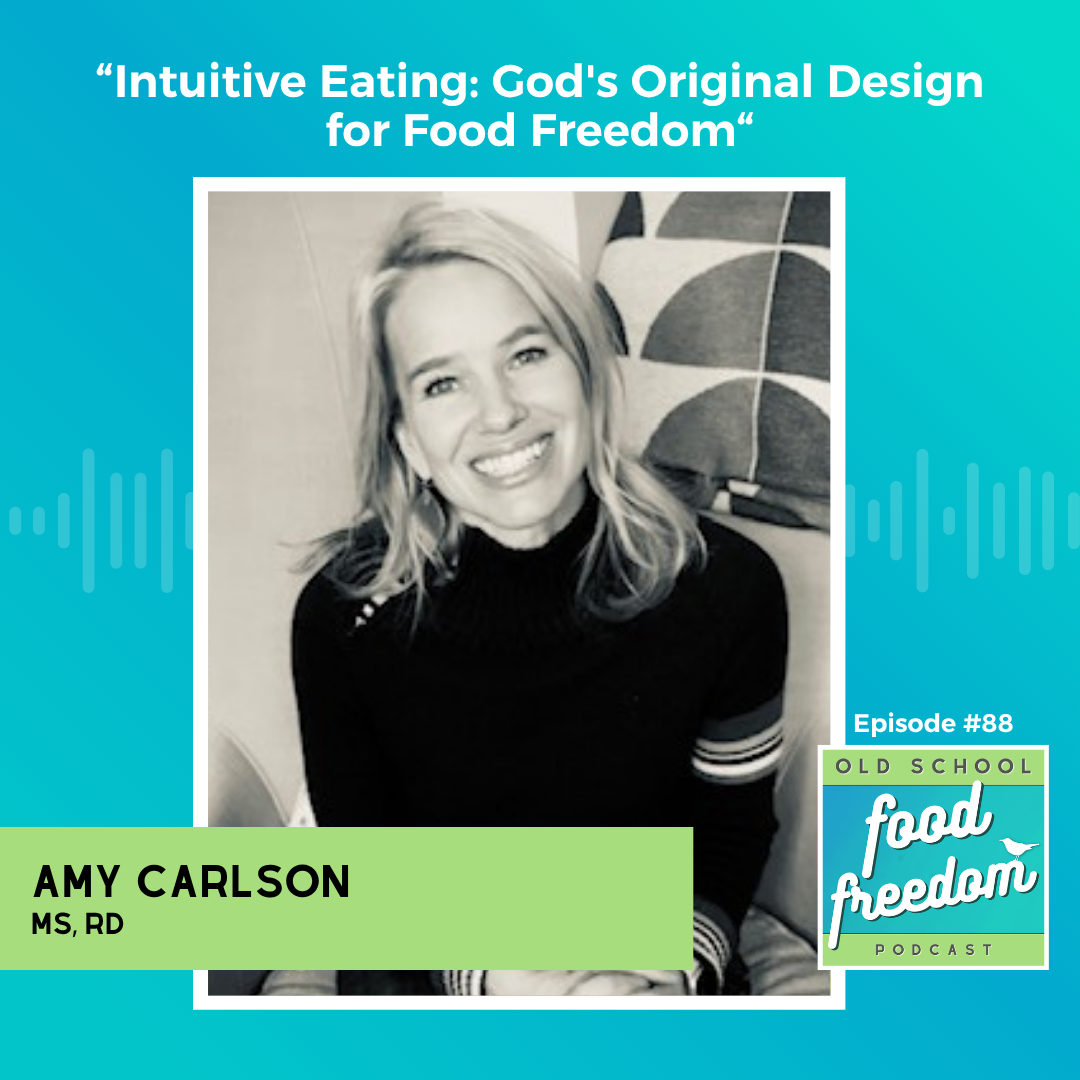
Intuitive Eating: God's Original Design for Food Freedom w/ Amy Carlson
"I want the whole world to know you don't have to diet your whole life."
You've probably felt the pull of diet culture so long that eating without rules sounds less like freedom and more like a setup. Maybe you were taught, in one way or another, that your body couldn't be trusted, that hunger was something to manage, and fullness cues were a problem to be solved. So you handed the wheel to external rules instead of internal ones, and wondered why you never actually arrived anywhere.
This throwback episode brings back a conversation Chrissy had with Amy Carlson, a registered dietitian and licensed nutritionist with over 20 years in practice, including nearly as long working specifically with girls and women in eating disorder recovery. Amy is also co-founder of the Peace With Food app, alongside Dr. Megan Osborne, and she has seen firsthand what keeps people circling and what lets them get off the conveyor belt.
In this conversation on Christian intuitive eating, they get into what it means to listen to your body when you've spent years overriding it, and why that work is less about food rules and more about recovering something that was always yours to begin with.
Here's what we cover:
What intuitive eating is, including Amy's clearest example of what it looks like before diet culture gets involved
Why people who have lived with restriction often interpret food freedom as permission to go off the rails, and why that fear is worth examining
How diet culture functions the same way it did decades ago, just through different delivery systems, and what Amy showed a college student that made the whole thing click
Why Amy believes eating was never meant to happen in a vacuum, the relational thread that runs from the Passover table through the way your family sits down to dinner tonight
What it looked like when the enemy questioned God's character in the Garden of Eden, and how that same pattern shows up in the way we relate to our bodies
Amy's client who, after years of eating disorder recovery, sat in session one day and said the freedom she'd been promised had finally arrived
Why sustainable eating looks completely different from dieting success, and why so many people blame themselves when diets fail instead of questioning the diet
The moment Amy's 17-year-old client realized she didn't have to diet for her whole life, and why the people around her still couldn't accept it was true
If your relationship with food has felt like one long argument you can't win, this episode makes a case for a different starting point. One that's less about controlling your hunger and more about trusting that God's original design for your body wasn't a mistake.
"There's freedom. There's freedom coming." - Amy Carlson
The answer to diet culture isn't a better diet. It's getting off the conveyor belt long enough to ask where it was taking you.
If this episode named something you've been carrying, come find us in the Hello Freedom Community. And if you know someone who needs to hear it, send it their way.
We’d love to hear your thoughts, so please drop us an email at admin@findingbalance.com, send us a voice message via SpeakPipe, or you can also subscribe for more practical episodes coming your way.
More About Amy Carlson
Amy Carlson, RD (Registered Dietitian), has maintained a thriving private practice in the Houston, Texas, area, serving the eating disorder population for nearly two decades. She holds a Bachelor of Science in Nutrition from the University of Minnesota, where she grew up, and a Master of Science in Nutrition from TWU in the Texas Medical Center. Passionate about truth and equipping women to find freedom, Amy is a highly sought-after speaker, traveling across Texas and the country to speak to women's groups at retreats and women’s conferences. Her longing to have a bigger reach with the truth and knowledge of food and the body became a reality with the co-founding of the Peace With Food App: the opportunity to pour years of her experience into a personalized application for anyone to use. Amy and her husband have been happily married for over 20 years, and together they lead a busy, active life with their four beautiful children.
Hello Freedom Community
Our Hello Freedom community is launched! This is a Christ-centered space to find connection, encouragement, and gentle steps toward freedom from food and body-image struggles. No pretending, no fixing yourself first, come just as you are. If you want in, your next step is to join us at findingbalance.com/community.
You were not meant to walk this alone. We're saving a seat for you!
Connect with Amy Carlson
Christian Treatment Finder Profile
FINDINGbalance
Facebook
Instagram
SpeakPipe – Send us a voice message!
CHRIST-CENTERED RESOURCES TO HELP YOU FIND FREEDOM
The Daily Vitamin eDevo: A free devotional with bite-sized truth emailed 5 days a week
Community Groups: Find connection with prayer groups and our Hello, Freedom! community.
Christian Treatment Finder: Connecting you with Christian providers experienced in treating eating issues.
Lasting Freedom Online Course: A Christ-centered, non-diet course to work through false beliefs about food and weight so you can live free from disordered eating and body image issues.
CREDITS
Interlude music by “Hotham” – Morning Thoughts
Intro music by “MokkaMusic” – Old Jeans (Funk)
Wrap-up music by Jesse Quinn – Christian Instrumental
Production & Editing by Leah Bryant Co
The content in this podcast is for informational purposes only and is not intended to diagnose, treat, or prescribe a particular course of action. If you have, or suspect you may have, an eating disorder, please consult your healthcare provider. If you desire to receive faith-based care, visit ChristianTreatmentFinder.com to browse professionals with a Kingdom campaign against eating disorders.
More about the Old School Food Freedom Podcast
In today’s diet-culture society, food issues and body hatred have become the norm. But you were created to be FREE. Welcome to Old School Food Freedom, where we go back to the basics, God’s basics, for how we view food, our bodies, and our worth.
Hosted by FINDINGbalance Executive Director Chrissy Kirkman, this podcast features Biblically-sound experts, thought-leaders, artists, and everyday people who will inspire you to interrupt negative cultural soundtracks and rediscover God’s original design for your relationship with food and your body.
This show will deliver practical, faith-filled insights on how to break free from diet culture and body shame through the lens of scripture. If you’re looking for guidance on how to heal your relationship with food while deepening your faith, you're in the right place.
We’ll answer questions like
What does the Bible say about food freedom?
How can I overcome an eating disorder or disordered eating with Jesus?
What is the biblical perspective on diet culture?
How can I find peace with food as a Christian?
What does it mean to treat your body as a temple in relation to eating?
How can I break free from diet culture with Jesus?
How can I align my eating habits with biblical teachings?
What are the first steps to finding food freedom in Christ?
This podcast is for anyone ready to walk away from diet culture and into the freedom that Christ offers. Whether you’re recovering from an eating disorder, disordered eating, wrestling with body image, or simply craving a more peaceful relationship with food, this space was made for you.
If you want to experience true food freedom with Jesus, this podcast will give you the encouragement, truth, and tools to do just that.
The unedited transcript for this episode of Old School Food Freedom
Chrissy Kirkman [00:00:47]: I really don't think it's an accident that this one is coming back around right now. So let's get into it. Amy Carlson, welcome to the show today.
Amy Carlson [00:00:56]: Thanks for having me.
Chrissy Kirkman [00:00:57]: you're so welcome. Before we jump in to the Old School Food Freedom podcast, I want to tell our listeners about you. Amy Carlson is a registered licensed dietitian in the Houston area. She holds her Bachelor's of Science and nutrition from the University of Minnesota, where she grew up, and received her Master's of Science in Nutrition from Texas Women's University. Amy has been practicing in her field for over 20 years and has had the privilege of working with girls and women with eating disorders for nearly as long. After recovering from anorexia and bulimia during a time when neither were well understood, it has become her passion to speak truth into girls and women as they seek to recover. Amy is also one of the co founders of the Peace With Food app alongside her dear friend and colleague, Dr. Megan Osborne.
Chrissy Kirkman [00:01:49]: Finding Balance is blessed to have had Amy as a featured speaker at our Hungry for Hope events and an expert in our Lasting Freedom course. Amy's a wife and mom of four, and she enjoys this most of all. Okay, Amy, we like to kick off each episode with a question. And what old school item do you miss from back in the day?
Amy Carlson [00:02:09]: Ooh, gosh, I love old school items. But let me think about that. Chrissy. You know what? I'm going to be super generic and tell you that I super miss letter writing. There's something very impactful about writing letters. I still do it. I still buy greeting cards. I love postcards.
Amy Carlson [00:02:29]: I love putting a stamp on something. I love writing a letter and sending it. And I also love receiving, which, if anyone I know is listening, actually don't get that many letters. So that would be nice. Including my children that live far away. But I super miss it because there's something really powerful. I just got one from of my closest friends in Colorado, and she wrote, like, we were missionaries on two, like, remote islands, and she was giving me an update, and it made me so happy. I was like, yes, Letter writing.
Amy Carlson [00:02:57]: Right. I miss it.
Chrissy Kirkman [00:02:58]: Old school. That's good. That's nostalgic. That makes me think of, like, at Christmas time, there are people in my life that every single year wrote a Christmas letter, that I do it every year.
Chrissy Kirkman [00:03:09]: Do you?
Amy Carlson [00:03:10]: Yes.
Chrissy Kirkman [00:03:11]: It's, like, gives the update of the whole year of the Carlson family.
Amy Carlson [00:03:15]: Okay. I confess, I don't actually give the update, but I usually let that be, like, my one moment to write, like, something profound. It's my. Chrissy, you're on my Christmas card list. You're on my Christmas card list. Oh, my gosh.
Chrissy Kirkman [00:03:29]: I will forget.
Amy Carlson [00:03:30]: Done and done.
Chrissy Kirkman [00:03:31]: That is so good. That's exciting. I love that. Well, I know that you have made a huge impact in my healing journey. I am not wherever I think I should be, but I'm right where I need to be, right in God's presence. And he has helped me in so many ways just find freedom from the bondage of these food struggles. And with intuitive eating, you and Dr. Megan Osborne both with the Peace With Food app, trying to get back in those rhythms.
Chrissy Kirkman [00:04:04]: I still find myself needing to go back and revisit and get back into rhythms. Cause I'll get into work mode and. And work, work, work, work, work, work, work, work, work, work, work, work. I need to go to the bathroom, but I don't want to eat because that just takes too much time. I mean, it's ridiculous. But intuitive eating, for anyone who doesn't know, can you just explain what does that mean? If someone's never heard the concept of intuitive eating? Like I like to say, well, it's really the way God designed our bodies to eat and think about food before this thing called diet culture came in and messed everything up. But that's my. My layman's terms.
Chrissy Kirkman [00:04:39]: How would you share that?
What Is Christian Intuitive Eating?
Amy Carlson [00:04:41]: That's actually pretty much it, Chrissy. And it's a wrap, folks.Chrissy Kirkman [00:04:44]: Chrissy's got it. And done and done.
Amy Carlson [00:04:47]: You know what? Intuitive eating is a word that we use, but I taught intuitive eating long before I even used that language. And intuitive eating, you're right. It's just the way that our bodies naturally. If you think about a little kid and you watch a small child eat and you watch sort of their natural rhythms, which is they really experience hunger, and they respond to it, and they eat. And they might say, I'm so hungry. And then they eat and they leave, you know, a quarter of the sandwich and half the chips on their plate and they're done. And they're going and playing because they're full and they've recognized their fullness cues and they walk away from food. That's the clearest example of intuitive yangibe, which is just that we listen to the natural rhythms of our body.
Amy Carlson [00:05:31]: And the. The reality is there's a lot of things that impact it as we age. There's a lot of things that impact it with our schedules. Exactly what you just described. It's one of the reasons that Megan and I built the app, which was an exciting kind of journey in and of itself. But it's because not just people who are in recovery from an eating disorder, but people who are recovering their life coming out of the diet culture or just are confused about how to eat and they need help trying to figure out what those rhythms are again. That's one of the reasons we do it. So intuitive eating is really just finding those natural rhythms again.
Amy Carlson [00:06:02]: And intuition is in the name itself, which is kind of finding that natural intuition, which, honestly, a lot of people say to me, I don't trust my intuition with eating. And so we have to kind of go backwards and work our way forwards to that.
Chrissy Kirkman [00:06:15]: And it's a long process. Do you see that? It's a long process and worth it.
Amy Carlson [00:06:20]: Yeah. I tell people, put on your seatbelt, we're going for a ride. Like, get comfy, get your bags, get a book.
Chrissy Kirkman [00:06:28]: Yeah.
Amy Carlson [00:06:28]: A cup of coffee. Get your playlist going, because we're going to be in it for a little while. Well, one of the reasons it's so complicated, and I know we'll probably talk about this more, but it's just that one, we have a lot of factors that have interrupted that. If you have a history of an eating disorder or disordered eating, certainly we're working on recovering, you know, from that. But we also have a culture that's immersed in the diet culture and really speaks that language very well right now. And so people who are coming out of that dieting culture, it can be very conflicting because those around them are there. So it is a long process and well worth it. And I just had a client who I adore, and she's in her 50s, and I've had her for several years recovering from an eating disorder, but a really a lifelong, you know, trauma and just a conflicted relationship with food for most of her life.
Amy Carlson [00:07:20]: And the other day, she was just in tears in our session, and she just said, the freedom you promised I would have is here. And I can't believe it. And just to see that and just kind of watch that happen, I just said, nobody knows what happens in these sessions.
Chrissy Kirkman [00:07:35]: Oh, my goodness.
Amy Carlson [00:07:36]: I'm so excited.
Chrissy Kirkman [00:07:37]: Right?
Amy Carlson [00:07:37]: Like, it's just amazing. And it's amazing to see and amazing to watch. So, yeah, it can be a process for sure. And I want that to be a word of encouragement rather than discouraging. I hope it would be a word of encouragement.
Chrissy Kirkman [00:07:48]: It is so worth it. I love that you shared that, because instantly I was like, I remember the day that I felt that way. Wow. The things that people were telling me, the things I was learning in the Lasting freedom course, and I was reading and it actually clicked. And I. I realized that ice cream that used to feel like it had so much power over me has been in the refrigerator, the freezer now, for two weeks, and I haven't even thought about it once.
Amy Carlson [00:08:18]: I love how you just corrected that. Wouldn't that be hilarious if it was in the refrigerator? And you're like, hey, that's one way to do it. That's one way to do it.
Chrissy Kirkman [00:08:26]: Right?
Amy Carlson [00:08:27]: It was there and you didn't even. You were like, oh, wait, I forgot I had ice cream in the freezer.
Diet Culture vs. God's Design for Your Body
Chrissy Kirkman [00:08:32]: Yeah. And it just. It's like the magnetic pull it feels like it had over you just goes away. And, you know, we talk about old school food freedom, but there are a lot of old school food rules, old books that our parents, our moms have, you know, read a book or done a program or something. You know, friends share things with us, and we all mean well. I think that when we're doing this and we're talking about it in a community or with friends, it's because we all relate to the struggles and we want to find freedom. And we think that freedom will come in a variety of ways, or it should look like this. Or now that I'm on more of a healed side of the journey, I see all these commercials and how they're just saying, you know, like, appetite suppressant so you can go longer without eating and shut down your food cravings.Chrissy Kirkman [00:09:29]: Now I see it in a different light.
Amy Carlson [00:09:31]: I know, right?
Chrissy Kirkman [00:09:33]: Because why are we trying to silence the voice that's trying to help our bodies be efficient? Fully efficient?
Amy Carlson [00:09:41]: Yeah, absolutely. Often when I talk or give a talk, I talk about how this way that our bodies are created and we're created reminds us that we are created people that, that rely on a creator just by nature is that hunger built in that rhythm. And we have natural rhythms. And we work so hard in this culture to manage and suppress our natural rhythms. We do it by trying to keep ourselves awake. And then now I've decided it's time to go to sleep. So I'm gonna medicate myself to go to sleep. And I need to manage my hunger.
Amy Carlson [00:10:18]: And I always try to sit with that language with somebody and just say, what does that mean for us to manage and control our hunger? What does that say about us? What if we stop? And we even just make a general commitment to not manage and control our hunger. But let's for a little bit of time consider, what if we listen and honor our hunger? What would that look like? And listening and honor ring our hunger comes also with listening and honoring our fullness. Because a lot of times the concept or the idea of food freedom sounds a little crazy to people. They'll say, well, I mean, freedom, yeah, I can have everything, but I can't have everything. And I'm like, okay, let's go down that road a little bit. But the idea of food freedom, people interpret that as, oh, I would go crazy. You know, they can't even imagine I would while I can't be trusted. But somewhere along the line in our journey, we were told to stop trusting our internal cues and start using external cues to decide, is it time to eat? Is that okay for me to eat? Am I allowed to eat that? And so we transfer the internal cues and we transfer to the external cues.
Amy Carlson [00:11:32]: And so this idea of food freedom, then, because people have lived sort of a restrictive managing controlling hunger, then they think food freedom means, ah, I'm gonna go crazy, right? I'm gonna have everything I've never ever had. Baaa.
Chrissy Kirkman [00:11:44]: Right?
Amy Carlson [00:11:45]: And the whole idea of food freedom is I'm free to say yes and I'm free to say no. I'm free to say no when I'm full. Which actually can be very conflicting in this culture too, because I often give this example. If somebody were to say, oh, do you want a piece of cake? And I was full and I were to say no, they would say, are you trying to be good? And it's like, no, I'm just full. I'm just full, I'm just full. There's the freedom.
Chrissy Kirkman [00:12:06]: I'm full, I'm satisfied, I'm satisfied. I'm okay.
Amy Carlson [00:12:09]: I don't need to. I'm okay, I'm Good.
Chrissy Kirkman [00:12:11]: But it seems like this concept that some of us, when we're so into that culture, we can't even imagine.
Amy Carlson [00:12:19]: Blinded. No. You know, a lot of times people say, well, what's something new that you have to share? And I'll say, I cannot even tell you how much people need to hear this over and over. Like, finding intuitive eating, and not just intuitive eating, but finding that food freedom and finding, like, what does my body need? And listening to my body is not something that we do temporarily. It's not like, oh, that's just one version of, you know, People say, well, you found something that works for you. It's like, nope, nope, that's actually not what that is. That's actually. It is a forever thing.
Amy Carlson [00:12:52]: I have this beautiful, precious teen client who has gotten so much freedom over the last year. And she said, I literally thought I was going to have to diet for my whole life. The way I grew up, the way I was taught, I thought I was going to have to diet my whole life. And I don't have to diet. I have to diet my whole life. I don't have to diet.
Chrissy Kirkman [00:13:10]: I don't diet.
Amy Carlson [00:13:11]: I want the whole world to know you don't have to diet your whole life. But she said, but that's what I witnessed. That's what I heard around me. That's what I heard. She is 17 and now knows she doesn't have to diet for her whole life. Life. I feel like she's like a little bird that just, like, flying, going, I don't have to die. I don't.
Amy Carlson [00:13:30]: I don't have. I don't have to tell my whole life. And wants everyone to know it. And you know what? She's not getting great reception. People are like, well, you know, you found something that works for you. And it's like, wait, what? Like, the reception is not that great. Because people can't imagine that that's true. Isn't that Say something?
Chrissy Kirkman [00:13:49]: Yeah, it's not wild.
Amy Carlson [00:13:51]: That says something. And, you know, people talk about how far we've come. Let's just say as women. I'm so glad if there's men listening to this too. We want you here. I want you here. But just think how far we've come as women when we kind of talk about, like, oh, you know, we can vote, we can, you know, all these things that have happened even before, you know, our lifetime, but with the last century, and yet we as women are still trying so hard to conform to one chair. I say it's like playing Musical chairs, and we're all trying to fit into the same chair.
Amy Carlson [00:14:24]: And it's like, no, no, there's one version of a body. And I'll show, you know, old magazines to my clients, old ones that my mama used to have that are like dieting. Diet, exercise. And the calorie restrictions are about 500 to 800 calories. And there's, like, images of women doing, like, slimming exercises. Well, I showed this to a college student not long ago, and she said, oh, my word, that's crazy. And I'm showing her the images, and we're laughing, you know, we're giggling, like, over the horrific. It was like liver cutlets for breakfast, you know, I mean, it was pretty much torture.
Amy Carlson [00:15:04]: It was a gag reflex, I'm gonna be honest. So she and I are giggling and laughing, and I said, wait. Hmm. This is so curious to me. I said, where have you seen this recently? And she goes, what? And I said, no, seriously, like, where have you seen this? And she sat there and she looked at me and she said, oh, Pinterest, TikTok, Instagram. And I said, yeah, same thing, darlin'. It's the same thing. I said, the message is the same.
Amy Carlson [00:15:34]: And she just sat there kind of with that, like, stunned revelation of going, oh, that's gross. Oh, my goodness. I'm. I'm letting some image on social media or something. For women back then, it was magazines, and many of the authors of the. The dieting self control kind of books that my mom had were men with no degree in nutrition, or they were like, an army guy and a, you know, a chaplain. And it was just so, like, wow, really? What's going on here? And you could see this sort of revelation. Your eyes go, oh, yeah, that I am like, what am I consuming in my social media that's telling me, you need to be a different version of yourself.
Amy Carlson [00:16:17]: And here's how to get there. Because what happens is, if we're talking about old school food rules, it's new school food rules. We just compound them, and we just sort of add them to our list, and then we just keep putting them in our backpack, and we never take them out of our backpack to evaluate if they're true or relevant or anything. And suddenly the only thing I can eat is quinoa and baked beet. I don't. It's like, what's left, right? Actually, that sounded really gross. I hope that did sound gross.
Chrissy Kirkman [00:16:44]: It was not appetizing to me.
Amy Carlson [00:16:46]: No.
Chrissy Kirkman [00:16:47]: You know, it's so true. It's like, we have to unlearn, step by step, all these things that we've learned, like you said, put in our backpack. We gotta take them out one at a time. And not just take them out, but, like, take them out and replace them with God's truth from the Bible. What does the Bible say? What does he say? How did he design? What is the actual old school food freedom that he designed in the beginning?
How Jesus Modeled Eating Relationally
Amy Carlson [00:17:15]: Yeah. And you know what is so compelling? If you want to get me on a soapbox, Christy, just put it up there. Here we go. Here, it's coming. Are you ready?Chrissy Kirkman [00:17:23]: I'm ready.
Amy Carlson [00:17:23]: Okay. One of the things that we talk about so much when we're talking about recovering our piece of food and when people are getting freedom. Right. Is this unbelievable, you know, like, oh, this is so compelling. And like that sweet girl who's like, I want everyone to know and you don't have to diet. One of the things that we don't talk about and I feel passionate about doing is that Jesus does things relationally. When we read the Gospels, he is relational. What he does is relational.
Amy Carlson [00:17:54]: He does ministry in relation. He didn't have to invite the 12 disciples. He did. He does things in relation in his family context as a child. He is born into a family, and so his ministry is done relationally. And he eats relationally. I mean, the Passover meal then transformed into the communion table is done in relationship. That is done as a body of believers.
Amy Carlson [00:18:18]: And so he sanctified and made holy even the act of eating. But he does it when he feeds the 5,000, and he does it when he transformed water into wine. And so he does this in relation. And what we do is as people, as humans, right? Is that we do all of this in a vacuum. So individually, what's right for me now, I'm not talking about I have diabetes and I need to change some of the way I eat, or I have celiac, and I'm not talking about that. Of course, those are individual needs that are important and relevant. But I'm talking about families that go to a quote, unquote nutritionist and come back with five different ways of eating and can't sit at the table together because none of them can eat the same thing. I'm talking about one of my clients who goes to a preschool training at church, and she sits around a table with adults in this preschool training for lunch, and none of them are eating because they're all on different diets.
Amy Carlson [00:19:10]: Now she's getting free, and she comes back confused. This is the thing Jesus ate it. In relationship, we cannot get better outside side. Our eating isn't supposed to be taken out of context. It's in context, not only in our relationship with the Lord, but our relationship with other people and our relationship with the earth. What is this impacting? How is this impacting the farmers that are growing it? How is this impacting our earth? How is it impacting people? How is it impacting my family? The way that I'm eating, if I'm on a diet and I am a beast to be with, I am irritable and I can't even stand myself, how am I impacting? It doesn't happen in a vacuum. I mean, I understood food rules and dieting because my mom was on and off a diet my whole life. That didn't happen in a vacuum.
Amy Carlson [00:19:55]: It impacted me. I went on to have a full blown eating disorder, not just because of my mama, but it doesn't happen in a vacuum. And so freedom doesn't happen in a vacuum either. And when we think about our eating relationally, this should excite us. I'm sure you have a story of how you getting free has impacted those around you. Oh, of course, right. And everyone who gets free has a story of how it impacts because it doesn't happen just for us. And as believers, when our eyes are love, your neighbor as yourself should impact the way that we eat.
Amy Carlson [00:20:27]: Isn't that interesting?
Chrissy Kirkman [00:20:29]: It really is.
Amy Carlson [00:20:31]: You're like, I know, curious.
Chrissy Kirkman [00:20:34]: Yeah, I'm like internally processing. Wow, it's deep.
Amy Carlson [00:20:39]: It's deep.
Chrissy Kirkman [00:20:40]: And I feel like I have an easier time loving my neighbor than myself sometimes. So that's. My hesitation is like, I can love other people pretty well, but I have a hard time sometimes just loving myself or just. I've worked through a lot of the self loathing piece of my story and my journey and I'm giving every day there's more grace offered to Chrissy from Chrissy with Love.
Amy Carlson [00:21:08]: Think about how beautiful that is. Because your story, whether you want it to or not, positively impacts those around you. And it's nothing you have to do. You didn't have to force it or manufacture it, it just does. But what we think is I can be on a diet and it's not gonna impact anyone, but it does. It absolutely impacts those around us, especially as mothers and wives and dads and husbands. And I have kids that are like, oh, my teacher talks about their diet all the time and I'm confused and conflicted and coaches and so relationally we think, well, Jesus did everything in relation and ministry and it's just a beautiful model for us. I think that's so good.
Amy Carlson [00:21:46]: It's a whole nother podcast. Whole nother podcast, Christy. Whole nother podcast.
Chrissy Kirkman [00:21:49]: It sure is. All right, noted. Noted. Check, check for season two. If you've been wondering if your struggles with food are normal or if you need help but you're just not sure where to start, we have created a brand new free eating issues check in just for you. So this is a confidential tool that helps you understand your relationship with food and eating. And when you're done, you'll get instant personalized results showing where you are now and what kind of support might help you. Plus, we're going to connect you with Christ centered resources matched to your specific needs.
Chrissy Kirkman [00:22:23]: So this just takes about 10 minutes and it could be the brave first step toward the freedom you're seeking. So if you are ready to find out where you stand, take the eating issues check in at Finding balance. Com. So you and I in our pre production call, we were talking about, you know, the way it was in Eden.
When the Enemy Questions God's Character: Food, Faith, and the Garden of Eden Amy Carlson [00:22:42]: Yeah.
Chrissy Kirkman [00:22:42]: And how the enemy leads us to question God. Let's talk about that.
Amy Carlson [00:22:48]: Yeah. You know, I love sharing this because I think as believers again, we so often think about it just in terms of like it's our own personal sort of battle. And you know, I'm doing good or I'm doing bad with this. But one of the things that we see again relationally. Right. Adam and Eve were in the garden in relation. The enemy. One of the things that he did right then and there, that we bear witness when we hear this story is he questions God's character to Eve.
Amy Carlson [00:23:18]: He assaults God's character really by putting into question, did he really tell you not to eat from that tree? And so of course we know that he did because we read it in scripture before that, just a few verses before. But Eve begins to question whether God, did he really say that? And then he's just, you know, kind of like, why would he say that? Right. Like, and Eve begins to wonder, is God holding out on me? And then now I'm starting to doubt God's character, his care for me. He's holding out on me. And now I need to take it for myself. And so we're doing that all the time. And I loved your response. It's like the OG Gaslighting.
Amy Carlson [00:23:58]: Right? It's like the original Gaslighting.
Chrissy Kirkman [00:24:01]: How did I not see it like the enemy. That was the first example of gaslighting.
Amy Carlson [00:24:06]: Yeah, right, yeah.
Chrissy Kirkman [00:24:08]: That we are being gas lighted Lit.
Amy Carlson [00:24:10]: We're being gaslighted. Yeah, gas.
Amy Carlson [00:24:13]: I think gaslighting. Gas. Gas litting. Yeah, we are. I mean, he says to Eve, really? For real? Wait, for real? God said that? And Eve's like, wait, did he say that? And then basically she starts to question. And we do that over and over. God's holding on to me. I've got to take it for myself.
Amy Carlson [00:24:29]: God's holding onto me. He does not have my good in mind. Honestly, when we ask ourselves that. If I were to say, do I believe God has my good in mind? The reality is a lot of us live in bodies that we feel have betrayed us, that we feel that we have to control and manage. And the reality is we do. We live in a broken world. These bodies, they are subject to decay, they're subject to disease, they're subject to abuse. Most of my clients have experienced some level of trauma.
Amy Carlson [00:25:00]: These are broken bodies. And so what we're not trying to do is restore perfection. But that is what advertising tells us, that we are trying to restore perfection. And only in Christ are we perfected. And so we're trying to get from the world what only God can offer. That is a dead end street. And we keep circling. It's like a cul de sac.
Chrissy Kirkman [00:25:21]: Yeah.
Amy Carlson [00:25:22]: Oh, it's like, chrissy, come out of the cul de sac.
Chrissy Kirkman [00:25:26]: The hamster wheel.
Amy Carlson [00:25:27]: Yes. Get off your trike. Come on. We've got a hoverboard and we're going straight. You're like, I can't get off the cul de sac. It's like we're trying to get from the world what only God can do. And you know what? It's exhausting. And, and so that's one of the reasons that it's like, people will often say, well, that diet worked for me for a while and I didn't commit.
Amy Carlson [00:25:46]: You know, it's always like, what didn't I do right with the diet? Rather than, well, the diet stunk. I mean, that's reality. The diet's not made. It's not sustainable. It's not life giving. It's not relational. It's not meeting your needs. That's what's true.
Amy Carlson [00:26:00]: Rather than, you failed the diet. And so, wow, what freedom. I just want to shout it. There's freedom. There's freedom coming.
Finding Food Freedom When You Don't Know Where to Start
Chrissy Kirkman [00:26:08]: I love what you just said. And it put me in a place of, of a listener who might be thinking, it all sounds good, but I don't even know how to start. I don't even Know where to start. Like, I still feel like this is my fault. The enemy really loves to pour the shame on. And so if someone's feeling so much shame, like, but you don't understand my history or you don't understand this about my body or about me or if I just have more self control or. In the past, I've seen success air quotes. You know, we see what we think is success, but whose success? Help me out.Chrissy Kirkman [00:26:45]: What am I trying to say? Are we trying to divine a bite?
Amy Carlson [00:26:48]: Yeah. So one thing is, you're right. If I don't know you and you're listening to the podcast, I don't know your story, but I will say this, your story is important. That's the very first session I have with any client is I just say, tell me your story. Because we can be benevolent witnesses to each other of what our stories are. And they're unique and they're important and they're compelling. They just matter. They matter.
Amy Carlson [00:27:12]: Again, that's why relationships are so important. But I always tell people, as a dietitian with a master's in nutrition, I can give you 52 ways to lose weight. You have seen success as the measure of success. Is was I able to. To see the number on the scale change? And that's probably true. We can do that in a lot of different ways. We can restrict, we can restrict macronutrients, we can fast, we can do different things and see that number change. But it's usually short term and it's usually not sustainable.
Amy Carlson [00:27:43]: So sustainable living is very different than dieting success. And that's why people would even begin to listen or seek something different is because they're like, man, I have dieted, and it just doesn't last. And the reality is it doesn't last. That's why they're circling on to the next thing and the next thing. It's also why when somebody finds something that quote, unquote works, like to lose weight and they're really committed, a lot of times I'll say they're preaching the gospel of such and such diet. And they want to tell everybody, you know, but they have to be so bought in for it to last. And then when it doesn't, then there's this whole shame factor that comes back in, which is, I gave up. I was so good for a while.
Amy Carlson [00:28:26]: I felt this high. It's a dieting high. You know, if you're listening to this, you've probably felt it before.
Chrissy Kirkman [00:28:32]: You can't see me, but my hand is being raised to the roof. I get that's been me that dieting high.
Amy Carlson [00:28:39]: And some people say when they're in recovery that that's one of the things that they grieve and miss is sort of that like, hope of the next diet, kind of that promise of the next quick fix. And so really that success is if you look back in retrospect and you go, wow, it was always temporary. And so that's one of the reasons you listen to a podcast like this is you're going, I want something different, long lasting. I want something that lasts long lasting. Yeah, absolutely. And the enemy's always the enemy. He's always going to be telling us. The other thing is when we are searching to solve our problem, quote unquote, through our own means and method, it's like getting on a conveyor belt that goes nowhere.
Amy Carlson [00:29:16]: So can, if you could just have this image of everyone on this conveyor belt that's just headed to nowhere. It's like, we need to stop and get off and look at you and go, where are we going?
Chrissy Kirkman [00:29:25]: Does anyone have a clue what we're actually doing?
Amy Carlson [00:29:27]: To where end? It's like, can we get off the conveyor belt and look at you and go, where are we going? It's like nowhere, actually. We're like in a weird, like sci fi movie of like never ending dieting until we're 80. And then it's like, where did that get us?
Chrissy Kirkman [00:29:44]: Right?
Amy Carlson [00:29:44]: Right. It got us away from the table, away from people, away from relationships, away from our true self.
Chrissy Kirkman [00:29:50]: Yo, you know what that sounds like, Covid? Like, that sounds like this pandemic that we've just everything you named. It's this division. It's. It's pulling us into isolation and it's hard to want to go back to church or back to work or back in the public. And then when you do, everybody's still coming off this. It's kind of weird and we have a different feeling. But it's similar in the dieting, like moving from dieting to freedom.
Amy Carlson [00:30:18]: Yes. Let's get off the conveyor belt and just look at each other and go, where should we.
Chrissy Kirkman [00:30:21]: Where should we make a plan?
Amy Carlson [00:30:22]: Where are we headed?
Chrissy Kirkman [00:30:23]: Where's our ticket?
Amy Carlson [00:30:24]: Let's make a plan. Yeah.
Chrissy Kirkman [00:30:26]: Where are we headed? Yes. Thank you, Amy. So my last question for this episode is, describe to us the last time you experienced true freedom. What did that look like for you
Amy Carlson [00:30:38]: in relationship to food or anything?
Chrissy Kirkman [00:30:40]: It can be any type of freedom, but it can be food related if you like.
What Food Freedom Actually Looks Like in Real Life
Amy Carlson [00:30:46]: You know, I have four Kids. And I have a daughter and three boys. Two are in college and two still at home. And my kids have a lot of big things going on in their lives. And recently I had a feeling with the Lord. Kind of one of those moments where you have an epiphany with the Lord and you're like, just me and you, Lord. We're having this epiphany together. But I recognized that I was able to enter into my children's pain and story without having to fix or control it.Amy Carlson [00:31:19]: And it was so freeing. Trusting the Lord have, you know, real meat on it where it's like, oh, Lord, I trust you with these things. This is so freeing. And I remember feeling so free because I am somebody who likes to get things done. I like to produce. I'm a fixer, you know, like, got it. Let's fix it. I'm on it.
Amy Carlson [00:31:41]: I'll make that call. Oh, this furniture didn't get delivered. I'm on it. I'll call that, you know, and so recognizing that their stories are their stories and I just get to be part of it in a different way was very freeing.
Chrissy Kirkman [00:31:55]: That's so freeing. I feel like that could also really encourage if there are parents or people that have a loved one that's struggling. Like, your example wasn't necessarily an eating disorder, but, like, if there's someone who watches someone they love go through an eating disorder and battle this every day and how it affects your marriage and your relationship as father and daughter, mother and daughter, son, just to be encouraged, to know that we understand that's hard to let go, just to open our palms. Lord, I let go and I trust you. And then move them from a posture of, like, I give up, to, like, put your hands open, palms out, and, like, I receive what it is you have, especially when it's not the way I would imagine it. Lord, I'm trusting you. And, you know, at finding balance, we have prayer groups for loved ones that we meet weekly and pray with you through that and help you walk daily, you know, to surrender that desire to want to try to fix it, because we can't. Like, he's the healer.
Amy Carlson [00:33:03]: Yeah, I love that. Chrissy. Actually, that is such a beautiful, beautiful example of walking things out where you're fully present but surrendered to the outcome. We are not the ultimate fixer in those things. On a lighter note, driving my son across the country a month ago to college, and we were in the middle of nowhere, and we ate at this burger place that was fascinating. And I had the biggest juiciest burger with fries and a weird mystery sauce. And it was fabulous. And I laughed because I thought there was a time in my life where I could have never done this.
Amy Carlson [00:33:40]: And it was just absolutely fabulous. So that's on a lighter note, Food freedom.
Chrissy Kirkman [00:33:45]: That is such good food freedom. Juicy burger. A good burger. Mystery sauce.
Amy Carlson [00:33:50]: Good Juicy burger with mystery sauce.
Chrissy Kirkman [00:33:53]: Wonderful. Amy, it was so much fun to have you here. You're a blessing. Thank you so much for being on our show.
Amy Carlson [00:34:01]: I am thrilled to be here and I love all your listeners. So thanks for having me. Chrissy.
