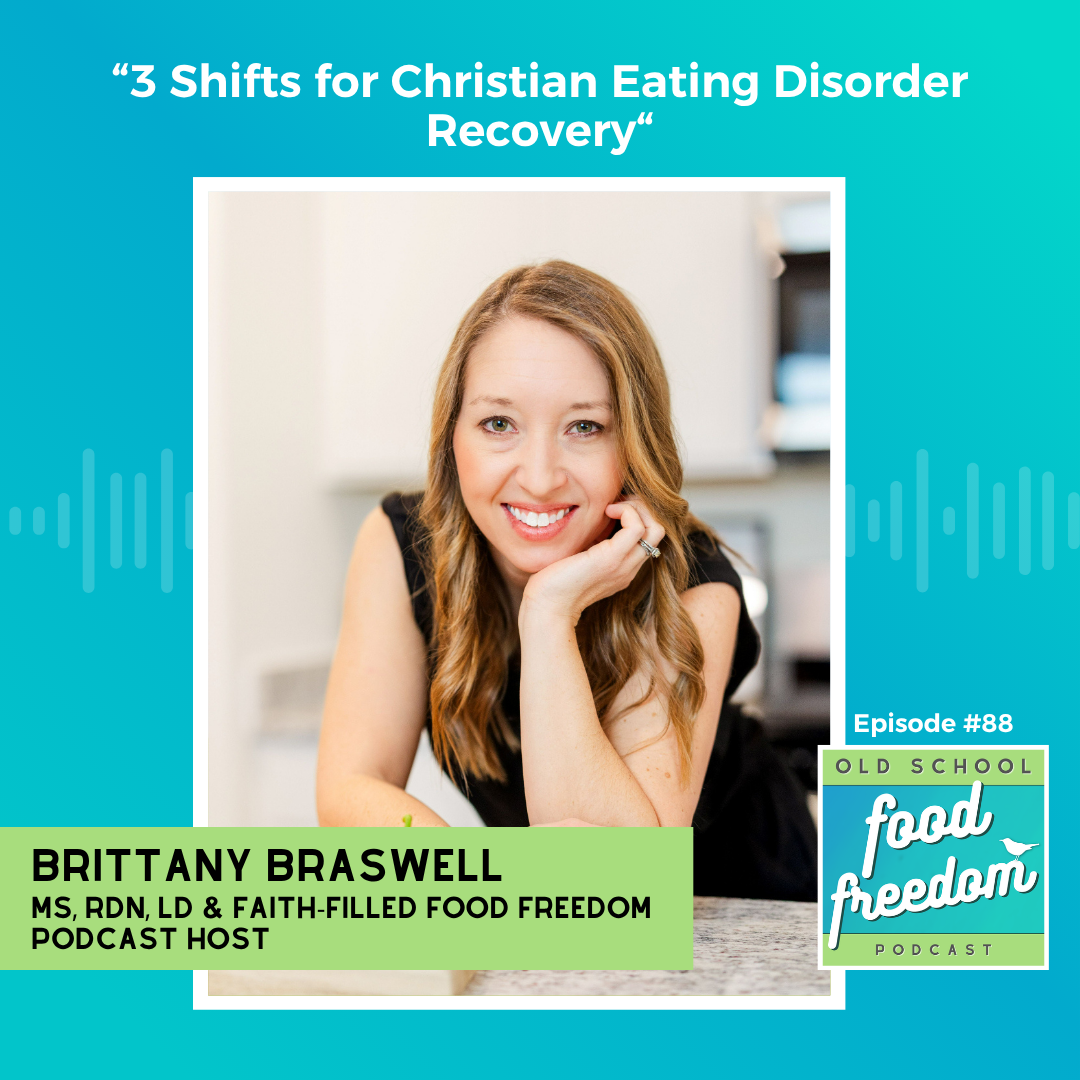
3 Shifts for Christian Eating Disorder Recovery with Brittany Braswell
“When you start caring for your body now, it really allows you to start that habit of just practicing, honoring your value, and it gives you a chance to focus on your body less, not more."
Maybe recovery has felt like a maze of good intentions that go nowhere. You've tried to wait until your body changes before you start treating it kindly. You've reached for a behavior that promised relief and found yourself, hours later, no closer to whatever you were needing. If any of that sounds familiar, you’re in the right place.
Today Chrissy pulls a favorite from the archives: a conversation with Brittany Braswell, registered dietitian, recovery coach, and host of the podcast formerly known as Joy Filled Eater, now Faith Filled Food Freedom. Brittany has spent years helping Christian women find food freedom, and in this episode she names the three mistakes she sees most often in recovery, the ones that quietly stall progress without anyone realizing what's really happening.
Here's what we cover:
Why so many people believe better body image is waiting on the other side of a smaller body, and why that belief keeps moving the goalpost
The difference between wanting to eat intuitively and learning to trust your body, and why skipping the second one keeps people stuck
What it means when a coping skill isn't meeting your real need, and the seven needs Brittany sees beneath disordered eating behaviors: feeling safe, feeling in control, easing anxiety, solving a problem, releasing anger, relieving stress, numbing out
Chrissy's own experience believing her body was a problem to be solved, and what happened every time she "solved" it
Brittany's “foot on the gas, foot on the brake” analogy for what it feels like to fight yourself in recovery
A simple next step for figuring out which need a behavior might be meeting for you, including a free quiz-style resource from Brittany
Why patience and community matter more than a quick fix, and where to find Christ-centered support through FINDINGbalance and the Christian Treatment Finder
What freedom following faith instead of fear looked like in Brittany's own life, including the moment she left a stable job to follow what she felt called to do
Friend, if you've been giving yourself grief for falling into one of these patterns, this episode is here to remind you of something different. There's no condemnation here. Just an invitation to notice what's happening, give yourself grace for it, and take one honest next step toward the freedom Christ already has for you.
"Freedom comes when you follow faith and not fear." — Brittany Braswell
Recovery isn't about getting it perfect, but noticing where you've had your foot on the brake the whole time you thought you were pressing the gas, and letting it off, one small step at a time.
If this episode named something you've been circling for a while, come join our Hello Freedom Community. Then pass this episode along to a friend who needs to hear it too.
We’d love to hear your thoughts, so please drop us an email at admin@findingbalance.com, send us a voice message via SpeakPipe, or you can also subscribe for more practical episodes coming your way.
More About Brittany Braswell
Brittany is a Registered Dietitian, recovery coach, and host of the Faith-Filled Food Freedom Podcast. She specializes in the treatment of disordered eating and negative body image, providing Christ-centered recovery coaching to Christian women who are ready to break free from the bondage of food guilt and body shame.
Hello Freedom Community
Our Hello Freedom community is launched! This is a Christ-centered space to find connection, encouragement, and gentle steps toward freedom from food and body-image struggles. No pretending, no fixing yourself first, come just as you are. If you want in, your next step is to join us at findingbalance.com/community.
You were not meant to walk this alone. We're saving a seat for you!
Connect with Brittany Braswell
Christian Treatment Finder Profile
The Joy-Filled Eater Live Course
Facebook
Instagram
SpeakPipe – Send us a voice message!
CHRIST-CENTERED RESOURCES TO HELP YOU FIND FREEDOM
The Daily Vitamin eDevo: A free devotional with bite-sized truth emailed 5 days a week
Community Groups: Find connection with prayer groups and our Hello, Freedom! community.
Christian Treatment Finder: Connecting you with Christian providers experienced in treating eating issues.
Lasting Freedom Online Course: A Christ-centered, non-diet course to work through false beliefs about food and weight so you can live free from disordered eating and body image issues.
CREDITS
Interlude music by “Hotham” – Morning Thoughts
Intro music by “MokkaMusic” – Old Jeans (Funk)
Wrap-up music by Jesse Quinn – Christian Instrumental
Production & Editing by Leah Bryant Co
The content in this podcast is for informational purposes only and is not intended to diagnose, treat, or prescribe a particular course of action. If you have, or suspect you may have, an eating disorder, please consult your healthcare provider. If you desire to receive faith-based care, visit ChristianTreatmentFinder.com to browse professionals with a Kingdom campaign against eating disorders.
More about the Old School Food Freedom Podcast
In today’s diet-culture society, food issues and body hatred have become the norm. But you were created to be FREE. Welcome to Old School Food Freedom, where we go back to the basics, God’s basics, for how we view food, our bodies, and our worth.
Hosted by FINDINGbalance Executive Director Chrissy Kirkman, this podcast features Biblically-sound experts, thought-leaders, artists, and everyday people who will inspire you to interrupt negative cultural soundtracks and rediscover God’s original design for your relationship with food and your body.
This show will deliver practical, faith-filled insights on how to break free from diet culture and body shame through the lens of scripture. If you’re looking for guidance on how to heal your relationship with food while deepening your faith, you're in the right place.
We’ll answer questions like
What does the Bible say about food freedom?
How can I overcome an eating disorder or disordered eating with Jesus?
What is the biblical perspective on diet culture?
How can I find peace with food as a Christian?
What does it mean to treat your body as a temple in relation to eating?
How can I break free from diet culture with Jesus?
How can I align my eating habits with biblical teachings?
What are the first steps to finding food freedom in Christ?
This podcast is for anyone ready to walk away from diet culture and into the freedom that Christ offers. Whether you’re recovering from an eating disorder, disordered eating, wrestling with body image, or simply craving a more peaceful relationship with food, this space was made for you.
If you want to experience true food freedom with Jesus, this podcast will give you the encouragement, truth, and tools to do just that.
The unedited transcript for this episode of Old School Food Freedom
chrissy [00:01:04 - 00:01:55]: Hey friends, I am thrilled to introduce today's episode to you. We are just gonna go back to the archives and pull out one of my favorite throwbacks like this one is too good to just get buried in season two. So my guest is Brittany Braswell, a registered dietitian nutritionist who really knows her stuff and makes it so easy to understand and apply. So here's what I love about this episode. We get into the three most common mistakes women make in recovery and Brittany doesn't just name them, she tells you exactly what to do instead. So we're covering things like waiting for your body to change before you start caring for it, wanting to lose weight before, learning to eat intuitively, and reaching for coping skills that aren't actually meeting your real needs. So tangible. So good.
chrissy [00:01:55 - 00:02:19]: And one quick update. Since we recorded this episode, Brittany's podcast now has a new name. You can find her on the Faith Filled Food Freedom Podcast. We'll drop a link in the show notes for you to find her. So whether you're brand new to recovery or you've been at this for years, I really think this one's going to hit home. So let's go. Hey Brittany, welcome to the show.
Brittany Braswell [00:02:20 - 00:02:23]: Hey Chrissy. I'm so pumped to be able to talk to you today.
chrissy [00:02:23 - 00:02:58]: Yay. We had so much fun on the Joy Filled Eater Podcast. So obviously we're going to have a lot of fun over here on the old School Food Freedom Podcast. Of course, before we begin. I really want to just tell our listeners about you. Brittany is a registered dietitian, recovery coach and the host of the Joy Filled Eater podcast. She specializes in the treatment of disordered eating and negative body image prevention, providing Christ centered recovery coaching to Christian women who are ready to break free from the bondage of food guilt and body shame. That is Brittany Braswell.
Brittany Braswell [00:02:59 - 00:03:00]: Well, thank you, Chrissy.
chrissy [00:03:00 - 00:03:08]: You're welcome. So we love to kick off this show with a question. What old school item do you miss from back in the day?
Old School Nostalgia
Brittany Braswell [00:03:09 - 00:03:23]: Gosh, Chrissy, as I was thinking through this because I always hear you ask everybody on the show this and I came up with three, but I'll give you kind of the one that I settled in on. Feel like it's going to sound silly, which is totally fine. It's the Kool Aid man pitcher. Did you ever have one of those?chrissy [00:03:24 - 00:03:27]: Yes, I had plastic cups with him on there.
Brittany Braswell [00:03:28 - 00:03:59]: Yes. And I don't know why, I think it's just because it feels so nostalgic to me. Because if you haven't had one, it's this little red pitcher that's you know, like I don't know, 10 or 12 inches tall and it has the Kool Aid man face on it. And we put like, I think that's the only picture we had for the longest time because my sister and I have a sister that's four years younger and we didn't want to drink out of anything else. Like we had water in it, we had Kool Aid, lemonade, whatever. And I think once it cracked like cuz we use it so much they stopped making em. So that was the end of the Kool Aid Man.
chrissy [00:03:59 - 00:04:02]: It was like the go to liquid container.
Brittany Braswell [00:04:02 - 00:04:11]: Yes. Before it was like popular to have, you know, your refillable water bottle or your whatever it was. Get the Kool Aid man pitcher and just keep it handy.
chrissy [00:04:11 - 00:04:38]: For sure. I don't know if we had the pitcher, but I remember having little like a translucent kind of plastic cup with him. Like etched on. Not etched, but like you could feel it, like sensory. You could feel it, but you could always see whatever color of Kool Aid that you know came through, it would always come through the cup. So. Oh, love that. Well, now we obviously have to know what your other two are because you can't just say oh, I thought of three.
chrissy [00:04:38 - 00:04:40]: But let's just go with this one. What are the other two?
Brittany Braswell [00:04:40 - 00:05:02]: Oh gosh. Okay. Well two of the three had to do with food and drink. So there we go. I'm a Dietitian sort of food and drink, I guess. The other two were the bubble jug gum. Do you remember those little containers that they look like a little teeny tiny jug of something, and it's filled with like these teeny little, like almost powdered bubble gum. And we used to.
chrissy [00:05:02 - 00:05:04]: Is this a Southern thing? What's going on?
Brittany Braswell [00:05:05 - 00:05:22]: I have no idea. Now that you say that now I'm like, curious. Bubble jug. And it came in like all these different flavors. It's kind of like the. I don't even know what the gum is called now that they used to have for like $0.05 in the gas station. But yeah, it's like powder folk. And you like pour it in your hand, you lick it off, and then it turns like from powder into gum.
chrissy [00:05:22 - 00:05:25]: Oh, that would have been my jam all day.
Brittany Braswell [00:05:25 - 00:05:35]: Oh, we loved it. We blow like giant bubbles. And of course, you know it gets stuck in your hair when you're in second grade. And it's great. I think the other one. And I don't know why they don't do these anymore. Maybe they do. And I'm just.
Brittany Braswell [00:05:35 - 00:05:55]: I don't see it. But I loved Polly pockets. That was like the thing for us. More so than Barbies. Me and my sister both would like, carry these teeny little Polly pockets around and they're like. I don't even know how we played with them. Cause they're so small, like you gotta pinch em with your fingers. And they have this teeny little house that they live, but for some weird, total choke hazards.
Brittany Braswell [00:05:56 - 00:05:58]: That's probably one of the most dangerous.
chrissy [00:05:58 - 00:06:00]: Yeah, like they're banned for life.
Brittany Braswell [00:06:00 - 00:06:14]: Oh, yes. All of the choke hazards. But I guess for some reason we just thought it was fascinating to make teeny tiny. I wanna say life size. Like they felt life size compared to their little house. So maybe that's what it was. But we were. We were like, fascinated.
Brittany Braswell [00:06:14 - 00:06:15]: Yes.
chrissy [00:06:15 - 00:06:32]: Amazing. Oh, I'm glad you shared those. That's so nostalgic. Yeah. All right, well, let's talk about three mistakes that most people make in recovery and what to do instead. This is a pretty good topic because recovery is hard.
Brittany Braswell [00:06:32 - 00:06:33]: Mm.
chrissy [00:06:34 - 00:06:51]: We're not perfect. So many people try to aim for perfection and it's just not possible. So right away, just wipe that slate clean. You don't need to be perfect. Don't try to be perfect. You're gonna make mistakes. And we're gonna talk about three mistakes that most people make and what you can do instead.
Three Common Mistakes in Recovery
Brittany Braswell [00:06:52 - 00:07:24]: Yes. And I love this topic, Chrissy, because I mean, of exactly what you said, most often, I find that when I have the most growth, it's because I've realized there's some mistake or something that has been happening that's been holding me back. And so I want to say that again just to give grace, that if you recognize any of these, this is not for condemnation or saying, hey, you're doing this recovery thing wrong. It's to say, let's see if we can remove one of the barriers that might be keeping you from making that next step in recovery that you need. So, yes, I'm excited to dive into this with you today.chrissy [00:07:24 - 00:07:27]: It's us helping you help yourself.
Brittany Braswell [00:07:27 - 00:07:28]: Absolutely.
chrissy [00:07:28 - 00:07:29]: Yeah.
Brittany Braswell [00:07:29 - 00:07:29]: All right.
chrissy [00:07:29 - 00:07:31]: What is mistake number one?
Mistake #1: Believing Body Change Leads to Better Body Image
Brittany Braswell [00:07:32 - 00:08:44]: Oh, so mistake number one for anyone who is trying to overcome issues with food and you're really wanting to get to food freedom, so often that is preempted by this dislike of your body weight, shape, size, whatever. And so one of the biggest mistakes that I see is women or men believing that body change is going to lead to or equal better body image. And that once my body changes, then I'll like it better or then I'll like myself better. But most people who struggle with negative body image, they just really have a hard time letting go of that belief that, like, there's this perfect or this ideal weight or composition, and when I get there, I'll accept my body. So I think in order to start really diving into that, you kind of have to ask yourself this question, like, okay, well, is there something or what is it maybe that I've been putting off until I reach that ideal weight? Because sometimes this mistake is hard to figure out. Do I struggle with this or not? But if you ask yourself that question and go, okay, and Chrissy, you may have some insight into this too. Like, was there ever anything that you feel like you put off saying, okay, well, once I get to this, you know, pant size or this number on the scale or this whatever, then I'll do that thing.chrissy [00:08:45 - 00:09:22]: Oh, I mean, the list is extremely long, especially, like in ministry, any anywhere that God could use me. And I feel that pull of like, you know, God gave me this gift. I am good at this, but I just can't show up the way I am. I gotta get this under control. I gotta shrink down with my body before he can really use me. And man, the enemy, the amount of things the enemy was able to. I mean, he can't make you do anything, but he can sure convince you and paint this picture and set traps. And I, at times I just fell right into them.
Brittany Braswell [00:09:22 - 00:09:43]: Yeah. And it's. It's so easy to do. We. We think that if we shrink our body or if we're in a smaller size or if we change this one thing, maybe for you, it's not weight. Maybe it's something else about your body you dislike that you're just, like, that thing has to change. So, like, for me and for. For some of my clients, it's been things like, you know, putting off a fun trip or vacation because, oh, I cannot afford to eat vacation food right now.
chrissy [00:09:43 - 00:09:44]: Yeah, right.
Brittany Braswell [00:09:44 - 00:10:12]: Or maybe it's like, you want to play with your kids or spend time with your friends, but, like, we used to live really close to the beach, and I would have so many clients that say, like, I'm not going to the beach. I can't spend time with my kids or family there because I won't put on a swimsuit or maybe I don't want to wear. I don't feel comfortable wearing shorts. And that distraction of your body or your negative body image gets in the way of experiencing life because you feel like, okay, in order for my body image to get better, my. My weight or my body has to
chrissy [00:10:12 - 00:10:30]: change first, and we just miss out. It's. It's robbing us of experiences and living life when it's. It's happening right now, even taking pictures. I personally, I'm in a position where I'm trying to just show up. This is the moment this is happening. These are my friends. These are my family.
chrissy [00:10:30 - 00:10:49]: I want to show up in pictures and not critique them. Not, you know, say, oh, we need to edit this out. Can you not post this one and not, like, control the whole thing. I want to show up and be present and have that memory rather than hiding in the background. So all you see is my face.
Brittany Braswell [00:10:50 - 00:11:22]: That. And that has been. I think it was just last week I was having a conversation with one of my clients who's a college student, and she said, brittany, one of the things that frustrates me or that I hate most about the struggle with body image is she's like, I'm in my second or third semester of college. And he said, I have, like, maybe two pictures from college so far because I've refused to get in them. And I want that to change. I don't want to graduate college and have no, you know, tangible images and memories of, you know, the things that I got to do with my friends because I was so distracted by my dislike of my body.
chrissy [00:11:23 - 00:11:34]: Oh, and that. It just feels like, gosh, that's so young to be feeling that way. But this is reality. Oh, but we don't have to be stuck there, right?
Brittany Braswell [00:11:35 - 00:12:04]: Absolutely not. So when you fall into these traps, like something that you can do, instead of saying like, okay, you know, body weight equals better body image, don't do that. Just start caring for your body now. Okay? And I think that the term self care gets used in so many different ways. But what I think is most helpful is to look at first. What does caring for yourself look like? And why is it necessary? And what does self care not look like? Cause I think we get the wrong idea.
chrissy [00:12:04 - 00:12:05]: Okay. Yes.
Brittany Braswell [00:12:06 - 00:12:26]: It's just really this intentionality behind different practices or habits to help you preserve or improve your whole health. And that's not just physically, but that's part of it. Right? So I think we often get this misconception, like self care is, you know, massages and manicures and that could be a part of it.
chrissy [00:12:26 - 00:12:27]: Bubble baths. Yes.
Brittany Braswell [00:12:27 - 00:12:43]: And bubble baths. Right. Those are all wonderful things. But it's. There's like these two extremes. It's. It's not just the aesthetic and the relaxing and the things that maybe feel a little bit more luxury or extravagant. Sometimes they're like, I have to take all this extra time for myself.
Brittany Braswell [00:12:43 - 00:13:11]: Right. Sometimes that could be the case. But it's. It's also, I think another big conception about self care is that it's not ignoring your health either and going, okay, I'll just do all of the things and only think about myself and ignore the physical side of things. So when you start caring for your body now, it really allows you to start that habit of just practicing, honoring your value, and it gives you a chance to focus on your body less, not more.
chrissy [00:13:12 - 00:13:14]: Okay, so, so good.
Brittany Braswell [00:13:14 - 00:14:09]: That is part of people think about, okay, well, when it comes to body image, I just need to give myself all these positive body affirmations and I need to tell myself how great my body. But when you focus on your body more, you're focusing on your body more, right? So you gotta focus on it less, not more. So that means that self care, when it comes to your body is not getting on the scale. It's not wearing overly tight or baggy clothing that's gonna cause you to focus on your body more. It's not cutting out whole food groups, Right. It's not pushing your body to its physical limits with movement. And so if you're having trouble figuring out, well, what would self care for my body look like, it's at least easier for me sometimes just to go what is self care? Not, like, what am I doing right now that is not filling my cup? And just give yourself that list of things and go, okay, what can I do to focus less on these things and not more?
chrissy [00:14:10 - 00:14:12]: You might even say it's finding balance
Brittany Braswell [00:14:13 - 00:14:15]: between ding, ding, ding.
chrissy [00:14:15 - 00:14:18]: I mean, like, can we stop doing that every episode?
Brittany Braswell [00:14:18 - 00:14:20]: I try not to, but, like, I love it.
chrissy [00:14:20 - 00:14:40]: That's why God gave the name Finding Balance to Constance when she founded Finding Balance 21 years ago. I mean, because so much of this diet mentality is all or nothing thinking, and it. It gets us in. Into trouble. It gets us into these mistakes that we make. And there's a better way.
Brittany Braswell [00:14:41 - 00:15:21]: Yes. And also, I guess some clarity with this too. This is not to say don't focus on your body at all. I know we don't have time to walk through it today, but I go through an illustration with. With my students on a framework that created called the Body Focus and Intentionality Framework, just to help you see, like, how much focus are you putting on your body and what level of intentionality is there? Because we want some focus, right? Like, we want to recognize what's going on in our body so that we can use wisdom to make the kind of decision that's gonna help us enjoy it, honor it, be a great steward of it. But we don't want it to bleed into. Okay, if I focus on my body all the time, then I'll like it better. Then it'll feel better.
Brittany Braswell [00:15:21 - 00:15:35]: So, yeah, there's absolutely this place where we have to find the balance between putting enough focus on it that you can hear from it and you're not afraid of that, but also not diving to the deep end going, let me just focus on everything about my body all the time.
chrissy [00:15:36 - 00:15:36]: Yeah.
Brittany Braswell [00:15:36 - 00:15:39]: Because it gets you in that place of critique more often than that.
chrissy [00:15:39 - 00:15:40]: And idolatry.
Brittany Braswell [00:15:40 - 00:15:43]: Oh, 100%. That's a whole nother conversation.
chrissy [00:15:44 - 00:15:45]: Another episode.
Brittany Braswell [00:15:45 - 00:15:51]: But yes, yes, go back and listen to the episode with Heather on that one. She did a great job talking about that.
chrissy [00:15:51 - 00:16:01]: Yeah. Okay, so that was mistake number one. Thinking body change equals better body image. Mistake number two, I get so much
Mistake #2: Waiting to Learn Intuitive Eating Until After Weight Loss
Brittany Braswell [00:16:01 - 00:16:18]: pushback on this one. But this is when someone says, okay, well, I'm just gonna wait to learn how to eat more intuitively until after I've lost weight or until after I've changed my body. I'm gonna do the weight loss thing. I'm gonna do the dieting, the whatever, and then I'll learn how to be more of an intuitive eater after that.chrissy [00:16:18 - 00:16:25]: Ooh, that's rough, right? Yeah. So when you say I get a lot of pushback, how does that look?
Brittany Braswell [00:16:25 - 00:16:35]: So, like, if I'm talking to a client and depending on where they are in their stage of recovery, most of what I do I would consider with a lot of my clients is kind of the prequel to intuitive eating.
chrissy [00:16:35 - 00:16:36]: Okay.
Brittany Braswell [00:16:36 - 00:17:39]: So it's kind of in this gap between, like, okay, I'm recovering from an eating disorder, but I don't know that I'm totally ready to dive into intuitive eating either. Like, there's some foundational things you gotta get set before you can work on being an intuitive eater. And so often they're still in the dieting mindset. We're trying to get to this place of focusing on your identity and focusing on your fears and looking at your behaviors and what are they doing for you. And so when I get pushback, it's usually like, well, if I focus on intuitive eating now, my body's just going to change a lot and it's going to make my body image worse and it's going to make my behaviors worse and all these things that they're afraid of. And so I have to ask them, like, okay, if you've been telling yourself, hey, once I lose X number of pounds, then I'll switch to intuitive eating and maintain my body size. We can't just look at how you feel about it or your experience with it because we have to look at big picture. So part of that, if logic or statistics helps you to come at it from like a objective place and not this subjective feelings, like letting your feelings make the decision for you.
Brittany Braswell [00:17:40 - 00:18:23]: We know from tons of research and studies that tell us that weighing yourself and dieting are so much associated with the development of eating disorders and the severity of that. And so when you can move your focus from weight or body change to health promotion, that can actually result in significantly better outcomes from a physical health standpoint, mental health, and I would even absolutely say spiritual health, than pursuing that intentional weight loss. Because if that's the focus first, it's going to be really hard to switch to intuitive eating because you're going to be focused on, okay, now that I've achieved this specific weight, now I'm going to eat intuitively, quote, unquote, to maintain.
chrissy [00:18:23 - 00:18:24]: Oh, right.
Brittany Braswell [00:18:24 - 00:18:26]: But it's going to be the same mindset.
chrissy [00:18:26 - 00:19:12]: Yeah. And when you said, I've actually forgotten the exact word that you used, but you said something about moving into healthy health promotion. Health promotion. And so I feel like it's worth noting that when you say health promotion like we mean a balanced, healthy health promotion. Not to an extreme, because I feel like when you're in that dieting mentality. Okay, so I'm just gonna share from my personal journey because it was really difficult. I was so afraid to get into intuitive eating, which is just learning how to view food and respond to food and those hunger cues and even hearing hunger cues again, the way God intended it. It's like eating.
chrissy [00:19:12 - 00:19:46]: It would just be eating and living in our body if diet culture wasn't a thing. This would just be normal. But because it's so broken, diet culture is just a mess and we've learned all these bad rules and false teachings. Like you feel this panic of where do I find the balance? How can I get there without going from one extreme to another? With extreme healthy eating and cutting out all kinds of food groups and rigid health rules. That was very terrifying for me. I was really, really scared.
Brittany Braswell [00:19:47 - 00:20:40]: Yeah. And I think that's why there is a lot of intention, I think, in the order behind the principles of intuitive eating. But I fully believe that's why it's so important to do a lot of the foundational work when it comes to what you really believe about yourself and who you are and where your value comes from. Before you start trying to implement even health promotion behaviors. A lot of times it's not to say we're just going to focus on this one thing and ignore the behaviors, but when you focus on the behaviors so early and you don't have like the why and the reasoning and the understanding behind what's going to happen when these behaviors are gone, you're just going to find new behaviors to cover it up. So, yeah, so, yeah, like general nutrition. Yes, absolutely important. A health promoting behavior could be incorporating more nutritionally dense foods and that could also turn into an obsession if you're not in the right.
Brittany Braswell [00:20:40 - 00:21:07]: Right mindset to do that. So. So health promoting behaviors don't have to only be physical either because we're looking at whole health here, at the whole person. You are not your body. Right. You live in a body. So it might be prioritizing sleep, it might be prioritizing other forms of rest. It could be joyful movement, it could be getting into scripture and learning how to abide with Christ rather than just trying to follow all the quote unquote Christian rules.
Brittany Braswell [00:21:07 - 00:21:50]: Right. There's so many different things that promote our health that are oftentimes going to lead to better health outcomes physically and mentally than focusing on weight loss. And Chrissy, this is one of my favorite things to debunk for people, because I see this time and time again with the women that I work with when they're like, if I start intuitive eating, if I start it now, I'm not going to have these changes that I want or my health is going to get worse. And one of my clients that I got to work with recently shared this. We've been on this food freedom journey for a little while. And she came to me initially because she said, my doctor told me I need to lose weight to improve my cholesterol levels. And so I like, y' all can't see me. I'm like doing this.
chrissy [00:21:50 - 00:21:54]: She's sliding down. Let me paint the picture. She is sliding down into her chair,
Brittany Braswell [00:21:54 - 00:22:22]: on my chair, because I just want to pull my hair out. So we had this conversation about how, okay, again, weight loss is a means to an end here. So if you're listening to this and you're like, no, I just want to lose weight, because whatever, figure out what that the cause is, that's what you actually want. The weight loss isn't. That's never anybody's end goal. It's a means to an end. So we looked at, okay, what can we focus on to improve your cholesterol without screwing up your relationship with food in the process? Okay.
chrissy [00:22:22 - 00:22:23]: Yeah. Gentle.
Brittany Braswell [00:22:23 - 00:22:55]: Oh, yes. And so there are things that you can do not just from a nutritional standpoint, but that can be one of them. Right. So we looked at, first and foremost, what is your relationship with food in your body right now? Let's look at, at gentle movement. Let's look at your body image, let's look at your beliefs about what's even possible. And it was so fun for her. Like, she got to see her LDL drop over the course of, I don't know, maybe four months, five months that we were focusing on this, it dropped like almost 25 points. Her vitamin D levels improved, all of her vital signs improved.
Brittany Braswell [00:22:55 - 00:23:08]: And she came back and there was one week in session. She was like, I'm nervous because I've got my follow up doctor's appointment. You know, after he sent this initial referral and she comes back the next week and she goes, he told me just to keep doing what I was doing because everything improved.
chrissy [00:23:09 - 00:23:11]: Yes, Praise God, that's a victory.
Brittany Braswell [00:23:11 - 00:23:20]: Yes. I loved it too, because she was able to tell her doctor, like, I wasn't focused on weight loss. Like, I got all these improvements and I didn't do what she told me to do.
chrissy [00:23:21 - 00:23:25]: Did she say what the doctor's response was to that or did they respond at all?
Brittany Braswell [00:23:25 - 00:23:31]: Yeah, she just said like, he was amazed. And that's. And she was like, he just told me, keep doing what I'm doing because it was obviously helping.
chrissy [00:23:31 - 00:23:37]: That's so good. Yeah. And you know, that's a gentle way of advocating for yourself.
Sarah Joy [00:23:38 - 00:23:38]: Yeah.
chrissy [00:23:38 - 00:23:53]: Teaching a physician, just by your example of what has worked in your life. We want to come in there, you know, with our fist in a ball, like, ready to fight. But like, it doesn't have to be that way. I think that's a very sweet, gracious approach.
Brittany Braswell [00:23:54 - 00:24:15]: Yeah. She was able to voice that to him in a way that wasn't brash or she was, she just said like, I heard what you said. Like the recommendation was not bad. Like, we need to do something to improve your cholesterol levels. It was the means to that that was off. Right. So just because you get a recommendation and again, like, please take this with a grain of salt. I don't want anybody to take this as medical advice.
chrissy [00:24:15 - 00:24:16]: Right. Yes.
Brittany Braswell [00:24:16 - 00:25:00]: But when you do get a recommendation from, whether it's a physician or someone else, really focus in and ask more questions. Because if the goal is, you know, in this case it was improved cholesterol levels. If they mention something about weight, it's okay to question and say, you know, why do you believe weight loss is the only way to get this. Or this is a little bit more blunt one. So if you're a little more straightforward, maybe I'm your girl for this. But like, it's okay to tell the doctor and I've had clients do this before. Like, if I was in a smaller body size, what recommendation would you be giving me right now to improve my cholesterol? Because that's a big hesitation for so many people is saying, like, I don't want even want to go to the doctor because I know they're just going to tell me to change my body. And.
Brittany Braswell [00:25:00 - 00:25:17]: And so it's okay to ask questions or to ask for clarity on. Okay. If this is what's necessary. You know, this improved cholesterol level, that's. That's a health related thing. That's totally fine. We can work towards that. But is the weight loss, like, why do you believe that's necessary? And what are some other approaches we might could take?
chrissy [00:25:17 - 00:25:28]: Yeah. So good. So do you feel like we, we covered mistake number two, losing weight before learning to eat intuitively or. I, I don't know if it's losing weight, but the desire to lose weight before?
Brittany Braswell [00:25:28 - 00:26:17]: Yeah, I think the Only thing I would add to that, cause we've really already kind of touched on this, is just instead of focusing on the weight loss, focus on cultivating body wisdom. And we already kind of talked about that to some degree. But you know, it really just means like give yourself that opportunity to learn what fuels your physical and mental health. And that's oftentimes where a provider can come in and be, you know, really helpful, like to help figure out, okay, when I, when my body feels this way, what is that potentially an indication of? Right. And so you, you want to be able to recognize what's going on in your body so that you can respond to it. And you are going to know your body better than anybody else. So having someone come alongside you and finding balance. I love that you guys have the provider referral list.
Brittany Braswell [00:26:18 - 00:26:48]: So if y' all are looking for somebody like therapist, dietitian, so many people, such a phenomenal resource. But you don't have to go it alone if you need help going, my body's given me all these really uncomfortable, horrible symptoms and side effects. I don't even know what they mean. That's a really fantastic place you can lean in. So instead of focusing on just that desire for weight change, you can focus on what is my body telling me and what can I do specific to my body or to my health to focus on instead of, you know, just the weight.
chrissy [00:26:48 - 00:27:30]: So good. If you've been wondering if your struggles with food are normal or if you need help but you're just not sure where to start, we have created a brand new free eating issues check in just for you. So this is a confidential tool that helps you understand your relationship with food and eating. And when you're done, you'll get instant personalized results showing where you are now and what kind of support might help you. Plus, we're going to connect you with Christ centered resources matched to your specific needs. So this just takes about 10 minutes and it could be the brave first step toward the freedom you're seeking. So if you are ready to find out where you stand, take the eating issues. Check in at findingbalance.
chrissy [00:27:30 - 00:27:33]: Com. Okay, what is mistake number three?
Mistake #3: Using Temporary Coping Skills That Don’t Meet Your Real Needs
Brittany Braswell [00:27:34 - 00:28:18]: This is my favorite one. This could be a whole other conversation in itself, but I think probably one of the most frequently made mistakes is trying to use temporary coping skills that don't actually meet your needs. So I guess to kind of explain what this means. Like coping skills are usually meant to act as like kind of this usually temporary band aid right in a, in a situation. And they may not always Be effective. So I think a good analogy for this, if you think about, like you're sitting on your back porch, right, and you get stung by a wasp, right, it's gonna be really painful. You're gonna go inside and you're kind of fixed for that moment. Might be like some topical Benadryl or an ice pack or something to like take the swelling down or reduce the pain.Brittany Braswell [00:28:18 - 00:29:24]: But if you go back outside and the wasp nest is still there, you're probably gonna get stung over and over again. Yeah, right. So you've gotta really figure out, like, how can I deal with this in a way that's gonna be sustainable and effective, not just, okay, let me go get another ice pack every time I get stung. And I hear this from a wide variety of therapists that I've even had conversations with, Coping skills are wonderful. But if the skill that you're using, like, let's say you feel like you just need to keep your hands busy, right? Like, okay, well, I'm going to play with putty, right? And it's not to say this isn't a great coping skill, but it just depends on what you're using it for. If the behavior you're trying to eliminate is binging and they're like, okay, well, instead of going and opening a wrapper of something, just play with putty and keep your hands busy. Well, if binging isn't only a means of like, hey, I'm stressed and I need some sort of like physical stress relief, okay, putty might be great for that. If the binging has a whole nother need or purpose, if it's to reduce anxiety, if it is a way, like a means of taking out your anger or self punishment, putty's not gonna do that for you.
Brittany Braswell [00:29:25 - 00:29:57]: So you've got to identify first the need that the behavior's meaning for you. And once you know that, then you can focus on choosing a coping skill. And especially working with a therapist with, this is so helpful to say, hey, this is what I'm figuring out, like, binging is doing for me. Can you help me figure out how to cope with this in a different way so that that need doesn't go unmet? Because if you use putty and it's not meeting the same need, then it might work temporarily, but you're probably just going to end up coping in another unhealthy way later?
chrissy [00:29:57 - 00:30:47]: And there's a root to uncover, to unearth and remove. Like, I know we've talked about this in other episodes before, but, you know, if I go out into my backyard that's filled with dandelions, and I just go and start pulling them up by their stems. Like, the next day or a couple days later, they're going to be back in full force. And so I've got to get to the root to get rid of that. Sometimes getting to the root, it's more likely than not. It's uncomfortable, it's hard. It's something we want to avoid many times because we're ignoring things that have happened to us because we don't want to go there. But in order to go there or to find that freedom and the healing from traumas and things that have happened to us, we've got to get to the root of it.
chrissy [00:30:47 - 00:31:00]: And so that really does require working with the professional who understands how to get to that root. Because even though we know that they are there, we need help locating them and removing a professional. Yeah.
Brittany Braswell [00:31:01 - 00:31:35]: And I think this goes too, with so many different types of behaviors. There's probably six or seven needs that I see a lot of disordered eating behaviors meeting. But this goes across the board. Like, for me, one of my habits that I. I have had phases that it's. It's improved and phases where it's like, is hitting the snooze button. And so when I go, okay, okay, well, what need is that meeting for me? You know, in that moment, it's more sleep, right? It may not be restful, deep sleep, but I'm like, okay. The problem with it, though, I have to go, oh, my goodness.
Brittany Braswell [00:31:35 - 00:32:03]: Like, this is making my morning more rushed. If I keep hitting snooze, it's going to have the potential to make me, you know, get my kids to school late or miss a session with a client or just, like, feel frazzled, right? So instead of hitting the snooze button going, okay. I mean, this is meeting a need in the moment, right? It's. It's a valid need. Like, I need more sleep. But a better solution would be to go, okay, I'm not going to, like, shame myself for hitting snooze today. Right. But I can explore solutions.
Brittany Braswell [00:32:03 - 00:32:36]: Like, maybe it's going to bed earlier the next night, maybe it's taking a nap. If I'm able to, maybe it is choosing activities that are less physically draining that day or the following day. Right. There's other things that can meet the need for more sleep or more rest in a much more effective way than just hitting snooze and ultimately creating new problems. So, like you said, we gotta get to the root of what is the need or what is the purpose that this behavior is fulfilling, and how can I cope with it in a very targeted, intentional way so that I'm not just putting a band aid fix on it?
chrissy [00:32:37 - 00:32:45]: So, Brittany, what are some of the most common needs that you see? Disordered behaviors are meeting for people.
Brittany Braswell [00:32:46 - 00:33:05]: The ones that I see, and I'll say this is not fully comprehensive, but there's seven, I guess, that I see over and over and over again. And so if you can identify any of these seven, it gives you a chance to explore even further out from that. So maybe if it works for you, Chrissy, I'll just kind of list through them and then if there's any that jump out at you that you want us to dig into a little bit, we can do that too.
chrissy [00:33:05 - 00:33:06]: That works. Yep.
Brittany Braswell [00:33:06 - 00:33:27]: So the top seven that I see, I guess in no particular order, is providing a sense of safety. So as you hear these, think about, like, behaviors like restricting, binging, over exercise, isolation, whatever it might be. So those behaviors can provide a sense of safety. Right. And it's a sense of it. It doesn't mean it's like real safety. Right. But it gives you that sense.
Brittany Braswell [00:33:28 - 00:33:42]: It may feel like it's helping you to reduce your anxiety level. The third one would be making you feel more in control. A fourth one would be, it's promising to, let me use air quotes here. Solve a problem or make it feel like that in the moment.
chrissy [00:33:42 - 00:33:42]: Yeah.
Brittany Braswell [00:33:42 - 00:34:12]: The fifth one would be like a means of taking out your anger, whether it's anger of yourself, I guess, like being mad at yourself or someone else taking it out on yourself, essentially. Number six would be kind of temporarily relieving stress. And that can often kind of go hand in hand with the anxiety reduction as well. And then the seventh one would be like to numb out or repress feelings. So those are the ones I see most often when it comes to disordered eating and body image related behaviors.
chrissy [00:34:12 - 00:35:08]: So the one that really jumps out to me is feeling like I was solving a problem. And I say that because I viewed my body, my weight as a problem, because my society told me, even in church sometimes I would get that message that a larger body was a problem to be solved. I see it on TV commercials every single day. I saw that when I was a kid, every single day. It was modeled for me at school. It was modeled for me in other areas by women I looked up to, family members I looked up to. And so to solve a problem and then feel like I'm in control of that by doing these things, I could reduce my number on the scale because the scale seemed to mean a lot to me at the time. And then hearing compliments when I did air quotes.
chrissy [00:35:08 - 00:35:27]: Here we go, air quotes again. Solve the problem. But then when the problem came back, because that was not sustainable ever, every single time, multiple times I ever lost weight, I always gained it back, gained more of it. And so it felt like I was solving a problem, but it just created more problems.
Brittany Braswell [00:35:28 - 00:36:14]: And Chrissy, that's like the golden nugget. Back it up 10 seconds and listen to that again, because that's what happens. We want this like instant gratification sort of solution. Right. To if you're feeling stressed, if you're feeling like, okay, there's this big issue, I need something to solve. And restricting will do that, or bingeing will do that, or fill in the blank with whatever the behavior is that you're struggling with. And 99.99 forever percent of the time, it's not going to solve that problem and it's going to create more. And so if you know, with working with a provider, a therapist, recovery coach, whomever it might be, figuring out what is that problem I'm trying to solve and why do I feel like this behavior is the key to that?
chrissy [00:36:14 - 00:36:14]: Yeah.
Brittany Braswell [00:36:14 - 00:36:32]: Then you can start exploring. Okay, well, what are some actual solutions to the problem? Why do I feel like this has been a solution? Because let's look at when has it actually solved the problem fully in the past? Right, right. And if it hasn't, if you're still struggling with it, I guess I hate to break it to you, but the problem hasn't been solved.
chrissy [00:36:33 - 00:36:34]: The root's still there.
Brittany Braswell [00:36:34 - 00:36:55]: Yeah, the root is still there. And so I say this, and Chrissy, I think we're both like saying this in love again, please don't feel shame. Give yourself grace. Because I promise you're not the only one that has tried to fill these needs with a behavior that's not life giving. Right. And these needs are valid. We need all of these needs met. You have so many needs that need to be met.
Brittany Braswell [00:36:55 - 00:37:04]: And the enemy doesn't have to be the one controlling the way that you think those needs are getting met. They can actually be met. And the Lord wants to come alongside you and be part of that process.
chrissy [00:37:05 - 00:38:01]: He does and he will. I noticed this happening to myself, so I'm gonna say it right now. Listener, I want you to take a moment to unclench your jaw, just kind of open your mouth, just let your jaw fall and Open your mouth and then take a very deep breath in through your nose and hold it, and then exhale through your mouth slowly until you get it all the way out. This is something that has been very healing for me. It's a temporary coping skill, but it's come to my attention how often I will clench my jaw when I hear things like this that are. You know, I don't want to say that they're triggering, but that they're hitting home. And then my internal wiring is saying, you should feel ashamed of yourself. You should feel terrible.
chrissy [00:38:02 - 00:38:40]: Why is this a problem for you? Why can't you get it together? Like, this is the messaging I hear. This is not from God. This is from the enemy. And as I. I don't realize that I'm hearing those things, but when I hear those things, that's when I start to feel my jaw clenched and my hands will be in a ball, in a fist. Just take a moment to receive the love that God has for you right now, that he sent his son to die on the cross for you, to set you free. Free from this bondage that you feel and that he cares about this struggle that you're in. He's there.
chrissy [00:38:40 - 00:39:11]: He sees you. And if you haven't invited him in, I encourage you to consider it. Just sometimes we don't even consider where God fits in this story, but he fits. And the enemy has tried to come in and really cause this big division between you and the Lord, but He's there. I know that took it a different direction a little bit, but, like, that's ultimately why we're here. That's why these podcasts that we host, that's why they exist, because we want you to understand how much the Father loves you. He created you. He knows everything about you.
chrissy [00:39:12 - 00:40:02]: He finds you very worthy of freedom, worthy of life and breath and unclenched jaws, and worthy of good things, and he wants to use you. He wants to use your story of brokenness and restoration to help others. But hear me say that it just starts with this one step, this one first step, and what that is for you, I don't know. But I guess I would ask you, Brittany, what are some next steps? If we have come to this place and we had to, like, stop for a moment and unclench our fist and unclench our jaws and breathe and look around the room, what do we see? If you're driving, is there something pretty? A tree or gardening? I don't know. Just to kind of bring yourself back around. Brittany, what next steps could you share for Us.
Next Steps for Healing and Recovery
Brittany Braswell [00:40:03 - 00:41:03]: I loved what you just said, Christine, that you walked through that, because I'm a hundred percent in agreement that Christ wants to be not just a small part of this process. He wants to be at the very center. And he will be if you allow him to be. And, and so from our conversation today, if you recognize and you're again giving yourself grace for saying, okay, I've fallen into some of these mistake traps. I've believed that my body image is going to get better, you know, if my body changes or I've been putting off learning how to develop and cultivate that body wisdom because I don't know that I want to eat intuitively yet I'm, you know, still holding on to diet mentality or that goal of weight loss or, oh, I've, I've realized like I'm trying to do all these things to cope that aren't actually meeting a need or creating a pathway to freedom. They're just perpetuating it. Give yourself again grace for that. And I would say a couple of simple next steps to take.Brittany Braswell [00:41:03 - 00:41:49]: If you recognize any of those needs that I walked through and you're like, Brittany, Chrissy, like one of those or more maybe all seven stuck out and I notice I'm using this behavior to meet this need and this other behavior to meet these needs. Or maybe you're just saying, like, I recognize I need those needs met, but I'm not sure what behaviors are doing what. Krissy, I will send you a link. I've got a free resource. It's just like a quiz sort of style assessment and you can go through and just like fill in the blank with whatever the behavior is to figure out which of those needs maybe is that behavior meeting for you? That's a really simple next step. And take it to a friend or family member. That's a great support for you. Take it to a provider maybe that you're working with to talk through and say, I really think bingeing is doing this for me.
Brittany Braswell [00:41:49 - 00:42:36]: Or I really feel like restricting might be doing this for me. Ask the Lord for wisdom in that first, right? A quiz or a resource is like not the be all, end all. So if you do that, take the solution or take the, you know, whatever the results are to the Lord and say, God, is this, is this accurate? Is this helpful for me to know? And then have a conversation with someone about it, filter it through the lens of scripture and go, how can I really take a step towards freedom? You know, I really need to feel more safe, but I'm tired of trying to shrink my body to feel more safe. What can I do instead? And open up that really scary conversation? Because it's hard to bring up those vulnerable things, whether it's in a therapy session or with a friend. Right. We don't always want to talk about the root stuff. We want to talk about what's the day and day to fix this right now. So patience is a big key to that.
Brittany Braswell [00:42:36 - 00:43:10]: So take the needs assessment if that feels like a. A smooth, simple next step to just figure out where, like, what those needs are and then absolutely reach out for some support. I'm such a huge believer, and I love seeing it play out. What happens when you get in community. I know, Chrissy, y', all. Finding Balance has some great resources to get you connected to community. Prayer groups, the Finding Balance modules and courses, and getting the, the education so that you know how to generate some of that conversation in your own community. Get the support that you need.
Brittany Braswell [00:43:10 - 00:44:14]: Because once you figure out what are these areas where maybe you've been putting your foot on the brake, right? Where maybe you're trying to move forward. I give this analogy sometimes of like, I did something super embarrassing when I was learning how to drive, and I was essentially trying to drive with both feet, and so I pushed my foot down on the gas pedal and my car just went, you know, and it made this horrible noise. And it's because I had another foot on the brakes. And so give yourself grace if you've been trying to drive with two feet. Right. Just uncover those areas where you've still got your foot on the brake, where it feels like I've been putting in all this energy to try to get rid of my food guilt or get rid of these body image issues and give yourself grace to go, okay, if I'm finding these mistakes or these areas that I'm struggling, there's no condemnation, there's freedom in going. Now I know what to do, maybe to remove them or at least I know where to focus. So take the needs assessment or get some support from somebody so you can have some genuine conversations about these areas where maybe you're finding that you've been holding yourself back or something else has been holding you back.
chrissy [00:44:15 - 00:44:47]: Yes, we will link all of those things in the show notes. Brittany, you've mentioned the Resource for Finding Balance, the Christian Treatment Finder. So that link is in the show notes as well. And it's a great place to find help that is from Christian providers who can take the approach of a biblical, Christ centered Where does Jesus fit? Kind of Approach. And, and for those who are looking for that, it is a great resource. So. And you really gotta sign up for Brittany's, her newsletter. They're really good.
chrissy [00:44:47 - 00:45:10]: I remember when you said the, the breaks thing. I remember seeing that come across my email and I thought, that is good. I remember learning how to drive and that was my natural instinct to want to use two feet. But. And I love how you put it in this context. Brittany, thank you so much. This was really good to wrap up. Would you describe to us the last time you experienced true freedom?
Closing: Freedom, Faith, and God’s Provision
Brittany Braswell [00:45:11 - 00:45:34]: I so love this question, Chrissy. And, and I think for me freedom comes when, when you follow faith and not fear. And so the last time that I remember just like feeling really afraid and choosing faith instead was when I said yes to the Lord when he called me away from my very predictable, very secure eight to five kind of job.chrissy [00:45:34 - 00:45:36]: Oh yeah, we've both been there.
Brittany Braswell [00:45:36 - 00:46:02]: Yes. Yeah. And he was like, I need you to go into private practice. And I was like, I have a client base built up. I'm not going to have benefits. What are you asking me to do? And I really had to trust in his leading and. But I had this like joy filled, peaceful assuredness that he was calling me to minister to women through Christ Centered, specifically recovery coaching. And so that was terrifying for me, like the knowing that that's what I wanted to do.
Brittany Braswell [00:46:02 - 00:46:57]: I was so confident in that. But leaving something that felt so secure and so predictable, I was like, are you sure this is how you want me to do it? Right? I know what you want me to do. I'm on board. Are you sure this is how you want it to happen? And so I just remember this total sense of freedom when I turned in my resignation and said like, I'm taking the next step that God has for me and I'm sure that this is what it is. And it's been so cool to see how he's used that even in just simple things. Like today my daycare is closing early because there's a threat of severe weather. And I have the ability now to go pick my kids up instead of scrambling and going, oh my goodness, like, I gotta leave, I gotta reschedule all these sessions, you know. And so as scary as it was to get to do that process initially, the Lord is, he's given me opportunity to be more present with my family, to minister and make an impact on women who, you know, wouldn't have maybe even been able to come to like a residential treatment center.
chrissy [00:46:57 - 00:46:57]: Right.
Brittany Braswell [00:46:57 - 00:47:05]: So, yeah, I think just that takeaway like freedom follows faith and not fear. Like just holding onto that. That's where I found the most freedom.
chrissy [00:47:05 - 00:47:20]: That is stunning. I love the imagery of that. I relate to you so much. Those Moses moments in the beginning of Lord, don't you see all of these things that reasons this won't work. Like, he's like, darlin, I just love you. Like, it's gonna be fine. Trust me.
Brittany Braswell [00:47:21 - 00:47:25]: I love that you just said darlin' that like darlin' blesses my heart. I love hearing the Southern accents.
chrissy [00:47:26 - 00:47:31]: Oh, that's so good. Thank you, Brittany for being on the show. I'm so glad we did this today.
Brittany Braswell [00:47:31 - 00:47:35]: Oh, me too. Thank you for having me, Chrissy. It's been such a joy and pleasure.
chrissy [00:47:37 - 00:48:28]: Thank you for listening to the Old School Food Freedom podcast. For over 20 years, finding balance has been helping people walk in freedom by discovering where Jesus fits into their struggles with food and body image. If you want more biblical truth and encouragement, head on over to findingbalance.com and subscribe to our free daily Vitamin Devotional. While you're there, explore our Christ Centered Lasting Freedom online course and small group tools. You can help keep this ministry going by donating today@findingbalance.com see you next time. The content in this podcast is for informational purposes only and is not intended to diagnose, treat or prescribe a particular course of action. If you have or suspect you may have an eating disorder, please consult your healthcare provider. If you desire to receive faith based care, visit ChristianTreatmentFinder.com to browse.
chrissy [00:48:28 - 00:48:31]: Professionals with the Kingdom Campaign Against Eating Disorders.
