
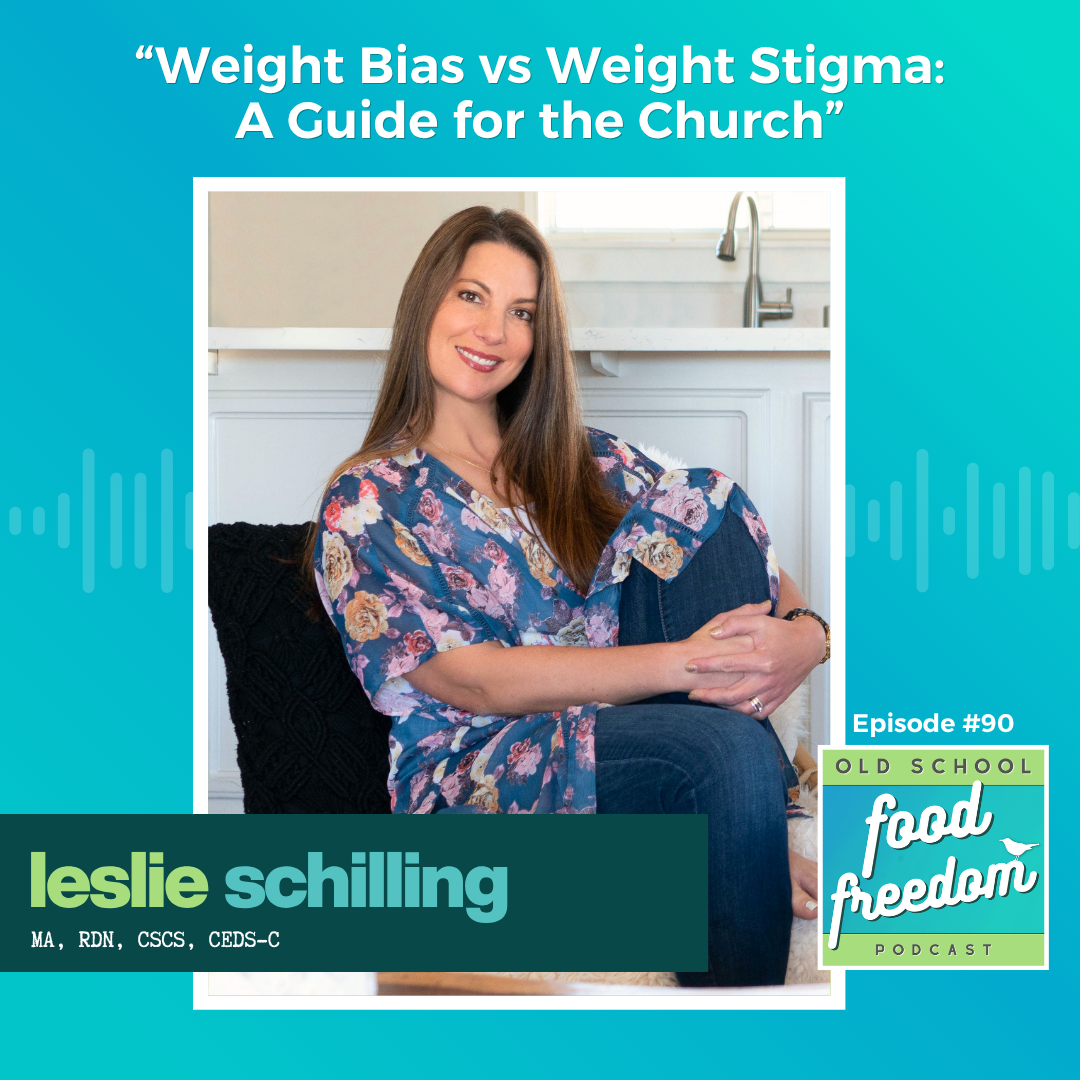
Weight Bias vs Weight Stigma: A Guide for the Church with Leslie Schilling, MA, RDN, CSCS, CEDS-S
"Bias is beliefs about the body, and stigma is when that belief turns into harm."
You know weight bias when you feel it: a comment from a doctor, a look in the mirror, a joke at a potluck that lands wrong. But weight bias and weight stigma are not interchangeable, and knowing the difference is where real body image healing starts. If you're a Christian woman working through disordered eating, body shame, or the quiet suspicion that you don't measure up, this conversation with Leslie Schilling is for you.
Leslie is back on Old School Food Freedom, and this time Chrissy brought her in for the conversation neither of them wanted to have, and both of them knew needed to happen: weight stigma in the church.
Here's what we cover:
Weight bias vs. weight stigma: the real difference, and why most of us have used the words interchangeably
Why weight bias in healthcare often looks like silence, not cruelty, and how it still causes harm
Why the church, of all places, has become one of the safer-seeming spaces where weight stigma hides in plain sight
How 1 Corinthians 6:19 gets twisted into a diet culture verse, and what it's actually saying
Internalized versus externalized bias, and how predatory marketing keeps both wired to fire
A fill-in-the-blank script for the exact email you send your pastor after a sermon lands wrong
Why "everybody hates their body" is not a joke to build a sermon around, and what to say instead
What fasting could look like when it has nothing to do with food
Why Weight Stigma Awareness Week, September 14 through 18, 2026, is the right week to have this conversation before New Year's sermon planning starts
Friend, if that list made your chest tighten a little, you're not the only one. Chrissy felt it mid-recording. So much of Christian body image work skips straight past this and goes right to fixing your plate. Weight-based discrimination doesn't always look like an insult. Sometimes it's a sermon, a comment at a potluck, or a health class from seventh grade that never quite left you. This episode gives you language for what you've been feeling and a way to bring it up without becoming the enemy in the room.
"Would you be open to hearing a different perspective on how this landed for me?" - Leslie Schilling
That's the sentence Leslie hands you, the one that turns a hard conversation into an open one.
Weight bias and weight stigma both trace back to the same lie: that a body's size tells you something true about a person's worth. It doesn't. Your body has never been the thing standing between you and God, and this conversation is one more step toward the food freedom this show is named for.
If this episode named something you've felt but never had words for, share it with a friend, a small group, or whoever is leading your Bible study this fall.
We’d love to hear your thoughts, so please drop us an email at admin@findingbalance.com, send us a voice message via SpeakPipe, or you can also subscribe for more practical episodes coming your way.
More About Leslie Schilling
Leslie Schilling, MA, RDN, CSCS, CEDS-S, owns a Las Vegas-based private practice specializing in nutrition counseling for families, people with disordered eating concerns, professional athletes, performers, and military personnel. Leslie has served as a performance nutrition consultant for Cirque du Soleil® and the NBA and an expert contributor to U.S. News & World Report. Her latest book, Feed Yourself, about how diet culture shows up in our safest places, is available anywhere books are sold.
Hello Freedom Community
Our Hello Freedom community has launched! This is a Christ-centered space to find connection, encouragement, and gentle steps toward freedom from food and body-image struggles. No pretending, no fixing yourself first, come just as you are. If you want in, your next step is to join us at findingbalance.com/community.
You were not meant to walk this alone. We're saving a seat for you!
Mentioned Scripture
1 Corinthians 6:19
Mentioned Resources
OSFF Episode 52 - An Unfed Believer is an Easy Target
Five Questions to Ask before Giving a Health-Related Sermon
Weight Stigma Pastor Conversation Email Template
Book: Feed Yourself: Step Away from the Lies of Diet Culture and into Your Divine Design by Leslie Schilling
Facebook
Instagram
SpeakPipe – Send us a voice message!
CHRIST-CENTERED RESOURCES TO HELP YOU FIND FREEDOM
The Daily Vitamin eDevo: A free devotional with bite-sized truth emailed 5 days a week
Community Groups: Find connection with prayer groups and our Hello, Freedom! community.
Christian Treatment Finder: Connecting you with Christian providers experienced in treating eating issues.
Lasting Freedom Online Course: A Christ-centered, non-diet course to work through false beliefs about food and weight so you can live free from disordered eating and body image issues.
CREDITS
Interlude music by “Hotham” – Morning Thoughts
Intro music by “MokkaMusic” – Old Jeans (Funk)
Wrap-up music by Jesse Quinn – Christian Instrumental
Production & Editing by Leah Bryant Co
The content in this podcast is for informational purposes only and is not intended to diagnose, treat, or prescribe a particular course of action. If you have, or suspect you may have, an eating disorder, please consult your healthcare provider. If you desire to receive faith-based care, visit ChristianTreatmentFinder.com to browse professionals with a Kingdom campaign against eating disorders.
More about the Old School Food Freedom Podcast
In today’s diet-culture society, food issues and body hatred have become the norm. But you were created to be FREE. Welcome to Old School Food Freedom, where we go back to the basics, God’s basics, for how we view food, our bodies, and our worth.
Hosted by FINDINGbalance Executive Director Chrissy Kirkman, this podcast features Biblically-sound experts, thought-leaders, artists, and everyday people who will inspire you to interrupt negative cultural soundtracks and rediscover God’s original design for your relationship with food and your body.
This show will deliver practical, faith-filled insights on how to break free from diet culture and body shame through the lens of scripture. If you’re looking for guidance on how to heal your relationship with food while deepening your faith, you're in the right place.
We’ll answer questions like
What does the Bible say about food freedom?
How can I overcome an eating disorder or disordered eating with Jesus?
What is the biblical perspective on diet culture?
How can I find peace with food as a Christian?
What does it mean to treat your body as a temple in relation to eating?
How can I break free from diet culture with Jesus?
How can I align my eating habits with biblical teachings?
What are the first steps to finding food freedom in Christ?
This podcast is for anyone ready to walk away from diet culture and into the freedom that Christ offers. Whether you’re recovering from an eating disorder, disordered eating, wrestling with body image, or simply craving a more peaceful relationship with food, this space was made for you.
If you want to experience true food freedom with Jesus, this podcast will give you the encouragement, truth, and tools to do just that.
The unedited transcript for this episode of Old School Food Freedom
Chrissy [00:01:02 - 00:01:13]: We could not do this without you. And friend, I have a feeling season 9 is going to be so good. So let's get into it. Leslie Schilling, welcome back to Old School Food Freedom. So glad you're back. Guest Introduction and Old School Nostalgia
Leslie Schilling [00:01:14 - 00:01:16]: Thanks for having me. I'm glad to be here. Of course.
Chrissy [00:01:16 - 00:01:38]: And this is such a difficult topic for me because my heart I just want truth. I want to advocate for truth. I want the enemy outta here. Like, and I wanna scream from the top of the roof, like, listen up! And there is grace for what we don't know. There's grace for, like, I was once there.
Leslie Schilling [00:01:39 - 00:01:39]: Yeah.
Chrissy [00:01:39 - 00:02:31]: And the Lord opened my eyes. Now I can't unsee it. And I pray, right before we hit record, we prayed, I prayed that The Lord would help people see this truth, not for any shame, not for anything other than look what we are allowing the enemy to do in the church, the big C church, in the church. He doesn't have any right to be there, right? So like, let's talk about this first. If you haven't heard Leslie, she's been on the show before, but this is Leslie Schilling. And she owns a Las Vegas-based private practice specializing in nutrition counseling for families. People with disordered eating concerns, professional athletes, performers, and military personnel. Lesley has served as a performance nutrition consultant for Cirque du Soleil and the NBA and an expert contributor to U.S.
Chrissy [00:02:31 - 00:03:06]: News and World Report. One of her favorite things to do is support registered dietitians, coaches, and other professionals working at the intersection of eating disorders and sport through professional supervision and mentorship. in the Dietitian Development Hub Mighty Network community. You've got to check out her book, Feed Yourself, about how diet culture shows up in our safest places. And that is available anywhere books are sold. We will have the link in the show notes if you want to purchase it easily. So Leslie, thanks for being here. First, we're going to kick it off.
First Jobs and Paper Nostalgia
Chrissy [00:03:06 - 00:03:15]: Now you've been here before, so I'm not going to ask the normal question. I want to know what was your first job or your first jobs back in the day, like old school jobs?Leslie Schilling [00:03:16 - 00:03:57]: The most old school job I had, which was kind of my late college, um, grad school job. And the reason it's double old school is because I worked at a paper store and I'm obsessed with paper. You know, cards, wrapping paper, books, um, invitations. And that's also why it's double old school because I love beautiful paper. I love writing a thank you note. I love stationery that's monogrammed. And I loved helping people make beautiful invitations. And so I love just the old school touch of having a beautiful paper in my hand, just like a book.
Leslie Schilling [00:03:58 - 00:03:58]: Yes.
Chrissy [00:03:59 - 00:04:01]: Were you ever a scrapbooker or did you have time for that?
Leslie Schilling [00:04:02 - 00:04:10]: You know, I tried to do that for, for a few years. I would say my motivation was strong. My follow-through was not.
Chrissy [00:04:11 - 00:04:29]: Same here. Like it was such a great idea. There were discounts. So I had to buy all the things and I had all the things and then it was like, mm-mm, like they just started collecting dust. But I love that. I do. I am that way too. I love good paper and a good pen, the way a good quality pen writes on that paper.
Chrissy [00:04:30 - 00:04:31]: Like it's a hand in hand.
Leslie Schilling [00:04:31 - 00:04:43]: Oh yeah. We even had like the wax that you could press to do a seal on an, I mean, I just loved, I loved that job and I loved the papers. I even, we, I picked up my wedding invitations there too. So it was very old school.
Chrissy [00:04:43 - 00:05:29]: Oh, that's so sweet. I didn't expect that. That's so nice, but it makes So good. Well, today we're talking weight stigma in the church and weight bias. And so the reason this is happening right now is Weight Stigma Awareness Week is September 14th through the 18th of this year, 2026, as we're recording. This is just an awareness week. This is a problem every second of every day, and most of us have experienced Some form of weight bias, whether we've directed it, you know, at ourselves or whether it's been directed at us. It shows up in medical offices and workspaces, schools and social media for sure, everyday conversations.
Introducing the Topic: Weight Stigma in the Church
Chrissy [00:05:29 - 00:05:38]: And as we're going to talk about it today, it shows up in our churches. And so that's what today's conversation is about. Leslie, I'm really glad you said yes to this.Leslie Schilling [00:05:39 - 00:05:39]: Yeah.
Chrissy [00:05:39 - 00:06:00]: So let's just kind of start at the beginning. Like, how do you define Weight bias and weight stigma. Friends, first, I'm going to tell you, Leslie, before we even started, she helped me understand that weight bias and weight stigma are 2 different things. And it blew my mind. I didn't even know. I just kind of used them interchangeably. So if you feel like, oh, I didn't know that, you're not alone.
Defining Weight Bias and Weight Stigma
Leslie Schilling [00:06:00 - 00:06:06]: And that's okay. It's like, I think once we realize like the intention and, and what's going on, it's easier to see.Chrissy [00:06:07 - 00:06:07]: Yeah.
Leslie Schilling [00:06:07 - 00:06:15]: So weight bias is something I think we all have growing up in diet culture. learning in diet culture, health classes in junior high.
Chrissy [00:06:15 - 00:06:16]: Oh yeah.
Leslie Schilling [00:06:16 - 00:06:34]: My daughter's doing that now, so I'm monitoring that for, uh, weight bias. But weight bias is when we hold a prejudice, when we hold beliefs about someone based on the body that they live in. So that's the bias. So it would be me making an assumption about someone based on their body size—
Chrissy [00:06:35 - 00:06:41]: large or small, medium, any height, Anything like that. And I'm sorry, I did not mean to interrupt you.
Leslie Schilling [00:06:41 - 00:06:43]: No, no, no, that's fine.
Chrissy [00:06:43 - 00:06:50]: It feels like it's easy to think when you hear weight bias or weight stigma, large bodies, like it just equals large bodies, but this is—
Leslie Schilling [00:06:51 - 00:07:41]: Now those in large bodies tend to bear the brunt of it more. That's when stigma comes in. So like if you have someone who say is living in, and I've, I have clients across the weight spectrum, you know, if you've got someone living in a smaller body, And say they go to the doctor's office, the doctor assumes that they're eating and doing everything just so, right? Possibly the health practitioner just makes an assumption based on their showing up in like a thin body. So they're assuming health. This person might not be eating at all. This person might be heavily restricting. So that weight bias is quite harmful there. Now, on the flip side, the weight bias of someone in a larger body They're probably going to get some negative advice based on if someone's just making an assumption based on their body.
Leslie Schilling [00:07:41 - 00:07:50]: So bias is beliefs about the body, and stigma is when that belief turns into harm. It's when it comes out your mouth.
Chrissy [00:07:51 - 00:07:51]: Oh yeah.
Leslie Schilling [00:07:52 - 00:08:18]: So stigma comes out your mouth usually, or it's a recommendation. So it might be if you're at the doctor's office and You know, someone, they do a weight check and nobody asks you about your life or your eating or anything. And then you leave with, oh, and by the way, you need to lose weight, or you're classified as unhealthy without having any context. Or, you know, just the blanket, like diet and exercise.
Chrissy [00:08:18 - 00:08:18]: Yeah.
Leslie Schilling [00:08:18 - 00:08:38]: You know, without context, we don't know if that person has a history of disordered eating. We don't know anything about their genetics. They could be living in any size body that is perfectly fine. And so we make a lot of assumptions. So bias is belief. Stigma is when that comes out your mouth and causes harm.
Chrissy [00:08:39 - 00:08:39]: Gosh.
Leslie Schilling [00:08:41 - 00:08:44]: Or comes out your keyboard. Like if people are typing on the socials.
Chrissy [00:08:44 - 00:09:08]: Oh, for sure. Like let's pause and think of that. That's happening a lot and there's internalized And externalized stigma. So the things that we're thinking about ourselves or thinking about other people or viewing others in certain size bodies and using that as like almost a mirror of reflection for ourselves. Like, can we go there a little bit?
Exploring Internalized and Externalized Stigma
Leslie Schilling [00:09:09 - 00:09:58]: Well, yeah. And again, like, I think we all have this internalized piece that if we haven't done work around it. It still lingers. It still makes us question and judge whether our bodies should generally be smaller. And that's usually like where it is. If we live in any type of body, culture tells us smaller is better, which we know is not true. But that is that internalized piece is when you're really caught up in the thinking that your body is bad because of its size. And then we also have a lot of external triggers that kind of light that up, right? Like if you see Right now there's a lot of predatory marketing about body sizes and weight loss and weight loss medications and all kinds of things, right?Chrissy [00:09:58 - 00:09:58]: Yeah.
Leslie Schilling [00:09:58 - 00:10:23]: And so then that really triggers something in us of like, well, should I do that? And that's that internalized bias or just concern that like, should I be doing something different? And that is really, I'd say it's really harmful right now. We see a lot of it. We see it in a lot of safe places. The marketing is really, is a way to see that external triggering the internal.
Chrissy [00:10:23 - 00:10:32]: Yeah. So I know I kind of mentioned some of the places that weight stigma shows up. Is there anything that you would want to speak to on those places?
How Weight Stigma Shows Up in “Safe” Spaces
Leslie Schilling [00:10:33 - 00:11:03]: Oh yeah. Well, I always say it shows up in all our safe places, unfortunately, because this is the culture we live in, but particularly medical offices, schools, And unfortunately churches. Weight stigma in the church is like, I feel like we expect it possibly in medical spaces and even schools because we know it's kind of tied to health curriculum, even though we're trying our best to kind of shift some of that language. Where we really, really don't want to see it is the safest of safe places, which is the church.
Personal Reactions, Scripture, and the Enemy in Our Midst
Chrissy [00:11:04 - 00:11:12]: Friend, if you hear this and you are feeling in your body, like I'm just going to share what I'm feeling. Like, I'm already feeling a tightness in my chest.Leslie Schilling [00:11:13 - 00:11:13]: Yeah.
Chrissy [00:11:13 - 00:11:35]: I noticed twice that my hands were in fists, like, and balled up in fists. I think it's showing me I'm feeling this. I'm feeling the frustration about it and not frustration at the members of the church, but just the enemy that, that we could have had the wool pulled over our eyes.
Leslie Schilling [00:11:35 - 00:11:36]: Mm-hmm.
Chrissy [00:11:36 - 00:12:12]: In a sense that we have been so influenced by a culture that values thinness over anything. And that, that the enemy has come into these safe spaces that are supposed to be safe, like that the Lord, you know, did not ever intend for it to be this way. And it's just like, I'm seeing the Garden of Eden. I'm seeing the snake slithering in and like, let's look at 1 Corinthians 6:19, you know, that the Lord said, do you not know that your body is a temple of the Holy Spirit within you? whom you have from God and that you are not your own. And let's talk about that, Leslie, because—
Diet Culture’s Favorite Verse and the Problem of Righteousness Tied to Body Size
Leslie Schilling [00:12:12 - 00:13:07]: Yeah, well, diet culture's favorite verse. Yeah, that's it. But also it's used so insidiously to make people believe that they really have to keep that temple, you know, aligning with diet culture standards, which is really just so unfortunate. And if we think about it, it's just kind of Yeah. But it can be beautifully wrapped up in this, here's your way to righteousness. And I think that's what makes, like, and you said your like palms are sweaty and your fists are balled up. I think that's what makes us so uneasy when we talk about weight bias and weight stigma in the church is because it's not just about health and that's not about health at all. But it is about tying your body size to your belonging.Leslie Schilling [00:13:07 - 00:13:10]: And that is heartbreaking.
The Experience of Exclusion and the Need to Repair Harm
Chrissy [00:13:11 - 00:13:11]: Yeah.Leslie Schilling [00:13:11 - 00:14:10]: Especially when you live in a body that, you know, is possibly more stigmatized than other bodies, but it's also like, you know, your own story of like, I am taking care of myself, whatever that looks like. It's different for everybody. I am coming here to be accepted and loved and included. And when I hear stuff about bodies or body shaming or good food, bad food, or making health equal to righteousness equal to weight, that is really harmful. And it makes me feel very quickly like this is an unsafe space and I'm not safe to be vulnerable here. And maybe I don't belong. And that's not how we want people to feel in the church. And I agree with you when you said at the very beginning, we don't think that people do this or ministry leaders have any malicious intent here.
Compassion, Grace, and Understanding When Confronted With Harm
Leslie Schilling [00:14:10 - 00:14:46]: It's just the culture we live in, which we have to be very, very careful as leaders to parse out, to not hurt the people we're talking to. 'Cause I don't think it's on purpose. And like you and I talked before, like intention may be very pure, impact may be very harmful. So we really wanna work on the congruence there. And I will just say, like, given the number of backend messages I get about things that people are hearing in their churches, we have a long way to go before our intention and our impact are congruent.Chrissy [00:14:46 - 00:15:08]: Yeah. And coming at it with compassion, grace, and understanding. It's, friends, if you've listened to this, this show for any amount of time, you know, I'm, I'm saying the same things in almost every episode, but they are so important. And if no one else needs them but me, then that's why I'm saying that. But like, A, we don't know what we don't know.
Leslie Schilling [00:15:08 - 00:15:08]: Right.
Chrissy [00:15:08 - 00:15:31]: And once God can open our eyes and illuminate something and show us truth and expose really the enemy's deceit, then we know it. And then we get to do better and we can say, okay, actually shame off me because I didn't know that. Oh, I, the amount of things I've done that, that I wish had not hurt people, but did.
Learning, Repair, and Moving Forward With New Awareness
Leslie Schilling [00:15:32 - 00:16:17]: Oh, same. And I did it as a nutrition professional where it's like we have caused harm, even though our intention was Um, very pure and we wanted it to land well, the impact was very different. And I think the compassion of that is like, one, realizing that we all have a journey and we don't know what we don't know until we do, and then we repair it. And so that's what I hope that people will understand too, is that we're all going to mess up. We're all going to engage in crazy diet practices because we live here. You know, we live in this culture and we think they're health-promoting. But when we know better, we do better. And we really think about our intention and, you know, we think about the impact.
Thinking Ahead About the Impact of Our Words and Practices
Leslie Schilling [00:16:18 - 00:17:29]: I've even started thinking about the impact at like, you know, start with the end in mind and asking, how do I think this is going to land? Do I think there are people in the audience that could take this the wrong way? Or, you know, I've had my first book, I had a subtitle that came across as not the way I intended. So thank goodness for second editions, you know, so we repaired that. Yeah. So yes, I think we truly mean well and want the health of our congregations, but there's a lot more to the story when we're talking about bodies and we're talking about food and we're talking about navigating a culture that wants you to be restricted and small. When we're restricted and small, we also don't have the energy to live out our purpose. to speak up for those who need us. So being fed is something we really want to promote among our congregations, being well-fed, so we can, you know, stand up for the least of these, help those who need help, speak when others can't. And that takes energy and not being scared of your own body.
Context of “Body Temple” Verses and Reframing How We Care for Ourselves
Chrissy [00:17:29 - 00:17:45]: Gosh, I have like 4 different points Based on what you just said, 4 different things I don't want to forget. And I wanna go back and just make sure I say that with, of course, our body is the temple of the Holy Spirit. Of course it is.Leslie Schilling [00:17:45 - 00:17:45]: Yes.
Chrissy [00:17:46 - 00:18:15]: And we have a responsibility to care for that temple. But the context of that verse is a sexual immorality context. So to turn it and twist it, that's something that the enemy has done. And on the, on the flip side, as our body is a temple of the Holy Spirit within us, there is something about, like you said, feed yourself, like nourish your body. That is the more kind thing to do than restrict it and try to make it small.
Leslie Schilling [00:18:15 - 00:18:15]: Right.
Healthcare Settings and the Costs of Weight Stigma
Chrissy [00:18:15 - 00:18:39]: But in addition to that, um, I was thinking of like, it's okay that as you grow up, you think a doctor, a medical professional is the ultimate authority Over your health. Like, I kind of just grew up, at least that was my experience, maybe not everyone's, but you go to the doctor and they tell you what's wrong with you just in a 10 to 15 minute, if you're lucky, session.Leslie Schilling [00:18:40 - 00:18:40]: Right.
Chrissy [00:18:40 - 00:18:50]: You're presenting with these symptoms. Oh, it must be this without going deeper. I mean, when you stop and think about it, man, hey, that's a lot of pressure on a doctor or medical professional.
Leslie Schilling [00:18:50 - 00:18:52]: 100%. Yeah.
Chrissy [00:18:52 - 00:19:21]: To just diagnose something right away. And I know this is kind of steering a little ways, but That's a lot of pressure for them. And of course it's easy to get it wrong without going deeper. Like we're so much more than what we look like on the outside. And so this has been a struggle for me. No matter what size my body has been, it has never been thin enough for doctors. It's never been thin enough. And I mean, didn't feel like I could even say, you don't know how little I'm eating.
Chrissy [00:19:22 - 00:19:41]: You don't know how hard I'm trying. I'm trying all kinds of diets. I'm restricting. Like, this is in the past, right? But like, I'm working out and doing Zumba and doing all these things like multiple times a week. And it's just like never good enough for you. It's never going to be good enough for you.
Leslie Schilling [00:19:42 - 00:19:42]: Yeah.
Chrissy [00:19:42 - 00:20:10]: And it makes me not want to come in here even for just like, I have hypothyroidism, so I'm going to always have to come in and have those Labs checked every 3 months or 6 months or whatever it is. I'll do anything to not have to go in there because you're going to tell me somehow that I need to lose weight and you're not even going deeper. And I know I've shared that in other episodes, but like weight stigma, I feel like really shows up specifically in healthcare settings. So, so what does that cost people, Leslie?
Leslie Schilling [00:20:11 - 00:20:20]: Yeah. Well, just like you said, it costs preventative care. It costs prolonged time to get a diagnosis if you need one.
Chrissy [00:20:20 - 00:20:20]: Yeah.
Leslie Schilling [00:20:21 - 00:21:02]: It actually causes health concerns. It can increase your blood pressure. It can increase inflammation in your body. So experiencing weight stigma is part of what it can lead us towards chronic disease. And you want to feel safe in those environments, right? You want to walk into your doctor's office and know that you can decline a weight check. and say, you know, I'm going to skip that, but if my practitioner needs it, I'm happy to do a blind check. Like, if you need to write me a prescription for something that's based on my weight, 90% or more-ish of adult weight or adult medical visits don't require weight check at all. We learned that during COVID Yeah.
Medical Advocacy and Agency With Practitioners
Leslie Schilling [00:21:02 - 00:21:38]: Oh, you talk to your doctor through the screen. So, I mean, and I think when you've got offices that are like, okay, no problem, Then they, oh, thank you. Thank you. And now gimme 5 minutes and my blood pressure can come down and it will be normal for the— so when you start doctor's visit with like, hi, they call your name from the waiting room, you come in, let's get a weight check. I'm always like, I'm not gonna do that today. Thank you. And usually, um, people are pretty gracious about that and where I've been going. But if not, like, then your blood pressure's high, you're a nervous wreck, or you do it and you know that it's probably gonna be harmful if you see it.Leslie Schilling [00:21:39 - 00:22:25]: So that is where weight stigma can harm you as soon as you're walking in the door. But knowing that you could say, no, thank you, that's really harmful for me. I'm happy to talk through that with my provider if necessary. That is something that you could do, because if you don't do that, then you might be too frazzled or too shut down to even bring up what you're there for. You're there because you feel like you're— you've got pressure in your head and you're having horrible headaches and What you really need is maybe an MRI or whatever. And then you're too shut down to even ask for what you need. So it prevents us from being self-advocates. And then that prolongs all kinds of issues and can lead to more chronic disease and misdiagnoses.
Self-Advocacy Printables and Learning to Use Your Voice
Chrissy [00:22:26 - 00:23:00]: So good. And just to the reminder that we actually have that agency we have. The right to be able, and we can do it in love and kindness and Finding Balance has made this super easy. If you go to the show notes, we have a link that will take you to some free printables that you can, it's weight discussion printables. And I printed one out, I used it and I slipped it. It's not this huge piece. It's one piece of paper with like maybe 6 that you can cut out and they're kind of smaller and you hand it to that first person, you know, that comes in like step on the scale. You hand it to her or him.Chrissy [00:23:01 - 00:23:25]: And my experience is they respect it and I don't have to get on the scale. And if anyone has ever said, oh, we have to do it, then I'll just step on it backwards and say, please don't share that number with me. I just, you know, it's like I'm in recovery and, um, it's not helpful. And so you've got another way. If that's the way, if it's hard to use your— because it was very hard to use my voice at first. I could, I just couldn't. I wasn't there yet.
Leslie Schilling [00:23:25 - 00:23:25]: Mm-hmm.
Chrissy [00:23:25 - 00:23:31]: And that's okay. And so I slipped that too, and that was my way. And then it got a little easier every time, and it took a while.
Leslie Schilling [00:23:31 - 00:24:03]: Yes, and those are great. And like, I would just recommend to your listeners too, if you haven't already, to like print that out, cut it out, and keep them with you all the time. Because you'll be in a conversation with a friend who's feeling uneasy, and you can be like, you know what, I have something here, use this. I keep those cards in my office, and I have them in my purse. So whenever I'm talking to people or, you know, and it comes up, it is, you know, I've trained in doing this and it's still hard for me because then I'm not a professional in that office. I'm a patient.
Chrissy [00:24:04 - 00:24:04]: Oh yeah.
Leslie Schilling [00:24:05 - 00:24:43]: Roles have flipped. The hat is very different, you know, and there's still the hierarchy of being taught that this medical provider who's going to give you 8 minutes of their day is the end-all be-all. But now, I mean, we also know that like, actually we're in charge, but We have to kind of reframe that and learn how to do that. And one way to do it is to use the CARS. If you feel like this is a step towards me getting my needs met better without me having to get so nervous about how I'm going to say it, or if I'm going to say it right. And the more you practice it, the easier it gets. And then maybe the true vitals, like your blood pressure and your temperature, might look a little more calm.
Weight Stigma Messages: Healthcare Meets Church
Chrissy [00:24:43 - 00:25:27]: Oh Lord, please. For sure. And you know, I was just thinking. We didn't really discuss this before, but it like totally, I could see it. It occurred to me that we are 2 individuals talking about this and we are Christ lovers, believers that are in church, but everyone in a church building and that is part of the church body at some point has gone to a doctor and has at some point heard the same message in a clinical, setting in a hospital. So there's the church and there's healthcare setting. And so if that message keeps being reinforced there, then we're all assuming that it's obviously the right way and the true way.Leslie Schilling [00:25:27 - 00:25:27]: Right.
Chrissy [00:25:27 - 00:26:24]: So then we come back on a Wednesday night, a Sunday morning, a revival weekend, whatever it is, and we gather together with that information and The church is not immune to weight bias and weight stigma. So we have a potluck dinner, we have, you know, a pastor bringing a message, we have youth leaders and children's workers and Sunday school classes going on and all kinds of other events, women's Bible studies, men's breakfast, all these things. And these people were all coming together under that same kind of context. Like, let's go there. Like, I don't know where to go next, but I, it's like, I'm hearing all this and seeing all this and feeling shame about my body in many of those settings, even today around certain people, because I, I've heard their comments about themselves or others. And so what does that mean about me?
What Can We Do? Repair, Compassion, and Safe Conversations
Leslie Schilling [00:26:25 - 00:26:33]: Right. And, and that's where one, it's really hard, but we do try to be like, wow, that person's not there yet. They've not experienced what I've experienced.Chrissy [00:26:34 - 00:26:34]: Yeah. And it's okay.
Leslie Schilling [00:26:35 - 00:27:09]: And it's okay. But if they had, I would be having a, what would feel like more of a safe experience right now. And we want this to be safe. So we want pastors to give sermons on, you know, repair. Like, hey guys, I just learned more about diet culture and that I have been a part of it. And I have mentioned things that were, you know, negative toward my own body. Or other size bodies or foods. And I have learned that, gosh, that could have really been harmful.
Leslie Schilling [00:27:10 - 00:28:10]: It was harmful for me and I didn't even realize it. And, you know, I want to just take accountability for that. And what a beautiful message of repair that could be. We don't necessarily hear those. I have heard those before, and those usually come after You know, a loving comment card or email of like, hey, I know you really meant well with this sermon last week, but when you were talking about how your body size was wrong, or that other people's body sizes were wrong, or you wrote this piece that said that pastors in larger bodies were wrong, I think you meant well, but I would love to offer you a different perspective. If you're open to it. And let me tell you how that landed or how that really impacted me. You know, when I was talking to a pastor one time about this, I said, I'm just curious if you know the, you know, incidence rates of eating disorders.
Leslie Schilling [00:28:11 - 00:28:46]: And he said, no, you know, they're pretty rare, right? Well, I'm like, no, it's really, it's not rare. Um, you know, it was like, actually they've doubled in the last decade. They've doubled. And that information is pre-COVID. So right now they're probably higher. So we're looking at, you know, like maybe, um, you know, 74 to 75% of women actually engage in unhealthy weight control practices. But in terms of clinical eating disorders, you know, it's the incidence rate is closer to 8+ percent right now. So I said, if you're sitting and you're looking at your congregation, The number's not zero.
Leslie Schilling [00:28:47 - 00:29:08]: And I just really want you to think about when you're saying everybody must fast or everybody must do this or everybody must aim to find this type of body. I want you to really think about, and this is me talking to a pastor who was very appreciative of the work that I do and asked me questions and was just so open.
Chrissy [00:29:08 - 00:29:08]: Yeah.
Leslie Schilling [00:29:08 - 00:30:18]: And I just think about how that lands for the fairly high percentage of congregants who either have or have had an eating disorder, or even more that are just suffering with disordered eating practices at the moment. So I think when we help people understand this isn't rare, and weight stigma plays a very big role in perpetuating disordered eating and perpetuating weight bias that we believe about ourselves. And other people. So it's really good when we feel comfortable to have a conversation with the person giving the negative message. Like if some, say you're at a potluck, it's really funny because wherever there's food, right, there's diet culture and there's a lot of food in the church. That's from Erin Bowers, who's the theologian who helped me with Feed Yourself. That's what she said, wherever there's food, there's diet culture and there's a lot of food in the church. And so You know, taking that person aside who say looked at me and said, are you really going to eat that? Or are you really going to have that much? And I think people mean well, but then sometimes I'm, I'm also like, that's kind of rude, but here we are.
Leslie Schilling [00:30:18 - 00:31:13]: But just taking that person aside and saying like, when you comment on my food, it's really harmful for me. And I really wish you would try to not do that because I love spending time with you, but that kind of shuts me down. When we're together, having the hard conversations is really how we provoke change. So however we do that, whether it's a text or, you know, I'm loving leaving all my buddies audio messages now because like, hey, it was so good to see you the other night at the potluck. You know, I'd love to have a conversation with you if you have time. If not, I'm happy to leave you an audio message if that's easier. Um, but just being willing to have those conversations, you know, and starting with, I wonder if you'd be open to another perspective or hearing about how, um, that lands for me is a way to kind of start those conversations to hopefully make our safe places safer.
Gentle Approaches for Speaking Up in Community
Chrissy [00:31:14 - 00:31:51]: And that doesn't feel like as scary to me. I was telling you earlier, it can just feel Terrifying to think, would like to have the conversation, but in my mind, it's like, you know, it feels threatening to me. Like I don't wanna approach someone and upset them. Like the whole people pleasing stuff. Like I don't wanna, you know, call 'em out and, and whatever, but you brought it in a gentle way, in a non-threatening way. I'm curious if you're open to hear a different perspective on how this might land. in the congregation. That doesn't sound judgmental.Chrissy [00:31:51 - 00:31:55]: That doesn't sound, you know, just snotty.
Leslie Schilling [00:31:55 - 00:32:49]: And you know, that came from practice because I can come across as, let me tell you, this is what I do for a job and this is really horrible. I mean, I can come across, so I have practiced. And my daughter actually asked me, like she said, I feel so like, she didn't use the word activated, but that's what she meant. Like, I feel so uneasy and uncomfortable when our junior high church leaders were talking about XYZ. I was so uncomfortable. I wanted to leave because I didn't know how to say what I needed to say. And so that was birthed out of her and I having a conversation about just saying, like, if we take a deep breath and say, I wonder if you would be open to a different perspective? And most people are going to say, yes, I would love to hear what you have to say. And she's like, I don't want to come across as like knowing everything.
Leslie Schilling [00:32:49 - 00:33:13]: And at that time we're talking like a 10-year-old. She has been heavily trained in health propaganda, spotting it. But, and I appreciated that because it also helped me, you know, maybe come across in a way that would land better for someone who's, you know, doesn't do what I do, right? Like we, we don't know what we don't know, but when we do know.
Chrissy [00:33:13 - 00:33:14]: Yeah.
Leslie Schilling [00:33:14 - 00:33:14]: We try to do that.
Chrissy [00:33:14 - 00:33:37]: We can do better. Yes. And that's really helpful for, um, the listener who wants to approach their pastor or a church leader or a youth leader or whatever. I'm curious if you're open to hear a different perspective on how this might land in your congregation. You also shared with me that you have an article that we have linked in the show notes that someone could send. Let's talk about that.
Resource: Article for Pastors About Health-Related Sermons
Leslie Schilling [00:33:37 - 00:34:44]: So this is an article. It's something like, you know, 5 questions to ask yourself before giving a health-related sermon. And it's, it's really about, are we confusing health with weight or weight with health. And we know weight is not truly a proxy for health, but there are a lot of people who don't know that. And when we're trying to give a sermon, these times kind of hit usually like New Year's, they hit around there. But the sermon is really just asking a pastor to ask the questions of like, is what you're asking, is it available to everyone? Um, do you know health history? So basically it sets them up to be like, be really careful with what you're talking about because there are a lot of people who could be harmed in a congregation with a sermon that might land fine for 25% of your people, but a larger percentage might question how they're caring for themselves when maybe they don't need to do that. And so that's— the article was written specifically for pastors. To just be really careful with those types of sermons.Leslie Schilling [00:34:45 - 00:35:16]: But also, I bet all the listeners have heard some type of health sermon that you're like, ooh, I don't like how that landed. That feels very not good. I don't like that. Right? So that is something that we can help them understand by asking them not to use the commiseration, like if I can use the right word, like we commiserate on being at war with our bodies. And unfortunately pastors will say, well, everybody understands that.
Chrissy [00:35:16 - 00:35:16]: Yeah.
Weight Stigma as an “Easy Target” in the Church
Leslie Schilling [00:35:17 - 00:35:59]: So it's an easy target, right? It's an easy topic to be like, everybody gets it. So I could use it. But in using it, we perpetuate weight stigma in the church. And so that is something like it's, it's the collective misery people understand. Sadly, we don't want them to feel that in the church. And so when I talked to a pastor about it, I was like, just because it's an easy target doesn't mean it needs to be our target, because it's very harmful to just say, this is the way it is. Everybody hates their body, so let's just ride that topic to prove a point that I'm trying to make down the road. And I've talked to several pastors about this and they were like, gosh, I never even thought about that.Leslie Schilling [00:35:59 - 00:36:08]: You know, it's just, it's like, You make a joke about something that everybody understands. So you're like, yeah, that's going to be a home run. Well, it's really not.
Chrissy [00:36:08 - 00:36:08]: Right.
Leslie Schilling [00:36:08 - 00:36:21]: Been there. But it makes sense, right? It makes sense that we would think, oh, everybody will get this. They will. But the intention might've been innocent, but the impact was pretty harmful.
Reframing Belonging and Body Image in the Church Community
Chrissy [00:36:22 - 00:36:32]: And when you think, like you were talking about the, you know, the, the target, it's like, To think that, you know, well, everyone hates their body. When was that God's design? It wasn't.Leslie Schilling [00:36:33 - 00:37:15]: Exactly. And it never was. But it's like, so it makes me even wonder, like, would you be open to another perspective of how do you think that aligns with being fearfully and wonderfully made? How do you think that aligns with grace? How do you think that aligns with the understanding that people in the congregation have all different walks of life? Different health journeys. Someone could be on a medication that saved their life that made them gain lots and lots of weight. And we don't want to stigmatize them. We want to be so grateful they are alive and with us. So these are things that we overlook in the church. Unfortunately, we overlook economic privilege.
Leslie Schilling [00:37:16 - 00:38:01]: We think if someone just eats well and moves that they can change their body a certain way. We overlook genetics. Yeah, big time. We overlook the beauty of body diversity. And that's not just in size and color, it's in ability as well. And there's such varying levels of abilities. And so that is something that I feel like we have to really bring back to the church to help get weight stigma out, is really appreciating the diversity, but having this hopefully open-ended grace for someone's story that we don't know about. You know, and we're not going to know about everybody's story, but we want to not make judgments or decide we know their story because of the body that they live in.
Shifting the Narrative: Moving the Church Atmosphere
Chrissy [00:38:02 - 00:38:39]: For sure. And for the church to truly get this right, for the church to start shifting the narrative, shifting the space and the atmosphere. And, um, I know that's not an overnight thing. I know that's going to take practice. It's going to take courageous, brave, Women and men to, to use their voice, their God-given voice to speak up in love and have conversations. I want to say hard conversations, but they're not hard conversations. And I feel like now they're not. Whenever I have this, I'm curious if you're open to hear a different perspective on how this might land.
Seeking Change: Timing and Planning for Health-Related Sermons
Leslie Schilling [00:38:39 - 00:39:14]: And one way to do that now, like it's September for Weight Stigma Awareness Week. You know, January sermons are already being planned, if not planned. And so what a wonderful time to say, hey, I'm just curious what the plan is for New Year's. And if you would be open to not taking a route that aligns with diet culture, I wonder if you would be open to a different perspective for your New Year's type sermons. That's such a good time. to kind of pregame and do some intention.Chrissy [00:39:14 - 00:39:15]: That's lovely.
Alternatives to Fasting and Focusing on True Distractions
Leslie Schilling [00:39:16 - 00:39:50]: Because sermons, depending on the church, are planned out months and months in advance. So this would be a good time to just say, I wonder if you would be open to a different perspective for the direction we're heading in the new year, because it's a really hard time for people who are stewards of human bodies in this culture. For most people, it's just really good timing to say, are we doing diet plans? Are we doing X number days of fasting? Are we doing these things? And if we are, would you be open to something a little bit different?Chrissy [00:39:51 - 00:40:15]: Even if they wanted to do a fast, making it not about your body, but about what are you eliminating. Maybe it's a serious social media addiction. Maybe that's what you need to step away from. And disconnect from so you can make room and make space and open up your mind and your heart to Jesus. Like, that's the best fast that I've ever done.
Broadening the Idea of Fasting in Faith Communities
Leslie Schilling [00:40:16 - 00:40:31]:
Yeah. Like, fasting, you know, it's funny. I was talking to the theologian who was helping me with Feed Yourself. And she's like, I don't do food fast in my congregation. She's like, when I really think about what's keeping me from, from Jesus and time with Jesus, it is not food.
Chrissy [00:40:31 - 00:40:31]: Yeah.
Leslie Schilling [00:40:31 - 00:41:14]: It is social media. It is, you know, Netflix. It is ESPN. It is spending money. It's so many of these other things or just busyness. She's like, those are the things, you know, she's like, can you give 20 minutes of your time every day to write a letter to someone you have, like on real paper to, to, um, someone and, you know, express gratitude or let people know you're thinking about them. And she just had the most beautiful way of like, when we think of fasting in medieval time, we think about food because that was what there was to give up. And now we have many, many, many, many distractions that aren't food.
Leslie Schilling [00:41:14 - 00:41:29]: And maybe sometimes people need to fast from their restriction. And what they're trying to do is actually feed their bodies appropriately. And that is the goal there is like, and then you're more connected to most things because you have the cognitive energy to be that. So. Yeah.
Chrissy [00:41:29 - 00:41:53]: Right. And the episode we did together about, you know, an unfed believer is an easy target. Like that is what changed and shifted my, like, what if the fasting I needed to do back then and maybe even now is to fast from the restriction, to fast from the not eating breakfast and not eating lunch and just having this one dinner. Like, and it helped me so much. I'm telling you.
Media Detoxes and Protecting Mental Health
Leslie Schilling [00:41:54 - 00:41:59]: Well, good. Yeah. And, and listen, social media is just. Isn't it just lovely when it's lovely?Chrissy [00:42:00 - 00:42:00]: Right.
Leslie Schilling [00:42:00 - 00:42:42]: But so, so harmful. And especially like when the algorithm knows you looked at one thing by accident, or you look at one thing because you're having a hard day, or you're curious, and then it's then curated towards restriction or bodies that aren't even real. We're seeing a lot of advertisement that are bodies that are AI. I'm like, look at this new routine. And And here's how it shows up. I'm not even a real human. So, I mean, we've taken the bar and making it crazy in diet culture, and now we've made it actually artificial. So it's, so fasting from, sometimes we really, and I've had a lot of clients that are like, we don't talk about detoxes unless it's a social media detox.
Leslie Schilling [00:42:43 - 00:42:50]: It's like, and then give it 3 days and see if your mental health feels better. See if you're able to eat lunch with your friends without dissecting every morsel.
Chrissy [00:42:50 - 00:42:50]: Right.
Leslie Schilling [00:42:50 - 00:43:04]: Um, so yes, that's what we want to see when we're talking about things in the church of like, How can we bring you closer to your community and closer to God? And it's usually not restriction. Mm-hmm.
Chrissy [00:43:04 - 00:43:05]: That's so good.
Leslie Schilling [00:43:05 - 00:43:09]: Or changing your weight. It's not changing your weight either. Right.
Sample Script for Approaching Church Leaders
Chrissy [00:43:10 - 00:43:12]: That doesn't even have anything to do with it.Leslie Schilling [00:43:12 - 00:43:13]: No, not at all.
Chrissy [00:43:14 - 00:43:28]: So Leslie, like, I know one thing that you have prepared for us is the sample kind of script that you can use with your pastor. You want to share a little bit about it? Yeah.
Leslie Schilling [00:43:28 - 00:44:09]: So, you know, sometimes it's hard to send that email to an authority figure, right? Like to a pastor, to a doctor, whatever. And so we were talking about maybe we'll just do an easy kind of fill in the blank, like, dear Pastor Blank, thank you for your service. I heard your sermon on Sunday about Fill in the blank. I know your intention was to make us more aware of health behaviors, but I wonder if you're open to another perspective. This is how it landed for me, and I bet I'm not the only one in the congregation. I would be open to a discussion with you about this. Something like that. It's really just kind of canned.
Leslie Schilling [00:44:09 - 00:44:41]: You can cut and paste it, you can fill in the blank, and we will have that in the show notes so that you can use it. You could use it for a doctor. You could add the little, um, the little blog post if you wanted to, but sometimes it's good just to have like a canned response that you can make more personable or, you know, put the personal touches on it to start the, you know, moving the needle. Because sometimes we get paralyzed by, I'm afraid to talk to this person, especially if you grew up in a church where you're told not to question. But I feel like—
Chrissy [00:44:41 - 00:44:42]: Yes.
Leslie Schilling [00:44:42 - 00:44:58]: That ship has sailed. I think most pastors are pretty open to, if they have brought someone to harm or disbelief or feeling like they don't belong, they really want to know and repair it for the most part. So it could just make that little step a little bit easier.
Wrapping Up and Looking to the Next Episode
Chrissy [00:44:59 - 00:45:33]: So wonderful. I love this. Thank you, Leslie, for being here. Friends, you can find links to connect with Leslie in the show notes. We'll have her book linked, that 5 Questions to Ask Before Giving a Health-Related Sermon. Article will be in there and the previous episode, episode 52, that she did with me on the Old School Food Freedom Podcast. And then in our next episode, we're going to be taking everything we talked about today, kind of like a foundation. We're going to go a layer deeper, um, because understanding weight bias and stigma is one thing.Chrissy [00:45:33 - 00:46:05]: We've got this good foundation, but then knowing what to do with that in your own healing journey. You know, that's a next level. And so Anna Marie Long will be here to point us toward healing in Christ. So Leslie, thank you so much. This was a delight that you have taken and giving us words to speak in love with a nonjudgmental, nonthreatening way. Like, that's like an entry point. It's like you took us in that kiddie pool, you know, the zero entry pool. That's how I feel today.
Chrissy [00:46:05 - 00:46:06]: So thanks.
Leslie Schilling [00:46:06 - 00:46:12]: Well, good. Yeah, I'm happy to help. That's a, it's a big topic that we, we all have to work on.
