
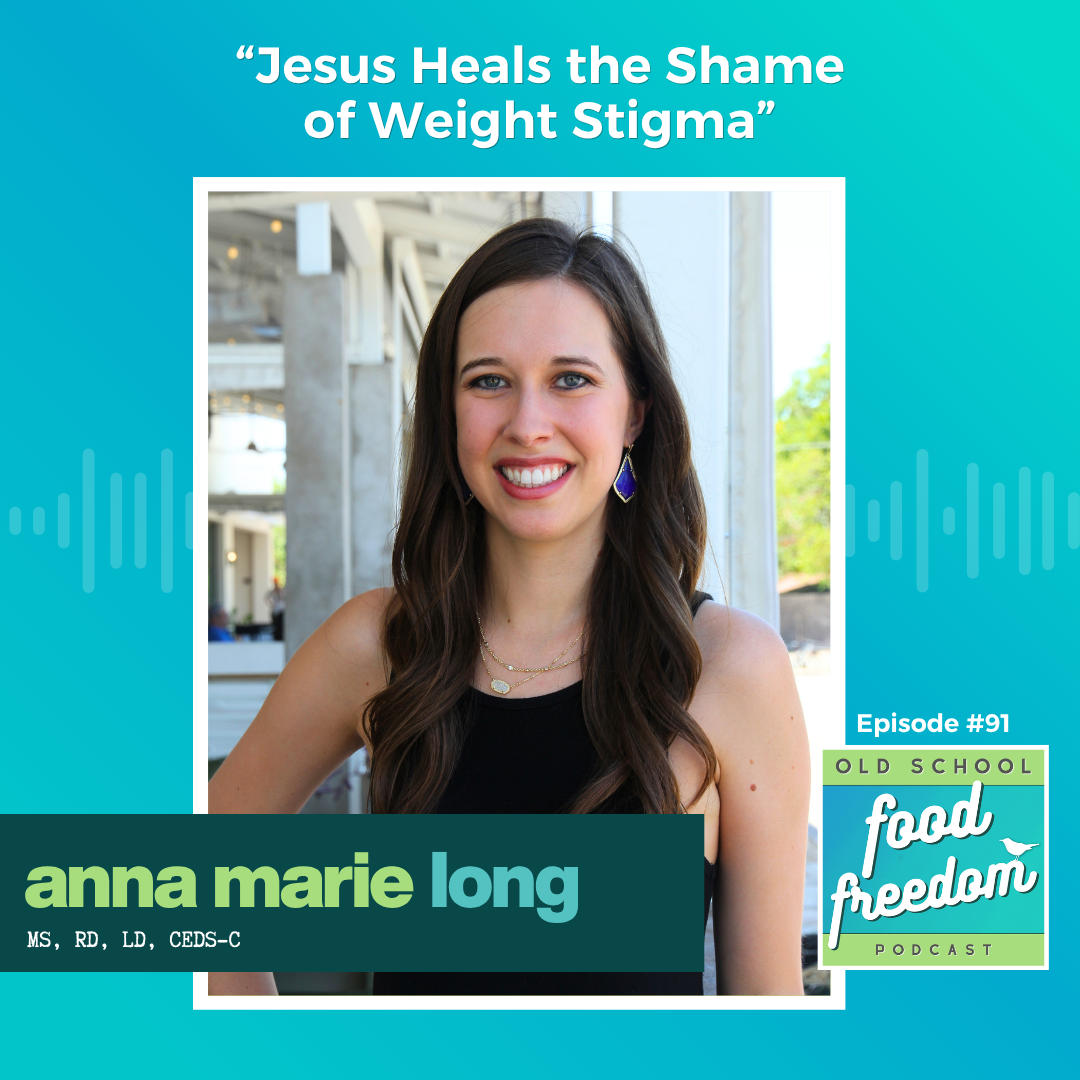
Jesus Heals the Shame of Weight Stigma with Anna Marie Long, MS, RD, LD, CEDS-C
"The Lord sees not as man sees. Man looks on the outward appearance, but the Lord looks on the heart."
Have you spent years listening to a voice that tells you your body is the problem? Maybe it started with a comment from someone in your own family. Maybe it was a stranger at the checkout line, or a doctor's office you stopped going to, or a verse about your body being a temple that got twisted into a reason to diet harder. Wherever it started, if you have carried weight stigma, you already know it goes deeper than the world's version of body shame. It hits your relationship with Jesus.
That is exactly where today's conversation lives. Anna Marie Long joins Chrissy to talk through it, bringing both her clinical training and the lived experience of learning that her relationship with food and her relationship with Jesus were never meant to be separate.
This episode picks up right where our conversation with Leslie Schilling left off. If you haven't listened to that one yet, it will be helpful to start there. It names the problem. This one walks through healing from weight stigma, verse by verse and practice by practice.
Here's what we cover:
What weight stigma really does to a person, and why it shapes everyone regardless of body size
The difference between the guilt we should feel over sin and the guilt diet culture manufactures around food and exercise
What "your body is a temple" means in its biblical context, and why that verse has nothing to do with the gym
Why a comment from someone inside your own faith community can wound deeper than the same comment from a stranger
The difference between guilt and shame, and why shame convinces us that we are the problem
What it looks like to grieve the years spent at war with your own body, and how lament makes space for that grief instead of rushing past it
Why "come as you are" means exactly that, and what changes when you stop waiting to “get it together” before you let Jesus in
The shift from chasing a certain body size to pursuing sanctification, and why that is the actual goal
A simple thirty-second practice Anna Marie recommends today for loosening the grip of internalized weight stigma
Friend, if you have ever stood in front of a mirror and heard that voice tell you your body disqualifies you, this conversation meets you right there. Anna Marie is honest that healing from weight stigma is not a one-time prayer that fixes everything. It is continual, and sometimes ugly, but it is available every single time you bring it back to Jesus.
"The Lord doesn't ask us to get it together first. He is just waiting for us to turn to Him." - Anna Marie Long
Your body was never what disqualified you. Come as you are, and let this conversation meet you there. If this episode spoke to you, send it to a friend who has been carrying this alone.
We’d love to hear your thoughts, so please drop us an email at admin@findingbalance.com, send us a voice message via SpeakPipe, or you can also subscribe for more practical episodes coming your way.
More About Anna Marie Long
Anna Marie is a registered dietitian and certified eating disorder specialist with a passion for helping others improve their relationships with food. She believes that letting Jesus into your healing journey is so important, so she co-wrote a book on what the Bible says about food and body image called Nourished by Faith. She has both bachelor's and master's degrees in nutrition from the University of Texas. She owns a private practice in Austin, Texas, where she works one-on-one with individuals and consults with professionals looking to grow their knowledge and skills in treating and preventing eating disorders, as well as incorporating faith into this journey.
Hello Freedom Community
Our Hello Freedom community has launched! This is a Christ-centered space to find connection, encouragement, and gentle steps toward freedom from food and body-image struggles. No pretending, no fixing yourself first, come just as you are. If you want in, your next step is to join us at findingbalance.com/community.
You were not meant to walk this alone. We're saving a seat for you!
Mentioned Scripture
1 Corinthians 6:19-20, Ephesians 4:22-24, 1 Thessalonians 5:17, Lamentations 3, 1 Samuel 16:7
Mentioned Resources
Book: Dark Clouds, Deep Mercy: Discovering the Grace of Lament by Mark Vroegop
Book: Gentle and Lowly by Dane Ortlund
Connect with Anna Marie Long
Book: Nourished by Faith by Anna Marie Long & Stephanie Brown
Facebook
Instagram
SpeakPipe – Send us a voice message!
CHRIST-CENTERED RESOURCES TO HELP YOU FIND FREEDOM
The Daily Vitamin eDevo: A free devotional with bite-sized truth emailed 5 days a week
Community Groups: Find connection with prayer groups and our Hello, Freedom! community.
Christian Treatment Finder: Connecting you with Christian providers experienced in treating eating issues.
Lasting Freedom Online Course: A Christ-centered, non-diet course to work through false beliefs about food and weight so you can live free from disordered eating and body image issues.
CREDITS
Interlude music by “Hotham” – Morning Thoughts
Intro music by “MokkaMusic” – Old Jeans (Funk)
Wrap-up music by Jesse Quinn – Christian Instrumental
Production & Editing by Leah Bryant Co
The content in this podcast is for informational purposes only and is not intended to diagnose, treat, or prescribe a particular course of action. If you have, or suspect you may have, an eating disorder, please consult your healthcare provider. If you desire to receive faith-based care, visit ChristianTreatmentFinder.com to browse professionals with a Kingdom campaign against eating disorders.
More about the Old School Food Freedom Podcast
In today’s diet-culture society, food issues and body hatred have become the norm. But you were created to be FREE. Welcome to Old School Food Freedom, where we go back to the basics, God’s basics, for how we view food, our bodies, and our worth.
Hosted by FINDINGbalance Executive Director Chrissy Kirkman, this podcast features Biblically sound experts, thought leaders, artists, and everyday people who will inspire you to interrupt negative cultural soundtracks and rediscover God’s original design for your relationship with food and your body.
This show will deliver practical, faith-filled insights on how to break free from diet culture and body shame through the lens of Scripture. If you’re looking for guidance on how to heal your relationship with food while deepening your faith, you're in the right place.
We’ll answer questions like
What does the Bible say about food freedom?
How can I overcome an eating disorder or disordered eating with Jesus?
What is the biblical perspective on diet culture?
How can I find peace with food as a Christian?
What does it mean to treat your body as a temple in relation to eating?
How can I break free from diet culture with Jesus?
How can I align my eating habits with biblical teachings?
What are the first steps to finding food freedom in Christ?
This podcast is for anyone ready to walk away from diet culture and into the freedom that Christ offers. Whether you’re recovering from an eating disorder, disordered eating, wrestling with body image, or simply craving a more peaceful relationship with food, this space was made for you.
If you want to experience true food freedom with Jesus, this podcast will give you the encouragement, truth, and tools to do just that.
The unedited transcript for this episode of Old School Food Freedom
Chrissy Kirkman [00:01:23 - 00:01:50]: It's available to you. Could Jesus heal you overnight? Absolutely. There's a lot of internal things and messaging from years and years of whispers, of lies that we've internalized. So it goes deep and it's not always the easiest route to take, but it is worth it, I promise. So it's not linear. There's ups and downs. It's not quick. It doesn't always look how we expect it to, but it is Real and available to you.
Chrissy Kirkman [00:01:50 - 00:01:58]: So that's why I wanted to have today's guest on the show, Anna Marie. Welcome to the Old School Food Freedom Podcast.
Anna Marie Long [00:01:59 - 00:02:01]: Thank you so much for having me. I'm excited to be here.
Chrissy Kirkman [00:02:01 - 00:02:34]: Yeah. I'm glad that you're here to talk about this with me. I feel like we're going to get pretty deep, like just based on our pre-production call, it was really good. Okay, friends, let me tell you about Anna Marie Long. She is a registered dietitian and certified eating disorder specialist. With a passion for helping others improve their relationship with food. She believes that letting Jesus into your healing journey is so important. So she co-wrote a book on what the Bible says about food and body image called Nourished by Faith.
Chrissy Kirkman [00:02:35 - 00:03:06]: She has both bachelor's and master's degrees in nutrition from the University of Texas. You might say hook 'em horns. I'm an LSU fan, so I won't say that, but I love you. She owns a private practice in Austin, Texas, where she works one-on-one with individuals and consults with professionals looking to grow their knowledge and skills in treating and preventing eating disorders, as well as incorporating faith into this journey. Anna-Marie, so glad to get to know you better.
Anna Marie Long [00:03:06 - 00:03:07]: Yes, I'm excited to be here.
Old School Nostalgia
Chrissy Kirkman [00:03:08 - 00:03:09]: Yeah. Now, do you say Hook 'Em Horns?Anna Marie Long [00:03:10 - 00:03:10]: Oh yeah.
Chrissy Kirkman [00:03:10 - 00:03:11]: Of course you do.
Anna Marie Long [00:03:11 - 00:03:12]: I always say Hook 'Em Horns.
Chrissy Kirkman [00:03:14 - 00:03:24]: So fun. And by the way, I love Austin. Texas as a city, it's so much fun. It's a great place. I can't wait to visit again in the off-season, like maybe February when it's not so smoldering.
Anna Marie Long [00:03:25 - 00:03:27]: Yes. Come in like February, March.
Chrissy Kirkman [00:03:27 - 00:03:27]: Yes.
Anna Marie Long [00:03:28 - 00:03:30]: Maybe early April. The weather's perfect.
Chrissy Kirkman [00:03:30 - 00:03:36]: Fantastic. And go to the Oasis and watch the sunset. Oh yes. And it sizzles as it hits the water.
Anna Marie Long [00:03:36 - 00:03:36]: Yes.
Chrissy Kirkman [00:03:36 - 00:03:37]: Is it Lake Travis?
Anna Marie Long [00:03:38 - 00:03:40]: I think so. It's either Lake Travis or Lake Austin. I get 'em mixed up.
Chrissy Kirkman [00:03:40 - 00:03:49]: Okay. Old school memories. But speaking of old school, What old school item or experience do you miss from back in the day? I can't wait to hear it.
Anna Marie Long [00:03:50 - 00:04:14]: Yes. So actually I had to ask ChatGPT this because I was thinking, what is the old school thing that I like? I'm hitting a roadblock. And based on my searches of ChatGPT, it came up with classic home-cooked meals because it says you've been asking about simple meals like lemon pepper tilapia with a starch and easy crock pot dinners rather than elaborate or trendy recipes. So My old school thing is classic home-cooked meals.
Chrissy Kirkman [00:04:15 - 00:04:31]: I think that is so fantastic. Classic home-cooked meals. And the fact that you do slow cooker is making life so much easier. I love slow cooker meals. Okay. It was very specific. What did you say? Lemon pepper tilapia with a starch?
Anna Marie Long [00:04:31 - 00:04:31]: Yes.
Chrissy Kirkman [00:04:32 - 00:04:35]: That's fantastic. Can you make that? And I'll just fly down to Austin.
Anna Marie Long [00:04:36 - 00:04:45]: Oh yes. Yes. Yes. Anytime. And I'll have dinner with you. Yeah. Our grocery store makes pre-seasoned lemon pepper tilapia. I'm like, okay, what starches will go well with this? So that was what I did.
Chrissy Kirkman [00:04:45 - 00:04:49]: That's so fun and very dietitian sort of thing to do.
Anna Marie Long [00:04:49 - 00:04:50]: Yes.
Anna Marie Long’s Journey
Chrissy Kirkman [00:04:50 - 00:05:01]: So great. Oh, well, you know, first I would love for you to tell us a little bit about your journey. Like, how did you end up doing this work? When did Jesus become central to how you practice?Anna Marie Long [00:05:02 - 00:05:54]: Yeah. So I actually became interested in nutrition kind of the same way that a lot of dietitians do. I kind of had my own disordered eating behaviors that I was on the Google rabbit holes and decided like, oh, I could major in this in school. But what that actually led to is me learning more about what our bodies actually need instead of like what all of this diet culture nonsense talks about, what's trendy at the time. I ended up studying nutrition in undergrad and grad school, and I really loved the application of science and how we can take these complex processes that we're learning about in chemistry and biochemistry. And apply that to our own lives. I just thought it was really cool. I actually followed Jesus before I became a dietitian, but like so many of my clients, I saw my work and my relationship with food and body, I kind of saw them as like 2 separate things that didn't really intersect.
Anna Marie Long [00:05:54 - 00:06:02]: And then at the beginning of the pandemic in 2020, I took a 9-month theology class through my church. I also met my husband in the class, but—
Chrissy Kirkman [00:06:03 - 00:06:04]: Hey, nice.
Anna Marie Long [00:06:05 - 00:06:25]: It was a very cool 9 months. Um, but the Lord showed me just through that class that like food and body is not separate from our relationship with him. And actually nothing is separate because he impacts everything. And so after that, I started talking more openly about my faith with my clients. And the Lord just showed me that he's the only one that brings true healing.
Weight Stigma and Its Effects
Chrissy Kirkman [00:06:25 - 00:07:13]: Oh, that's so good. I love that story. 'Cause I think so many, I would say a lot of clinicians probably relate to your experience. I've heard similarities to your story from others too, getting into it, thinking it was one thing and for the reasons that you shared, and then the Lord like opened their eyes to a better way. And I'm just so glad that you're doing this work and that you, you know, co-wrote this book that can really help people to view food and our bodies in a way that's like a biblical lens, a biblical context. So thank you for that. In our last episode, Leslie Schilling helped us understand like weight stigma, weight bias. Like I didn't even realize that there was a difference and how it shows up even in our churches.Chrissy Kirkman [00:07:14 - 00:07:21]: So can you start with helping us understand what weight stigma actually does to a person?
Anna Marie Long [00:07:22 - 00:07:45]: Yeah. So weight stigma impacts everyone. It impacts everyone regardless of body size, because whatever is said gets internalized. So there's going to be some point when we don't need someone to say the thing that we're already thinking, because like we're already saying it to ourselves. And so yeah, weight stigma impacts, I mean, it really impacts everyone and just being able to recognize it, I think is the first step.
Chrissy Kirkman [00:07:46 - 00:08:11]: Yeah. Immediately hits home with me. I don't know who's listening and what they're thinking, but yes, I'm already anticipating like, and just assuming even what I think someone else is thinking. And I'm being meaner to myself than A, they are being to me, and then I would ever be to anyone else. So I know what the inner voice sounds like for me, but what about like your clients that you work with? What message is on repeat for them?
Anna Marie Long [00:08:12 - 00:08:52]: Well, so this one I think is one that can be a little bit different depending on body size. So for people in smaller bodies, there's like the superiority and inferiority and like, oh, well, at least I am not like this person. Which kind of feeds into our pride, which, I mean, as we all know, is sinful. It's like when Jesus talks about the man going into the church and praying and saying, well, at least I'm not as bad as that guy right there. It's the same thing. We're, you know, we're living that same sin pattern over and over again. And then for people in larger bodies, it's that inferiority of, oh, well, this person is so much better than me. And there's these messages of, you're not good enough, you need to have more discipline and self-control.
Anna Marie Long [00:08:53 - 00:09:04]: But really, we need to be able to challenge those messages and ask ourselves, What does Jesus say? Uh, because at the end of the day, body size doesn't determine how much someone is created in the image of God.
Chrissy Kirkman [00:09:05 - 00:09:50]: So true. The whole, you're not good enough. If you would just fill in the blank, it would be better. And so it's kind of like that constant, I am constantly striving to be better, do better, look better, do less of this, do more of that. And trying to achieve a goal that it may be that my body is unable to ever achieve that goal. But we go so fast and go so hard and like, we don't even pause to really ask Jesus, is that even what you're calling me to? Is that what you're asking? Is this what I'm supposed to be doing and caring about? I don't know what the answer would be for each person. It's different for each person. But yeah, to even pause and challenge the message.
Chrissy Kirkman [00:09:50 - 00:09:52]: Sometimes it's a lie. Challenge the lie.
Anna Marie Long [00:09:53 - 00:09:53]: Yeah.
Stewardship, Body as Temple, and Diet Culture
Chrissy Kirkman [00:09:54 - 00:10:14]: And ask Jesus, what are you saying? We talked about this in the last episode, but the toxic messaging of stewarding your body and your body is the temple as how it has been a wellness and diet culture distortion from the enemy. I mean, I'd love to hear your perspective on that as well.Anna Marie Long [00:10:14 - 00:11:01]: Yes. And I'm sure Leslie talked about this because I know she talks about it in her book, but yeah, it's like there's all these messages of stewarding your body and I think that that's another example of how diet culture has kind of gotten its claws into the church because stewarding your body well looks like feeding your body and listening to your body. And if we're, you know, different people in recovery, hunger signals might not be reliable. So listening to your God-given hunger signals, if they're there, if they're not, it's listening to your meal plan and listening to your treatment team. And this idea of your body is a temple. Yes, that is in the Bible. And if you go read the entire chapter that that's in, like read it in the context, it never says work out more and exercise.
Chrissy Kirkman [00:11:01 - 00:11:01]: Yeah.
Anna Marie Long [00:11:02 - 00:11:22]: It's actually talking about sexual immorality, which has nothing to do with diet and exercise. So I always encourage people when they say, well, my body is a temple, doesn't that mean that I should diet? Doesn't that mean that I should spend X amount of minutes at the gym. Go read that entire passage and then tell me what you think it means that your body is a temple.
Chrissy Kirkman [00:11:23 - 00:11:56]: Yeah. And it's hard, you know, when we are living in a culture that values thinness and will do anything, like tells you to do anything it takes to be thin and to achieve that goal. And then you take that and then you sit down and start reading scripture. Those are the lenses that you're wearing. That's distorted and no shame, but once we know better, we can do better. And, you know, we don't know what we don't know, but once we know it, we can do something different. And is that what God's really asking of us? Yeah.
Anna Marie Long [00:11:56 - 00:12:25]: Yes. Well, and I think so often, like, we're tempted to read the Bible and read scripture through the lens of diet culture because that's the culture that we live in. And so If, you know, if we're putting on our diet culture lens and we're reading the Bible, then we're going to pull out everything that diet culture would say is true, when in reality, that's not what the Bible's saying. And the reality is that we should flip that and we should put on our scripture lenses and observe the world through those lenses.
Chrissy Kirkman [00:12:25 - 00:12:45]: Yeah, we call it our Jesus lenses. Finding balance, we're like, put on our Jesus glasses or through the Christ-centered lens. Yeah, in our culture, just treats body size as a moral issue. And there's this societal ripple effect that happens. So what does that cost us collectively as a whole?
The Cost of Weight Stigma in Society and Church
Anna Marie Long [00:12:46 - 00:12:51]: The big picture is it impacts who gets good healthcare or who even gets healthcare at all.Chrissy Kirkman [00:12:51 - 00:12:51]: Yeah.
Anna Marie Long [00:12:51 - 00:13:17]: Because not everyone feels welcome to the doctor's office. Like, say you trip on a crack in the sidewalk and break your arm. If you're going to go in and get the weight loss lecture, then It's like, well, I can just take ibuprofen, I'll be okay. And then you wait a couple days to go in until the pain is so bad that you end up having to have surgery. So it impacts who gets good healthcare, who feels like they deserve healthcare, or who feels like the doctor's office is even a safe spot. Yeah.
Chrissy Kirkman [00:13:17 - 00:14:15]: And we talked about, but at church too, like if you've heard any kind of comments from the stage or the pulpit, um, from any type of leader or just church members It can make you afraid to show up if you feel like you're really not accepted just exactly as you are. Like, that goes beyond body size. Like, I know we're talking about weight stigma, but it goes beyond body size. Like, if you want Jesus in your life and you want to be free from addiction or whatever struggles, or maybe you're going through a difficulty in your marriage, I've been there where I felt like Man, I don't want people to know that this is what's going on. And if I show up and they find out, it's a lie, but I was thinking, boy, that makes me a bad Christian, or I'm really letting down the youth and the children that are supposed to be looking up to me. It was always this kind of, well, you're letting people down. You're letting Jesus down. You're letting your parents down.
Chrissy Kirkman [00:14:16 - 00:14:20]: The church is going to be so upset. Like, just, yeah, you're right. And is that true?
Anna Marie Long [00:14:20 - 00:14:21]: No.
Chrissy Kirkman [00:14:21 - 00:14:32]: No. Like, so, but it made me not want to show up. And so just even thinking of something like that, the enemy can really get us believing things that are not true.
Anna Marie Long [00:14:33 - 00:14:53]: Well, and the enemy will do whatever he can to take our eyes off of Jesus. And so whether that's like putting our focus on our bodies or on a diet or just diet culture, The longer that we're focused on diet culture, the less that we're spending time with the Lord. And like, if we're avoiding church, then the enemy is happy.
Normalized Messages vs. What’s Actually Normal
Chrissy Kirkman [00:14:54 - 00:15:03]: Oh yeah. And you said something previously about normalized doesn't mean normal or okay. Let's talk about that because that's really profound.Anna Marie Long [00:15:04 - 00:15:31]: So I think a lot of these messages, like, you know, oh, your body is a temple, so that means you need to go to the gym, and that means that you need to follow this certain diet. These things are very normalized in church culture, but that doesn't mean that that's normal or okay. Like taking verses out of context to fit the diet culture narrative, just because it's normalized doesn't mean that that's normal. Feeling like I shouldn't go to the doctor because they're going to tell me to lose weight. Like that is very normalized, but that doesn't mean that that's normal.
Shame, Guilt, and the Spiritual Impact
Chrissy Kirkman [00:15:32 - 00:15:46]: Yeah. So chronic shame around body size, how does that affect someone's sense of self and their relationship and their ability to show up in the world, because I feel like this is the core. Like we really need healing from that.Anna Marie Long [00:15:47 - 00:16:12]: Yes. There's just such a big difference between if that wound or that chronic shame is from a stranger versus someone in your own family or own faith community. So for example, if your accountability partner is telling you like, hey, you should really steward your body better, that's going to produce a lot more shame than the stranger at the grocery store that makes a comment on your card at the checkout line. Both are harmful.
Chrissy Kirkman [00:16:12 - 00:16:30]: Yeah. 'Cause the point is you don't know me. So how can you say that? And I can more flippantly dismiss that 'cause you don't even know me or whatever, but someone who knows me and I've— that's walked with me, somehow that really seems to soak in. It doesn't bounce off as much. Yeah.
Anna Marie Long [00:16:31 - 00:16:43]: Yeah. So when those people that know us are making those comments, whether it's their own internalized weight stigma or it's something that they're projecting, it impacts a person spiritually, not just emotionally. Because it really hits on that guilt.
Chrissy Kirkman [00:16:43 - 00:16:44]: Mm-hmm.
Anna Marie Long [00:16:44 - 00:17:13]: There's a big difference between guilt over something that's objectively sinful versus guilt over not working out or not eating in a certain way. You know, if we're in Christ, we have the Holy Spirit, and we should feel guilt over things that are sinful. So say, you know, you go into the store and you forgot your wallet, and you just really need to buy some mascara. So you just put it in your purse and walk out. You would probably feel guilty about that, as you should. Like, stealing is objectively sinful.
Chrissy Kirkman [00:17:14 - 00:17:14]: Right.
Anna Marie Long [00:17:14 - 00:17:25]: Whereas that same guilt that we feel for not working out or not eating in a certain way, like, that's not actually sinful. That's from the enemy, and that's a tactic to get us farther and farther from the Lord.
Chrissy Kirkman [00:17:26 - 00:17:39]: Ooh, yeah. And the shame piece of that, so there's the guilt and the shame, that shame piece is super significant. Because the fact is it was never yours to carry. What is shame telling us here?
Anna Marie Long [00:17:39 - 00:17:45]: Yeah, so the shame tells us that the problem is who we are and that we are the problem.
Chrissy Kirkman [00:17:46 - 00:17:46]: Yeah.
Anna Marie Long [00:17:46 - 00:18:05]: When we take that on and when we take on that shame of like, oh, well, I didn't work out enough, I'm bad for doing that, that's really shutting the door on the Lord and shutting the door on letting him in on that because again, But it's telling us that we're the problem, not the unnecessary guilt and shame is the problem.
Chrissy Kirkman [00:18:06 - 00:18:46]: Yeah. Oh, it's really good. I mean, it's hitting home and no matter what body size you're in, I feel like we've been there because it's the enemy, how he operates. Like the more we talk about it, it's like, brother, like you are not, you just keep doing the same things. And the more I become aware of it, the more Frustrated I get with him that that is the way he operates. But then it's like, okay, I'm getting more aware. So in my personal life, things are becoming more obvious to me quicker than they used to. It's like that constant, you know, you keep showing up, take one more step and one more step, and then you're starting to jog and then you're running.
Chrissy Kirkman [00:18:46 - 00:18:59]: I'm not running yet, but it's helping. So like when you think of your practice, what does it look like when someone first walks into your office? What are they carrying in? whatever body size when it comes to weight stigma?
The Process of Healing from Diet Culture and Shame
Anna Marie Long [00:19:00 - 00:19:29]: Yeah. So a lot of the times when people come in, like they're bringing in this idea of like, okay, I'm doing something wrong and I want to make a change. Not everyone's ready to make that change, but they're bringing in this, okay, I need to make a change. And so I like to help them make that shift of like, okay, maybe there are behavior changes that need to happen. But we need to let go of that guilt and we need to die to diet culture and—Chrissy Kirkman [00:19:29 - 00:19:30]: Yeah.
Anna Marie Long [00:19:30 - 00:20:09]: Look at what that looks like in practice. So Ephesians 4:22-24 talks about putting off the old self and putting on the new. And so when we're talking about, like we said earlier, taking off the diet culture glasses and putting on those Jesus glasses so that we can really see like, okay, is what I'm doing glorifying God? And so it's important to look at how we can shift that goal For a lot of people, the goal is this perfect, you know, putting it in air quotes, but I know on a podcast you can't see this perfect thin body. Yeah. Uh, we're shifting the goal from a perfect thin body to sanctification and becoming more like Jesus. Because again, Jesus cares so much more about our hearts.
Chrissy Kirkman [00:20:11 - 00:20:16]: Jesus cares so much more about our hearts than how our body looks.
Anna Marie Long [00:20:16 - 00:20:16]: That's right.
Chrissy Kirkman [00:20:17 - 00:20:37]: Yeah. So how does the healing process work for someone who's been carrying this for decades? Someone like me that has heard these messages and felt the shame since childhood on and off that just increased in the teen years and then early 20s, and then it just kept piling on. How does that healing process work?
Anna Marie Long [00:20:38 - 00:21:18]: So it works through a lot of prayer. Well, the first thing that needs to happen before the real healing can begin is just surrendering to Jesus and just continually showing up. And inviting Jesus into it. I think so many people have this misconception that like, okay, I prayed, I let Jesus into it, but it's still there. We're asked to pray without ceasing. And just because like you're praying and you're letting Jesus in, but if someone's been carrying that for decades, it's not just gonna go away overnight. And so it's continually letting Jesus in and continually praying about it because it's gonna show up in different ways every day. And In the moment, like pausing and saying that prayer of like, hey Jesus, like I want to surrender this to you.
Chrissy Kirkman [00:21:19 - 00:22:09]: And I think there's a grieving piece that happens. I know that I had to spend time. It wasn't pretty. It was super ugly, cries, snot coming out of my nose and just like red face and headache afterwards. 'Cause I was praying and crying so intensely of grieving the years spent at war with my own body. And grieving that my plans and my envisionment of what it should look like and where I should be going, my goals, that it just wasn't happening. And that some of those were very unrealistic. Here we go, air quotes, feel let down by myself, feeling like I had set these goals to achieve and I let myself down when it really wasn't me letting myself down.
Chrissy Kirkman [00:22:09 - 00:22:21]: It was that the goals weren't the right goals. I didn't bring Jesus into those. I didn't ask him if this is what he's wanting me to focus on. So how do we grieve those years spent at war with our own bodies?
Anna Marie Long [00:22:22 - 00:22:57]: So really the biggest way to grieve it is through, again, bringing it to Jesus through lament. There are so many Psalms in the book of Lamentations that talk about lamenting. Uh, I know in Lamentations 3, it uses the imagery of, you make my teeth grind on gravel. Um, which even just thinking through that, right? It's like even just thinking through that, it's like really just letting the Lord in and like letting him be there with the ugly tears. 'Cause I think so often we wanna like clean ourselves up before we go to Jesus, but he never asks us to do that. It's like we, we only wanna show up in our Sunday best, but Jesus says, come as you are.
Chrissy Kirkman [00:22:58 - 00:23:42]: Wait, pause. Jesus says, come as you are. He doesn't say, come when you are X pounds, when you are this dress size, when you are this height and your skin color is this tone and your hair is this length and your hair is this color and your skin is smooth versus wrinkly and X, Y, and Z, your shoe size, whatever it is. No. I just feel like, I know that just sounds so obvious. But in our day-to-day lives, are we really pausing to think? Jesus says, come as you are. As you are. Not, Jesus says, come when you get it all together.
Anna Marie Long [00:23:43 - 00:23:43]: Yeah.
Chrissy Kirkman [00:23:43 - 00:24:20]: Jesus says, come when you've lost 30 pounds or 100 pounds, or when you've gained 5 pounds, when you no longer think shameful thoughts, when you have gone through 5 years of counseling. And eating disorder recovery, then come to me. He doesn't say that. I'm just, I'm shouting this to myself, not in a shameful way of like, Chrissy, remember, Jesus says, come as you are, as you are right now. He's not saying get it together first. Ah, like, I don't know. I just need to holler. Not at myself.
Chrissy Kirkman [00:24:20 - 00:24:32]: And again, not in a bad way. Just like, understand, really pay attention to that. Write it down. Repeat it daily for weeks until you get it. Come as you are.
Anna Marie Long [00:24:33 - 00:24:58]: Yeah, I think that's so important, like bringing the messy, because like, again, he never says, let's get it together first. No, come as you are. There's a really good book. It's called Dark Clouds, Deep Mercy by Mark Bogrop, and it basically is a step-by-step process of lamenting, and it takes you through a couple of lament psalms and lamentations, and it shows you how David lamented, and like how to apply that to your lament prayers. I highly recommend that book.
Chrissy Kirkman [00:24:59 - 00:25:01]: We'll link it in the show notes for sure. Yes.
Anna Marie Long [00:25:02 - 00:25:10]: I think it's a really good practical way of, okay, how do you come as you are? And here's a step-by-step guide of how to lament.
Chrissy Kirkman [00:25:11 - 00:25:28]: Yes. And scripture, it talks to that. It talks to the person who has been made to feel that their body is a problem to be solved, that that weight stigma has gone deep. What does scripture say to that person? I mean, I know it says a lot, but is there something we could cling on to right now?
What Scripture Says About Body and Worth
Anna Marie Long [00:25:29 - 00:25:45]: Yes, and scripture is so clear too. Uh, I think 1 Samuel 16:7 is a really good place to go, but it says that the Lord sees not as man sees. Man looks on the outward appearance, but the Lord looks on the heart. And so again, it couldn't be clearer That the Lord is after our hearts.Chrissy Kirkman [00:25:46 - 00:26:21]: Absolutely, He is. And Jesus encountered people who were marginalized, who were shamed, who were cast out, crippled, the woman with the issue of blood, people who others would avoid. And every single time, He moved toward them. Other people were walking clear around, taking different routes to not have to deal. with them, not have to interact with them, but Jesus moved toward them every single time. He didn't move away. So what does that mean for someone carrying weight stigma?
Anna Marie Long [00:26:23 - 00:26:41]: Again, it's pretty clear, like, Jesus wants to move toward someone carrying weight stigma. He was making people mad because, you know, he was eating with tax collectors and sinners, and those were the people that he drew near to. Um, so for someone that's carrying that weight stigma, Jesus wants to draw near to you. We just have to let Him in.
Letting Jesus In—Breaking Down Walls of Shame
Chrissy Kirkman [00:26:41 - 00:27:26]: Ooh, there's a key. We have to let Him in. We have to not allow shame to keep us on the other side of a wall that we have built to protect ourselves. Because I think one brick at a time, we can build this wall between us and the Lord. It's a wall of shame. And it's shame, accepting blame, you know, that we are wrong, we are bad, our bodies are just a wreck, and it's too much for the Lord when He could just blow His breath on the wall and it would come down. But He's not gonna do it and force us into something. Like, He is just waiting for us to turn to Him.Chrissy Kirkman [00:27:26 - 00:28:12]: And I think that's real sweet and gentle. And I know I may have recommended this book before, but there's a book called Gentle and Lowly by Dane Ortlund. We will link it in the show notes, but, but it's all about Christ's heart for us, his absolute love for us that, again, he doesn't ask us to get it together. The sin in our lives, the brokenness in our lives is what draws him to us all the more because he cares about it. He wants to To free us and heal us from that. And that book, I'm still going through it and it's just really opening my eyes. And I feel like I've known Jesus for 48 years. And in all those years, I've never experienced what I'm experiencing right now.
Chrissy Kirkman [00:28:12 - 00:28:37]: And it's pointing it all back to scripture in the Bible of like Jesus's heart for us. So I highly recommend that book. So what does it look like to bring this wound to Jesus? Not just in a general sense, but like our day-to-day moments when shame starts to creep back in and it slowly, like sinister way, kind of whispers in there. What does that look like?
Practical Steps—Continually Letting Jesus In
Anna Marie Long [00:28:38 - 00:28:41]: Yeah. So I feel like I'm going to sound like a broken record by the end of this.Chrissy Kirkman [00:28:41 - 00:28:47]: But hey, if it's on repeat with this show, we're probably going to need to really hear it. So repeat it.
Anna Marie Long [00:28:48 - 00:29:05]: Yeah. So it looks like continually praying. So 1 Thessalonians 5:17 says, pray without ceasing. And when you think that God's heard enough and you feel like, oh, he doesn't wanna hear this again, pray again. Pray some more because nowhere does the Bible say like, well, once you've prayed X amount of times, God has had enough of you.
Chrissy Kirkman [00:29:05 - 00:29:05]: Right.
Anna Marie Long [00:29:05 - 00:29:26]: It's just not true. And I also love the book Gentle and Lowly. I think it does a really good job of describing the heart of Jesus. But as we get to know him and as we can begin to even scratch the surface of understanding his heart for us, I think it makes us want to pray more and it makes us want to let him in because like his heart is so compassionate towards us.
Chrissy Kirkman [00:29:26 - 00:29:45]: It so is. So if someone has made progress and then they get knocked back down by a comment or a specific moment, or they, they made a choice they didn't want to make again, because who hasn't done that, right? Like the thing I, what I do, I don't want to do kind of situation, right? What can they do in that moment? Is there something you would recommend to that person?
Anna Marie Long [00:29:46 - 00:30:10]: Oh yeah, so there's 2 things. First, have compassion for yourself in the same way that Jesus has compassion for you. I mostly like the concept of self-compassion, but I like it not in the secular sense, but I like it in the way of like, hey, Jesus has compassion for you. Let's try to be more like Jesus and have compassion for ourselves. So one, have compassion for yourself, but 2, bring it to him. So kind of going back to that lament.
Chrissy Kirkman [00:30:10 - 00:30:10]: Yeah.
Anna Marie Long [00:30:10 - 00:30:25]: So lament, acknowledge it, but also ask for help. And so bringing it to him and saying like, hey, this is hard. I feel like I've been knocked back down by a comment or something happened, acknowledge it, but then ask him for help through it. Again, just letting him in.
Holding On to Freedom in a Diet Culture World
Chrissy Kirkman [00:30:26 - 00:31:04]: So good. And friends, like, here's the thing, we're in diet culture. While I would love to think that we'll eventually just end diet culture for good, and that's something I would love to happen. And we live in a fallen, broken world. And so it is very likely, as we see in the world, some things just increasingly get worse. So it doesn't seem to be going away. The same harmful messages keep being reinforced. So, Anna-Marie, how do we hold on to freedom when that culture isn't changing, when it's getting worse almost?Anna Marie Long [00:31:05 - 00:31:08]: Yeah. So the first thing is to just acknowledge the cross.
Chrissy Kirkman [00:31:08 - 00:31:08]: Yeah.
Anna Marie Long [00:31:09 - 00:31:48]: And just acknowledge that when it feels like culture is getting worse, and in a lot of ways it is, we acknowledge the cross and we acknowledge that Jesus's death paid for this. When you hear the food and body comments, when you hear people talking about all of the crazy things that they're doing to change their bodies, acknowledge that those things have no eternal value. Because again, Jesus's death and resurrection Paid for all of it. And so when we start to believe the lies that diet culture and that weight stigma says about us, we're essentially not believing that Jesus's death was enough. And so it's accepting the gospel for ourselves over and over again. Yeah.
The Lie of Disqualification—God’s Calling
Chrissy Kirkman [00:31:49 - 00:33:07]: And some of the weight stigma you might be struggling with, I'll just say that I have struggled with, is that my size disqualifies me from fully being used by God. For his calling on my life, for the purpose he has for me to help fulfill or further his kingdom or fulfill, you know, be his hands and feet, that can he use me in this vessel looking the way it does? And for so long, I felt like I can't even ask God to help me do this. Like I felt the calling, but I really can't be used until I get this together. That's not what he's asking. And if anything, it's just the opposite. It's like, okay, really start like going deeper with him to realize my self-worth, of my worth through Christ, to stop trying to achieve and perform and be funny or whatever, you know, the life of the party and entertaining so people will like you and forget about your body size, right? Like, Can I just be? Can I just be present? And can that be enough? And can Jesus be enough? And was his sacrifice, his death on the cross, was it enough for me?Anna Marie Long [00:33:08 - 00:33:08]: Yes.
Chrissy Kirkman [00:33:10 - 00:33:47]: I think what I get frustrated, really just fury, rage that I feel inside is that how we have allowed, and I'm not mad at us as individuals, but just that it's so easy for us to allow the enemy to keep us from walking in the purpose that God has because we have accepted blame that was not meant for us, blame that our body size is wrong and it's all our fault. And so we're not going to go with God or where he's asking us to go because we feel disqualified. What would you say to that?
Anna Marie Long [00:33:47 - 00:34:01]: Well, to you specifically, I would say you're in season 9 of this podcast. Like, look at how much the Lord has used you. And kind of in a more general sense, like, I was gonna add this at the end, but the Lord is more concerned with whose we are.
Chrissy Kirkman [00:34:01 - 00:34:02]: Oh yeah.
Anna Marie Long [00:34:02 - 00:34:27]: Right? And like, when we're talking about, oh, I'm not qualified, it's like, well, really no one is qualified. If anyone was qualified, it was Jesus. And if we were perfectly qualified, we wouldn't need him. And so depending more on Jesus and really believing the gospel and accepting that for yourself, like, I think that that's the biggest step that anyone can take is, um, just saying like, hey, I'm not enough and that's okay. And that's why I need Jesus.
Chrissy Kirkman [00:34:28 - 00:34:54]: Yeah. And it is not all on me. If he calls me to it, he will make a way. He will provide what I am incapable of. He will come in and fill in those gaps. He's looking for me. He's looking for you, friend, to be that willing vessel who is surrendered, whose fists are unclenched. I know, again, you wanna talk about broken record.
Chrissy Kirkman [00:34:54 - 00:35:17]: All I do is talk about unclenching my fist because still I have to unclench my fist, open my palms to receive and, and even put them up. I surrender mode. And then I'm gonna turn my hands to like, I receive this, and then extend them forward, open wide, like, I wanna give back. And then maybe hold my hand out, like, lead me, Lord, put your hand in mine and guide me.
Anna Marie Long [00:35:17 - 00:35:17]: Mm-hmm.
Chrissy Kirkman [00:35:18 - 00:35:40]: And none of that has anything to do with weight. Can you believe that? Like, I, I feel like I've gotten there and I still hear messages. So friends, you're not alone when you hear these messages. And, and so as we wrap up, Anna-Marie, what is one thing a listener could do this week to begin loosening the grip of that internalized weight stigma that's holding them back.
Action Step—Let God In Right Now
Anna Marie Long [00:35:41 - 00:36:08]: Yes. And I wanted to say one more thing to that last question too, um, of just loosening that grip. Like, the Lord doesn't ask for us to get it together. The Lord doesn't ask us for any of that. All he asks for is obedience. And if he's calling you to do something, then we respond by being obedient and knowing that we're not enough, but he is. And so one thing that a listener can do this week just to loosen that grip, to begin to let go of that internalized weight stigma, Even just right now. So like hit pause on this podcast.Anna Marie Long [00:36:08 - 00:36:13]: I know it's really tempting to just keep listening, especially if you're like me listening on 1.7 speed.
Chrissy Kirkman [00:36:13 - 00:36:13]: Yeah.
Anna Marie Long [00:36:13 - 00:36:37]: Actually, actually hit pause right now and let the Lord in and pray. Even if it's just a 30-second prayer, like the Lord hears that because the enemy wants us to keep the struggle separate from God. The enemy wants us to continue thinking that our struggles with food and body image are separate from our relationship with the Lord. But Jesus hears every prayer, no matter how small and no matter how short. So hit pause, let the Lord in, say a 30-second prayer.
Chrissy Kirkman [00:36:38 - 00:37:21]: That's such a great start. That's such an easy next step. 30 seconds. Who doesn't have 30 seconds to do that? And what might He say? Like, you might just be surprised what He would say or the love that you would feel. Like, I prayed that before we pressed record, that every listener would feel So tangibly, the Holy Spirit's presence kind of wrapping arms around you in the most loving, hugging way of like, I see you. I adore you and love you exactly how you are right now. And I feel like that's a next step. That's a step toward healing in Christ.
Anna Marie Long [00:37:21 - 00:37:22]: Yeah.
Wrapping Up and Resources
Chrissy Kirkman [00:37:22 - 00:37:31]: Oh, I loved this. This is so good. Anna Marie, like, How did this go so fast? I feel like I could talk about this for another 15 minutes. Oh, for sure.Anna Marie Long [00:37:31 - 00:37:32]: Minimum, right? Yes.
Chrissy Kirkman [00:37:33 - 00:38:14]: Oh, thank you for being here. And friends, you can find links to connect with Anna-Marie in the show notes, so be sure to check 'em out. And just a reminder, we always add every Bible verse that is mentioned on every episode. We link those in the show notes so you can go back when you're available with your Bible and go and highlight those scriptures, maybe even write in the margin of like, You know, if God spoke something to you, write the date. Like, I think that's so, so good. It makes it kind of seals it for me. It makes it even more personal just to remember and just to look back of like, gosh, I remember when I wrote that in 2003 and like now look what's happened. Look what the Lord has done.
Chrissy Kirkman [00:38:14 - 00:38:18]: And anyway, I encourage you to do that. But Anna Marie, thank you again so much for being here.
Anna Marie Long [00:38:18 - 00:38:20]: Yes. Thank you for having me. This was great.
Chrissy Kirkman [00:38:20 - 00:38:30]: You're welcome. Oh, and one other thing. You can find a link to her book as well in the show notes, so click on that, grab that. It is called Nourished by Faith.
