How to Stop Chasing Better and Find Rest from Body Image Comparison with Heather Creekmore
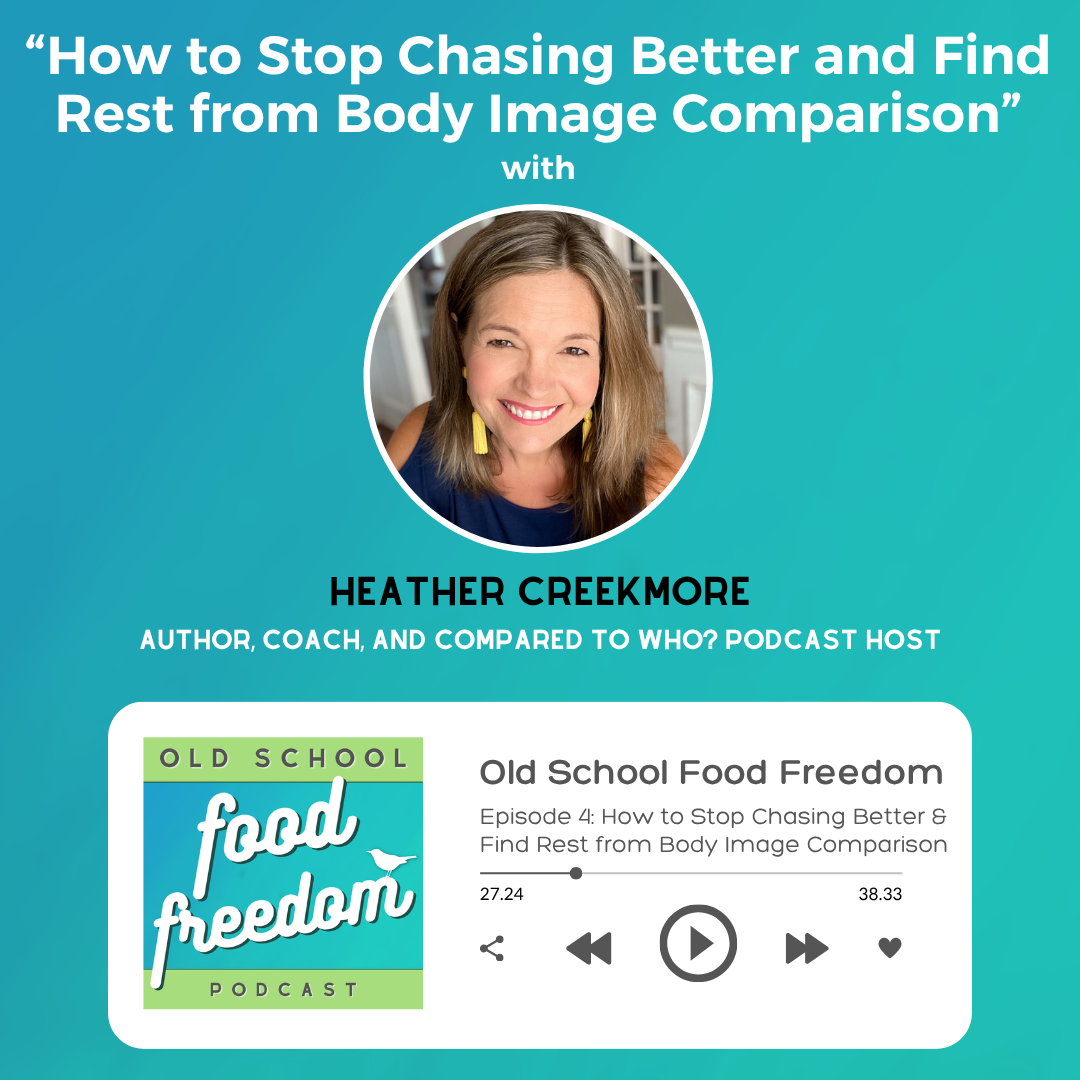
"The world has a different standard of beauty than God does. And chasing that other standard is always gonna not look as pretty as we hope it will."
If you have ever caught yourself thinking about who you used to be, what you used to weigh, or what the best version of you is supposed to look like, you already know the exhaustion Heather Creekmore is talking about. Chasing better feels noble, like the responsible thing to do. But for those of us who have struggled with Christian body image issues, food, and comparison, better is rarely a neutral word. It is a ladder with no top rung.
Today on the Old School Food Freedom podcast, Chrissy sits down with Heather Creekmore, speaker, author, and host of the Compared to Who? podcast, to talk about what chasing better is really costing us and why we can't seem to stop.
Here’s what we cover:
Why "better" is a comparative adjective and what that reveals about the trap we keep walking into
The difference between comparing yourself to others and comparing yourself to your ideal self, and why the second one is just as damaging
The Ideal Image exercise Heather uses with coaching clients to surface who we are actually trying to look like
How the ideals we chase can quietly become idols, and what it looks like when Jesus invites us to set those down
Why comparison functions like envy and covetousness in scripture, even when it feels like motivation
What "fat talk" is and why women often feel pressure to say something critical about their bodies just to fit in
What recovering from disordered eating and body shame looks like in the middle of a regular Wednesday, not just in a breakthrough moment
What it looks like to find rest in Christ when you have spent years trying to earn it
Friend, if you have been running on the comparison treadmill for so long that you can't remember what it feels like to just stop, this episode was made with you in mind. Heather is not here to add more to your list, but to invite you to put the list down.
"Freedom does not mean you're never tempted to think those old thoughts. It's what you do after those old thoughts come." - Heather Creekmore
Christian body image struggles rarely start with food. They start with a belief that there is a better version of you out there, one you owe it to yourself, or to God, to become. And they don't end by trying harder. They end when you recognize that the treadmill goes nowhere and that rest was always the invitation, not the reward waiting at the finish line.
There is no weigh-in at the gates of heaven. Share this one with someone who needs to hear that.
We’d love to hear your thoughts, so please drop us an email at admin@findingbalance.com, send us a voice message via SpeakPipe, or you can also subscribe for more practical episodes coming your way.
More About Heather Creekmore
Heather writes and speaks hope to thousands of women each week, inspiring them to stop comparing and start living. Her podcast, Compared to Who?, helps Christian women overcome body image and comparison issues. Her first book, also titled “Compared to Who?,” encourages women to uncover the spiritual root of body image issues and find freedom. Her latest release, The “Burden of Better”, offers women a journey into the depths of God's grace to find a way off the treadmill of constant comparison. Heather was a featured guest in our Lasting Freedom course and has appeared on dozens of shows and podcasts, but she is best known for her appearance on the Netflix show Nailed It. Heather and her fighter-pilot-turned-pastor husband, Eric, have four children and live in Austin.
Resources Mentioned
Books:
“The 40-Day Body Image Workbook”
Connect with Heather Creekmore:
Facebook
Youtube
Instagram
Pinterest
Twitter
Compared to Who? Podcast
Christian Treatment Finder Profile
FINDINGbalance:
Facebook
Instagram
SpeakPipe – send us a voice message
CHRIST-CENTERED RESOURCES TO HELP YOU FIND FREEDOM
The Daily Vitamin eDevo: A free devotional with bite-sized truth emailed 5 days a week
Community Groups: Find connection with prayer groups and our Hello, Freedom! community.
Christian Treatment Finder: Connecting you with Christian providers experienced in treating eating issues.
Lasting Freedom Online Course: A Christ-centered, non-diet course to work through false beliefs about food and weight so you can live free from disordered eating and body image issues.
CREDITS:
Intro music by “MokkaMusic” – Old Jeans (Funk)
Production & Editing by Marketing With Wisdom
_
The content in this podcast is for informational purposes only and is not intended to diagnose, treat, or prescribe a particular course of action. If you have, or suspect you may have, an eating disorder, please consult your healthcare provider. If you desire to receive faith-based care, visit ChristianTreatmentFinder.com to browse professionals with a Kingdom campaign against eating disorders.
More about the Old School Food Freedom Podcast
In today’s diet-culture society, food issues and body hatred have become the norm. But you were created to be FREE. Welcome to Old School Food Freedom, where we go back to the basics, God’s basics, for how we view food, our bodies, and our worth.
Hosted by FINDINGbalance Executive Director Chrissy Kirkman, this podcast features Biblically-sound experts, thought-leaders, artists, and everyday people who will inspire you to interrupt negative cultural soundtracks and rediscover God’s original design for your relationship with food and your body.
This show will deliver practical, faith-filled insights on how to break free from diet culture and body shame through the lens of scripture. If you’re looking for guidance on how to heal your relationship with food while deepening your faith, you're in the right place.
We’ll answer questions like
What does the Bible say about food freedom?
How can I overcome an eating disorder or disordered eating with Jesus?
What is the biblical perspective on diet culture?
How can I find peace with food as a Christian?
What does it mean to treat your body as a temple in relation to eating?
How can I break free from diet culture with Jesus?
How can I align my eating habits with biblical teachings?
What are the first steps to finding food freedom in Christ?
This podcast is for anyone ready to walk away from diet culture and into the freedom that Christ offers. Whether you’re recovering from an eating disorder, disordered eating, wrestling with body image, or simply craving a more peaceful relationship with food, this space was made for you.
If you want to experience true food freedom with Jesus, this podcast will give you the encouragement, truth, and tools to do just that.
The unedited transcript for this episode of Old School Food Freedom
chrissy [00:00:38]: The time is now to take a step toward the life you were created for. We're so glad you're here with us today. Let's get into today's episode. Hey, Heather. Welcome to the show.
Heather Creekmore [00:00:53]: Oh, Chrissy, I'm so glad to be with you.
chrissy [00:00:55]: I am so glad you're here. We're going to have so much fun today. I know God has so many things that he's going to reveal through our time together, so I thank you for just carving out a little time today. I want to introduce our listeners to you. Heather Creek Moore writes and speaks hope to thousands of women each week, inspiring them to stop comparing and start living. Heather's Compared to who podcast helps Christian women overcome body image and comparison issues. Her first book, also titled Compared to who, encourages women to uncover the spiritual root of body image issues and find freedom. Her latest release, the Burden of Better, offers women a journey into the depths of God's grace to find a way off the treadmill of constant comparison.
chrissy [00:01:44]: Heather was a featured guest in our Lasting Freedom course here at Finding Balance has appeared on dozens of shows and podcasts, but she's most recognized from her appearance on the Netflix show Nailed It. Heather and her fighter pilot turned pastor husband, Eric, have four children and live in Austin. All right, well, I will tell you, fighter pilot turned pastor husband is a total tongue twister. I have. I had to work through that so many times. So thank you for keeping me on my. On my toes. Um, so we like to kick this show off with just kind of reminiscing, thinking about the old school days.
chrissy [00:02:23]: What old school item do you miss from back in the day?
Heather Creekmore [00:02:27]: A home phone. Really?
chrissy [00:02:32]: Yes.
Heather Creekmore [00:02:33]: I mean, okay, so the. We would call them spam callers now, but you know, the telemarketers did get annoying. But we have four kids and we are not at the every kid gets a cell phone stage of life. So they're old enough to be left home alone when I run to the grocery store. But If I need to call back and say, hey, are we out of bread or something? There's no home phone. And so we. We've maneuvered a couple different things with Alexa and some other things. But, yeah, if we had a home phone, it would be so much simpler just to call and someone would answer it.
Heather Creekmore [00:03:09]: Hopefully.
chrissy [00:03:10]: You know, I hadn't. I didn't expect that. That's awesome that you say that. And I can understand in your scenario, in your situation, why that comes in really handy. It was funny, my husband said when he was calling to cancel his home phone and just. It was like, okay, we're making that transition to the. To just straight cell phones. This lady tried to talk him out of it, and she said, how are you going to be able to order a pizza? You don't have a home phone.
chrissy [00:03:38]: You can't order a pizza. He said, I guess that's a risk I'm willing to take. And here we are, like, doing it on apps now. Like, you don't even need to talk to anybod. Such a different time, right? Okay, Heather, So today our topic is chasing better. And I feel like we can all relate to that inside of us, that desire to chase better. Things aren't good enough. We always want something more.
chrissy [00:04:09]: Just take us into that. Let's just dive in today.
What Does It Mean to Chase Better?
Heather Creekmore [00:04:12]: Yeah. Yeah. Well, you know, even it's part of it, I think, is American dream. Right. You know, but I think even, you know, as I talk to women across cultures around the world, I find that it's. It's the same everywhere. There's this innate burden to just keep trying to be better. But the challenge, Chrissy, I mean, it sounds like a good thing, right? Like, self improvement.Heather Creekmore [00:04:38]: Like, shouldn't we always want to be better? Like, who wants to just stay a slob and just, you know.
chrissy [00:04:44]: Right.
Heather Creekmore [00:04:44]: Like, but. But, you know, those of us that struggle with eating disorders and body image and those kind of things, we tend to be black and white thinkers, right? We tend to be all or nothing. And so for us, it's like there's two dichotomies. There's better or there's, like, sitting still on the couch and there's nothing in between. And I think that's where we miss it, right? Because better. So I teach my children's homeschool co op English class, and one time I'm teaching, and it was right after I'd written my book the Burden of Better. And I was like, oh, the word better is on here. Oh, comparative adjective, like, huh? Comparative adjective, like, that is the classification of the word better.
Heather Creekmore [00:05:25]: And so as we think about comparison and you know, if we have body image, eating disorder issues, right. A lot of times there's some sort of comparison struggle woven in there. The word better cannot exist without comparison. Right. You don't know if you're better unless you are comparing to something. And for a lot of us, it might be comparing ourselves to, you know, people we see on television or, you know, on the Internet, on Instagram, like you're just in our church or whatever. And then sometimes there's another way we compare ourselves and that's just to our ideal selves, which is a different kind of comparison, but one that's equally, I think, damaging to those of us chasing better.
chrissy [00:06:14]: Wow. Yeah, that's really good. When we were talking about this the other day, I was, I don't know why it didn't occur to me but to think of, I mean, that it's total comparison. And it's bad enough when we're comparing ourselves to every, you know, maybe not everyone around us, but, but all these people around us or whatever is feeding us with our Instagram feed, social media and binge watching shows and things. But to think back to like, what is our ideal? What do we want to look like, how do we want to. What do we used to look like, or what do we dream to look like? That's damaging.
Heather Creekmore [00:06:55]: Yeah, that's.
chrissy [00:06:57]: That can be hurtful.
Heather Creekmore [00:06:58]: And, well, and Chrissy, if you think about it, I mean, even when we compare ourselves to other people, we are doing that based on what? Based on something. We decided internally that this kind of person is a good, you know, shape or size of person or an attractive person. And this type of person is not what we consider to be a good shape or size or attractive.
chrissy [00:07:23]: Right.
Heather Creekmore [00:07:23]: And so really, even external and internal comparisons, all of it is so entangled in these judgments we're making about other people that. Based on a belief system, right? A belief system of this is what. Someone who looks like this is valuable, someone who looks like this is worthy. And that's what I've decided. But it's really interesting. It's these ideals, right? And I don't know if you want to dig right into the ideal side of things. You want to go there?
chrissy [00:07:50]: Let's go, let's go.
The Ideal Self: Where Our Body Image Comparisons Really Come From
Heather Creekmore [00:07:51]: Okay. Yeah. So the ideals that we have, right. It seems so altruistic is the word that's coming to mind. Like, oh, I don't, you know, I don't compare myself to other people. I just want to be the ideal Me, I just want to be a better me. And, you know, like, we just talked about, like, there is comparison in there, but as you start to weed through, like, what is that ideal you. Where did that ideal you come from? Oh, Chrissy, that's when it gets really messy and I think really insightful for those of us who are just kind of stuck in that loop of believing that better is something we should chase.Heather Creekmore [00:08:41]: Because if you really start to dig in. Okay, the ideal me. So let's just all personalize it. The ideal Heather. And I know it's weird to talk about myself in the third person, but it just helps. It helps the illustration. I'll help you follow. Okay.
Heather Creekmore [00:08:56]: So the ideal Heather. Oh, she was going to be, like, a perfect mom. She was going to never let her children have, like, like Costco chicken nuggets because, you know, she was going to, like, be like, the pioneer woman and, like, make her own chicken nuggets. And you like, bread, the little things and fry them up and. And our kids were going to have, like, sliced peppers for lunch and cherry tomatoes and, you know, things like that. That's what her children were going to eat, right? Chrissy? I have four kids between the ages of 11 and 15. We homeschool, so they pretty much get their own lunch every day. It's been like that for years.
Heather Creekmore [00:09:33]: I have never made homemade chicken nuggets, not one time. And our air fryer is always running between the hours of like, 11:30 and one because someone is, like, cooking some processed, easy to fry thing for their lunch. Okay. And. And so I've got two ways of dealing with this scenario, right? Way one is the way I used to operate, which was every time someone made themselves some frozen egg rolls or some frozen chicken nuggets, I would feel this little, like, ping of, you're not a good mom. I can't believe you're letting your kids eat that stuff. You're a mom failure. Like, they really should be eating better.
Heather Creekmore [00:10:19]: Like, Heather, how are you? You're letting your children down by not, you know, being the mom you thought you were going to be. And then I feel, like, guilt and shame, condemnation around those things right over, like, chicken nuggets. Which sounds silly, but I think people listening can follow. Like, we feel guilt and shame around things that other people would be like, why are you feeling guilt and shame around that? But we do. We find a way to condemn ourselves. And then there's another way to think about it, which is this is something that I really think, like, God. God kind of showed Me one day as I was kind of just going through the, like, all the ways I failed today. And maybe I'm the only one, but I tend to sit around and think about all the ways I fail today.
Heather Creekmore [00:11:01]: Oh, I didn't get to exercise. Oh. You know, I. I didn't make chicken nuggets. Homemade chicken nuggets, of course. You know, like, I didn't work on that project as long as I wanted to work on that project. Like, all the different ways I'm failing. And I felt like Jesus kind of showed me this picture of him standing beside me holding a Bible.
When Our Ideals Become Idols
Heather Creekmore [00:11:23]: And I felt like what he was showing me was, I have created my own Bible. It's my own list of things that Heather has to do to feel good about Heather. It's Heather's again, third person. Sorry about that. But it's Heather's. It's my expectations of myself. Right. And it's a long, long book.Heather Creekmore [00:11:46]: You know, I expect myself to never be late. I expect myself to dress cute. I expect myself to, you know, all these different things. And I just saw Chrissy. I saw Jesus standing there with the Bible, like, oh, Heather, just put down that book. That's not my book. Those aren't things that I expect of you. All of these ideals that you're trying to chase, they're not what I ask of you.
Heather Creekmore [00:12:10]: They're not what I require of you. You have made your ideals into idols, and it was so true. Right. Because what idols are. Our idols are things that promise us a type of salvation. Right. They say, you will be free if. Or you will be better, maybe is a better word if you just do all these things.
Heather Creekmore [00:12:35]: And that's what I created. Chrissy. I have this list of all the things that Heather had to do to be the perfect or a better version of Heather. And the weight of that was crushing. And when I felt like God showed me that picture, the weight was just kind of released in a way. And so now new Heather hears kids making processed chicken nuggets for lunch and thinks, okay, good. At least they're eating. That's not a mom fail.
Heather Creekmore [00:13:06]: Like, I'm not outside of, like, the Bible's expectations of my responsibilities. Like, no, they're doing just fine. And there's so much freedom in. In letting go of. Of those ideals. And I think that's. It's a beautiful thing when we can see them and then. And let those ideals go.
chrissy [00:13:27]: Yeah. And putting it into perspective, because instead of all this shame and condemnation, which we know, let's just talk about it is not from the Lord. And so if we stop and recognize, like so many times, I would just operate through life and not even stop to recognize, okay, this is not God's voice. He doesn't talk like this. He. He. He convicts. And that's a loving, parental way of helping us see the light and.
chrissy [00:13:57]: And shine a light on you. Like, illuminate where we, you know, could use a change for our better. Better. Hey, but for his better. Okay, Now I'm like, yeah, is that okay? Yes, but it is because it's. It's a version that's getting our hearts prepared to. Instead of pleasing everybody else or pleasing ourselves to please him. And if we're pleasing him and laying down this other.
chrissy [00:14:29]: Just these other. The lies, I guess I keep. I'm trying to get there. But the lies that the enemy tells us, not accepting those, but rejecting those and laying the rest at his feet. Like, sometimes it could be easy to hear the lie, reject it. But then it's like, what do we do next? Well, when we don't know what to do, we pray. We just say. We surrender and pray.
chrissy [00:14:52]: And we say, lord, help me to see myself or see this issue. Like, what do you want me to see? And just to help illuminate it.
Heather Creekmore [00:15:03]: Yeah, yeah. Well, and to kind of help you out of your better dilemma there. Yeah, I definitely. I definitely believe Jesus wants us to be better, but he wants us to be better like him, not better like her or her.
chrissy [00:15:16]: Or her.
Heather Creekmore [00:15:17]: Or the ideal me, which is my old self.
chrissy [00:15:20]: Yeah, right.
The Ideal Image Exercise: Finding Out Who You Are Really Trying to Look Like
Heather Creekmore [00:15:21]: Well. And really, you know, I don't know if you want to go here, Chrissy, or not, but when I'm coaching people, I have them do an exercise. In fact, I'm just about to get on with a coaching group right after this, and we're going to do this exercise together. And it's called the Ideal Image exercise. And I have them find a picture of the person they think they should look like. And it's a really awkward thing at first, right, because it's uncomfortable to say, especially, like, in our culture, you know, because we bought enough of the. Like, well, I should just be me. And we kind of try to convince ourselves it might be one of those lies, Right? We convince ourselves that we're just trying to be us, the best us.Heather Creekmore [00:16:03]: But when you really start to dig through, you can find normally that there's someone that we are trying to be more like. Now, in very few cases, we get stuck at, you know, like, it's the picture of. Of the same person. Like, it's their picture from 20 years ago. But even then, even then, when the person's convinced that the person they want to look most like is them at 30 or 25, even then, when we start to dig in a little further, after a few more weeks of kind of sitting with it, we can find that like, celebrity that they idolized when they were 19 years old or the pop star that they, you know, people told them that they kind of looked like, right? Like sometimes. And you and I had this fun conversation too. Like, like sometimes people, people will just, you know, they're not trying to set us on a course towards disaster, but people are like, oh, hey, you, you know who you look like, you look like? So for me it was Leanne Rimes and she was, I don't know, maybe like nine or ten years younger than me. This was when I was, I was in my 20s and she was like the, you know, 15 year old celebrity singer.
Heather Creekmore [00:17:14]: And I lived in Dallas at the time and people would actually like, mistake steak. Like, I got great service at restaurants because people. And people come over and be like, oh, you're not her. Are you like her? Who, me? And rhymes? No, I'm not. I mean, stopped in airports. It happened so frequently. It was eerie. But, but this image of, oh, I kind of look like this person, maybe I'm supposed to look more like this person.
Heather Creekmore [00:17:42]: Or maybe if I looked more like this person, then you know what the idol says, right? Then everyone would love me. Or I would feel free of these body image issues because I would look like this person and this person's a celebrity and everyone loves the way they look, so they can't struggle like I do. And this whole spiral of things that goes through our heads can be really damaging as we chase these ideals. So, yeah, that's one thing I do is I make people figure out, okay, who is it you're trying to look like? And then when they do that, it's really eye opening. A lot of times there's some freedom that just comes in that. Because it's like, oh, as believers, we have to be able to recognize, no, no, no. The world has a different standard of beauty than God does. And chasing that other standard is always gonna, I don't know, not look as pretty as we hope it will.
The Danger of Comparing Yourself to Others
chrissy [00:18:33]: So what would you say? What is the danger of comparing ourselves to others? Like, yeah, why is that? Why is that so bad? Someone may want to know. I don't know.Heather Creekmore [00:18:44]: No, I'm glad you asked that question because it is kind of fuzzy, right? It's like, in fact. So Leon Festinger is a scientist in the 1950s, and he actually coined the term social comparison. So he was kind of the first social psychologist to observe that people naturally compare themselves to others. And so scientifically speaking, it's a very natural thing. Like that's. It's just what we do. But we don't live according to the flesh anymore, Right? We live according to the spirit. And I think the word comparison, it's a nice word, it's a safe word.
Heather Creekmore [00:19:21]: But I think if we look into scripture, comparison actually, according to scripture is probably more aligned with words like envy and covetousness and pride. And those are things that are not good. So, yes, there's a danger to comparison just from the perspective of as believers, we can't get caught in it. But then there's this other aspect to comparison that I think is just helpful to recognize. And that's comparison's ladder has no top rung. Like, you're never going to be the best if you are comparing yourself to other people because you're going to just keep climbing and climbing and climbing. And like I said at the beginning, better is a comparative adjective. You can't even be better, quote unquote, without comparing yourself to someone else.
Heather Creekmore [00:20:08]: It's the treadmill to nowhere, Chrissy. You are on the treadmill and you're running, and you can make the speed go faster, you can raise the incline, you can just keep running, running, but you're not going anywhere. You are staying right there on your treadmill. And really what you're doing is you're just going to be exhausted, right? It's so exhausting to chase. Better to climb that wrong, that ladder rung by wrong. Like, oh, I'm a little better than her now. Okay, I'm better than better than I
chrissy [00:20:38]: thought I would be.
Heather Creekmore [00:20:38]: Oh, you know, I'm improving in this area. I think God invites us to rest. And the life of comparison is not a life of rest.
chrissy [00:20:49]: It feels. Even when I hear you describing it somewhere inside of me, I feel exhausted. Like, I just feel this, this overwhelming sense of just. Oh, it's just exhaust, exhausting. It's striving for things that he's not even calling us. He's never even calling us to be like anyone else. He created us uniquely just to be just like us. And, and that constant change, like, every day, we can, we can take one step closer to where he's calling us to be.
chrissy [00:21:23]: Getting in his word, soaking in his presence, soaking in worship music and hymns that are that are classic and timeless that. That praise him and give him glory. And surrounding ourselves with good friends who can speak the truth in love and help us point back to what his word says is true. And sometimes we'll find ourselves saying things about ourselves, putting ourselves down. I want to have friends that can call that out, because sometimes I feel like. Do you feel like you find yourself saying things negatively every now and then and you're like, man, I didn't even hear myself say that.
Fat Talk, Body Shame, and the Power of Christian Community
Heather Creekmore [00:22:03]: Yeah, well, that's. That's actually a psychologically studied phenomenon, too. There is. So when you're under 50, there's a psychologically studied phenomenon called fat talk. And then over 50, it's called old talk, but it is that when a group of women get together, they play the, like, who's the biggest ogre? Contest, Right? Like, they start complaining about things normally physical, and that's why it's fat talk. Under 50. And then over 50, you start to obsess and have these conversations about wrinkles and. And other signs of aging.Heather Creekmore [00:22:38]: Right? And. And it's so true. And. And it's. It's like negative peer pressure, right? Like, well, everyone else is saying something bad about their body. I guess I need to say something bad, too, or else I don't look humble, right? But no, no. Like, we need women who can change the conversation, who can be part of that group conversation, and instead of just playing the. Well, no.
Heather Creekmore [00:23:01]: Did you see this part of me that doesn't look like the way I want it to look? Who can speak truth and say, you know, hey, I struggle. It is hard to believe that my value doesn't come from my weight or my size or the way my hair looks today. But I know. I know the truth, that that is not where my value comes from. And I am learning to redefine that every single day and to put all of my trust and hope in the truth of the Bible that my value and worth comes from Christ alone. And it doesn't matter if I'm bloated or have a PMS breakout or whatever. My body size doesn't matter. I love you all.
Heather Creekmore [00:23:45]: Put this on Instagram. You've done it a couple times, but there's no weigh in at the gates of heaven. There's no crown for reaching your goal weight in heaven. And I just. You know, we need friends that can remind us of that and that can praise us and support us in a godly way to get our eyes off of our thighs and back onto him. Amen.
chrissy [00:24:16]: Oh, wow, that's so good. And that concept seems pretty foreign to a lot of people. I know there are listeners right now who are like, I don't even know if that's possible. To have a group of friends where we get together and we talk about where God showed up for us this week, and we talk about what he's doing or where we're struck. I mean, it's. To talk about what you're struggling with in a. In a productive, encouraging way of, like, here's where I'm struggling. This.
chrissy [00:24:48]: I'm. I feel horrible about myself. I didn't want to come to this dinner because I didn't want you seeing me eating because I was afraid you were going to judge me. And I'm in my head judging myself. Like, I don't know how many times that's happened in my life where I. You just want to hide. You just want to isolate, but to come together in community, and we've seen this for over 20 years at finding balance of getting together in community, hearing from one other person that they struggle with this, too, and then another person shares some of their story, and you're like, wow, I am literally not alone. I am not the only one feeling alone, because we are.
chrissy [00:25:29]: I feel like we all just really feel alone in that struggle. And even when we try to reach out to the Lord and, like, pray. I have this issue, Father. You. You see me here, and I don't know how to get better. And. And now I'm hearing this podcast, and I'm like, I don't know if it's wrong to want to be better. Like, it just.
chrissy [00:25:50]: God will help you sort that out. He'll show you. He'll show you exactly what that's supposed to look like for you.
Heather Creekmore [00:25:56]: And.
chrissy [00:25:57]: And I really do like the idea of just sitting with, maybe journaling and writing it down. But when I say I want to be better, what does that look like for me? So I take a pen and a paper, and I start, here's the ways that I want to be better, and then go back and pray over that.
Heather Creekmore [00:26:17]: Yeah.
chrissy [00:26:18]: What. What is. Is it. Is it God's better for you? Is this a biblical better? Are you looking at the. The book of me? Like, Heather, like you were saying earlier, you know, your own Bible, your own standards. Wow, that's. That's powerful.
Vision Boards, God's Goals, and What We Are Really Chasing
Heather Creekmore [00:26:36]: Yeah. Another way I talk about this, Chrissy, is in terms of a vision board, Right? So, I mean, throughout. You know, I think vision boards are a big thing a couple years ago, and then, you know, back in the day, I think they've come and gone. Right? But what's your vision board look like? If your vision board is about your, you know, your size goals and your car goals and your career goals and your house goals, like, how many of those goals are aligned with God's goals for you? And it's not that God doesn't want you to. To. To live and enjoy your life, right? It's not that those things are bad. It's just we put them as ultimate things, and that's when things get completely out of order. Right? So, like, I've never seen a vision board where it's like, I want to grow in patience and kindness and gentleness.chrissy [00:27:28]: Right?
Heather Creekmore [00:27:28]: Like the fruit of the spirit. You don't see that on a vision board anywhere. And yet, I mean, so to your point with, like, the list, just, like, what, Just being intellectually honest with yourself to stop and say, what is it I'm really chasing, right? Am I chasing these ideals I have? Am I chasing better, or am I chasing hard after really what Westminster Catechism says, the chief end of man is to know God and make him known and enjoy him forever. Am I chasing that? And if not, then, okay, what's. What's distracting me? What's in my way? I think those are really important questions to ask.
chrissy [00:28:11]: And, and what's preventing the things that I'm chasing? Are they preventing the freedom my heart desires? And where does that freedom come from? It. It comes from Christ alone. Yeah, this is good. This is good stuff. So, Heather, what would you want our listeners to be left with when we're thinking of chasing better? How does it look for us? Like, we always. We don't want anyone to leave here feeling shame if you're feeling shame if you are feeling condemned right now, or like all we're doing is talking down, no way. That is not from us. That is not from God.
chrissy [00:28:52]: That is not our heart for you. So what would you want our listeners to. To leave here knowing today?
Finding Rest in Christ When You Have Been Chasing Better Your Whole Life
Heather Creekmore [00:28:58]: Yeah, so just going back to my picture of Jesus standing beside me holding the Bible and saying, heather, you don't need to follow the book of Heather. I also see, and this is what I would want any listener to see. I see him, like, setting the Bible down and just kind of opening his arms and inviting me, inviting a listener into his rest. Because really, that's the choice. The choice is keep chasing better, hoping, because I think we chase better because we hope we'll be able to find rest. We think as soon as I get that thing, as soon as I get that job as soon as I get whatever it is I desire, then I'll be able to take that big sigh and just rest. But like I said, comparisons Ladder doesn't have a top rung. You never reach rest that way.Heather Creekmore [00:29:48]: It will never be good enough. And all of my friends that have struggled with eating disorders know that's the truth, right? It's never enough. There's never a point where you're like, okay, now I'm good. I can just be done with this and rest. It doesn't work that way. And so I would just invite everyone to just picture Jesus kneading there with his arms open, inviting you into his rest, saying, you don't have to chase better like that anymore. I am enough for you, and I will give you that rest that you crave and want and need. You can just rest in me and
chrissy [00:30:23]: come as you are.
Heather Creekmore [00:30:24]: Yes, yes.
chrissy [00:30:25]: You don't have to do anything. Whatever you're. Whatever it is right now, maybe, yeah, you. You just shut the refrigerator door because you just stopped binging. This is. I have been here so many times. I just finished a binge and I feel horrible. And the shame level is at a new low.
chrissy [00:30:47]: And that's when I want have felt like I wanted to hide from God. He must be so mad at me. He must be so ashamed of me. I'm gonna get in trouble. I mean, like, all these things I get when I say them out loud, I'm like, ridiculous. That's not our God. But boy, did I. In that moment, the enemy had me convinced.
chrissy [00:31:05]: I believed it and I acted in it. So he just wants you to come. However you are, whatever you've just done or thought about yourself right then and right now, he is. He is waiting with open arm. It's such a beautiful picture, Heather. I love how you described it, because that's who he is. That's the kind of father he is. And it's hard when, for those who haven't had a father that was nurturing and loving and compassionate and understanding and would hold you like that.
chrissy [00:31:37]: He sees you. He knows you, and he can be that for you. And I know it's. It's different because he's not a physical person standing in your room right there, but his spirit, the Holy Spirit, can just fill the room and will.
Heather Creekmore [00:31:54]: And you feel that? Yep.
What Freedom from Body Image Struggles Actually Looks Like
chrissy [00:31:56]: Yeah. I love it. I love it so much. This is so wonderful. So, Heather, will you describe to us when was the last time you experienced true freedom? What did it look like for you?Heather Creekmore [00:32:10]: Yeah. So I have been on a journey with trying to eat more intuitively. And so my size has been changing and. And I just this last week bought a bunch of new clothes in a new size. And it was an interesting battle, right? Because that is a battle every woman understands. It's a battle to buy a new size of clothing. And. But I really felt like I was able to.
Heather Creekmore [00:32:41]: You know, the temptation comes, right? Like I always tell people, freedom does not mean you're never tempted to think those old thoughts. It's what you do after those old thoughts come. And those old thoughts would come. And I was like, these fit me. Wow, it feels good to wear jeans that don't cut off my circulation. Like, oh, it's kind of nice to be able to, like, put these on and feel comfortable. Like, oh, this is good. And speak truth to myself.
Heather Creekmore [00:33:07]: Heather, you are almost 50 years old. You are going to need different clothes than you wore when you were 38. 28. You know, and so. So I think. I mean, God has been gracious to me, and I felt moments of true freedom a lot over the last several years, but just recently, that was it. Just like, okay, it's not that big of a deal to wear clothes that are a different size and feel comfortable. This is actually quite a strange and nice thing that I could have been experiencing for a long time.
chrissy [00:33:40]: It's actually better, Dare we say better? Yes, it's a better, free, freeing better.
Heather Creekmore [00:33:46]: Yes. Well, we'll give that better. That's a good.
chrissy [00:33:48]: Okay, That's a good better. There are good betters. Oh, that's so good. Well, Heather, thank you so much for being on the show and just for having your podcast and for all the listeners, we'll have all the links to how you can connect to Heather in our show notes, and I really encourage you to go out and buy. Compared to who? Such a great book. You have a new book coming soon too, right? Maybe next year?
Heather Creekmore [00:34:14]: I do. I have two new books coming out next year. But the book that we talked about today was the Burden of Better. Okay, so that's. That's the book where I talk about comparisons called the Burden of Better. And it's on Amazon and all the
chrissy [00:34:24]: places too, so perfect. Thanks, Heather. Thank you for listening to the old, Old School Food Freedom podcast. For over 20 years, finding balance has been helping people walk in freedom by discovering where Jesus fits into their struggles with food and body image. If you want more biblical truth and encouragement, head on over to findingbalance.com and subscribe to our free daily vitamin devotional. While you're there, explore our Christ Centered Lasting Freedom online course and small group tools. You can help keep this ministry going by donating today@findingbalance.com see you next time. The content in this podcast is for informational purposes only and is not intended to diagnose, treat or prescribe a particular course of action.
chrissy [00:35:15]: If you or someone you care about is battling an eating disorder or is experiencing unmanageable thoughts or feelings, please call 911 if in the US or visit your nearest emergency room.
