
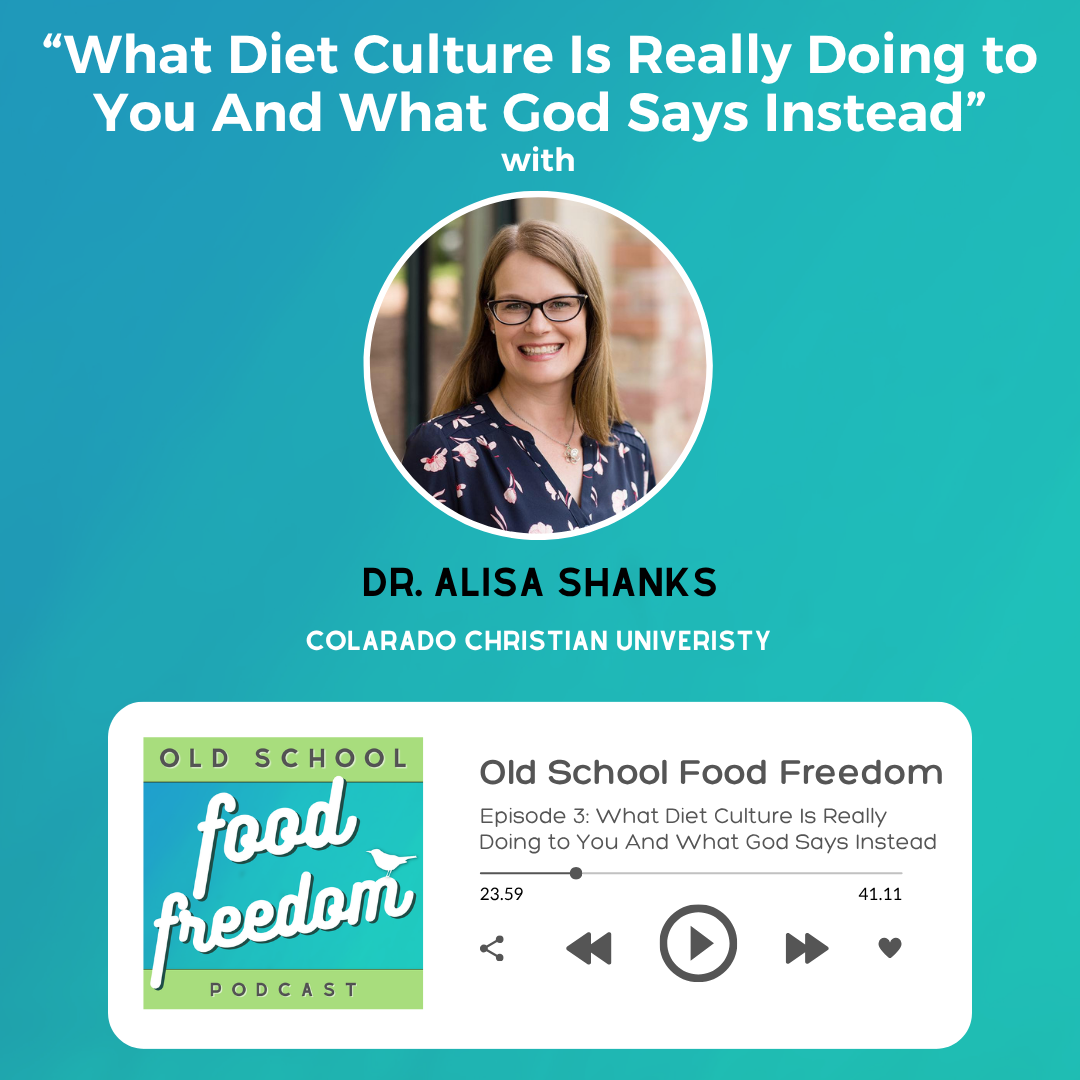
What Diet Culture Is Really Doing to You And What God Says Instead with Dr. Alisa Shanks
"How you look is the very most important thing about you”; it's the lie from the pit of hell that pervades this diet culture soup."
A marinade infuses flavor. Unfortunately, we live in a diet culture infused with toxic messages about size, shape, body image, worth, value, what is and isn't "okay" to eat, how our bodies are "supposed" to look, and other lies from the enemy.
Be filled with hope as Dr. Shanks exposes cultural lies and replaces them with sound, biblical truth.
Dr. Alisa Shanks is a clinical psychologist, FINDINGbalance board chair, and the director of the Larry Crabb Center for University Counseling at Colorado Christian University. She has spent her career at the intersection of faith, eating disorders, and university mental health, and she believes in full eating disorder recovery, not management or coping strategies, but actual freedom.
Here’s what we cover:
What diet culture is, and why Dr. Shanks calls it a soup we are all marinating in
How these messages about size and shape show up from childhood, through pregnancy, and into every stage of life
The historical roots of beauty ideals and how scarcity has always driven what a culture decides to call beautiful
Why "your body is a temple" gets ripped out of context, and what that verse is really about
How diet culture messaging sneaks into Christian spaces, from January pulpit sermons to sugar fasts framed as spiritual disciplines
What it means that your weight is as genetically determined as your eye color and hair color
Why eating disorders are the most deadly mental health diagnosis, and what fuels them
How to think about body acceptance and weight loss without shame, and what it looks like to honor your body without punishing it
Where God's actual call on your life lands, and it has nothing to do with your pants size
Friend, if you have ever sat in a pew and felt like your body was somehow evidence of spiritual failure, or if you have been marinating in these messages so long that you cannot tell where diet culture ends and your own voice begins, this episode is for you. Dr. Shanks is an anti-shame person to her core, and she says so plainly. She is not here to condemn anyone. She is here to name what is really happening and point toward something better.
"Your weight is essentially as genetically determined as your hair color, your height, and your eye color. And that is good news and really freeing." Dr. Shanks
Christian eating disorder recovery does not start with getting your body right. It starts with recognizing that the soup has been on the stove your whole life, that you have been marinating in these messages since before you had words for them, and that you are allowed to get up from the table.
If this one hit close to home, share it with someone who needs to hear that the voice telling them their body is wrong is not God's voice.
We’d love to hear your thoughts, so please drop us an email at admin@findingbalance.com, send us a voice message via SpeakPipe, or you can also subscribe for more practical episodes coming your way.
More About Dr. Alisa Shanks
Dr. Alisa Shanks has been a licensed clinical psychologist in Colorado since 2004, having built her career around three deep passions: her faith, eating disorder recovery, and university mental health. She has served at Biola University and the University of Colorado at Boulder, and currently serves as Director of the Larry Crabb Center for University Counseling at Colorado Christian University in Lakewood. Dr. Shanks believes wholeheartedly in full eating disorder recovery and brings that conviction to everything she does. She also serves as Chair of the FINDINGbalance Board of Directors and brings over two decades of clinical expertise to her role. Alisa has been married for 25 years and has 2 teenage sons.
Here are the vintage advertisements Dr. Shanks referred to in this episode:

And check out Dr. Shanks with her “vintage” old school unicorn folder from her home economics class!

Mentioned Scriptures
Micah 6:8, 1 Corinthians 6:19-20, John 4, Luke 7
Connect with Dr. Alisa Shanks:
Christian Treatment Finder Profile
FINDINGbalance:
Facebook
Instagram
SpeakPipe – send us a voice message
CHRIST-CENTERED RESOURCES TO HELP YOU FIND FREEDOM
The Daily Vitamin eDevo: A free devotional with bite-sized truth emailed 5 days a week
Community Groups: Find connection with prayer groups and our Hello, Freedom! community.
Christian Treatment Finder: Connecting you with Christian providers experienced in treating eating issues.
Lasting Freedom Online Course: A Christ-centered, non-diet course to work through false beliefs about food and weight so you can live free from disordered eating and body image issues.
CREDITS:
Intro music by “MokkaMusic” – Old Jeans (Funk)
Production & Editing by Marketing With Wisdom
_
The content in this podcast is for informational purposes only and is not intended to diagnose, treat, or prescribe a particular course of action. If you have, or suspect you may have, an eating disorder, please consult your healthcare provider. If you desire to receive faith-based care, visit ChristianTreatmentFinder.com to browse professionals with a Kingdom campaign against eating disorders.
More about the Old School Food Freedom Podcast
In today’s diet-culture society, food issues and body hatred have become the norm. But you were created to be FREE. Welcome to Old School Food Freedom, where we go back to the basics, God’s basics, for how we view food, our bodies, and our worth.
Hosted by FINDINGbalance Executive Director Chrissy Kirkman, this podcast features Biblically-sound experts, thought-leaders, artists, and everyday people who will inspire you to interrupt negative cultural soundtracks and rediscover God’s original design for your relationship with food and your body.
This show will deliver practical, faith-filled insights on how to break free from diet culture and body shame through the lens of scripture. If you’re looking for guidance on how to heal your relationship with food while deepening your faith, you're in the right place.
We’ll answer questions like
What does the Bible say about food freedom?
How can I overcome an eating disorder or disordered eating with Jesus?
What is the biblical perspective on diet culture?
How can I find peace with food as a Christian?
What does it mean to treat your body as a temple in relation to eating?
How can I break free from diet culture with Jesus?
How can I align my eating habits with biblical teachings?
What are the first steps to finding food freedom in Christ?
This podcast is for anyone ready to walk away from diet culture and into the freedom that Christ offers. Whether you’re recovering from an eating disorder, disordered eating, wrestling with body image, or simply craving a more peaceful relationship with food, this space was made for you.
If you want to experience true food freedom with Jesus, this podcast will give you the encouragement, truth, and tools to do just that.
The unedited transcript for this episode of Old School Food Freedom
[00:00:31] God adores you and wants you to experience the fullness of life without body hatred or bondage to dieting. [00:00:38] The time is now to take a step toward the life you were created for. [00:00:42] We're so glad you're here with us today. [00:00:44] Let's get into today's episode. [00:00:50] Hey, Dr. [00:00:51] Elisa Shanks. [00:00:52] Welcome to the show.
[00:00:54] Hi. [00:00:54] Thank you.
Meet Dr. Alisa Shanks
[00:00:56] So good to have you on. [00:00:57] Before we get into today's topic, which is a good one, I want to introduce you to our listeners. [00:01:03] Dr. [00:01:04] Lisa Shanks is a clinical psychologist and Finding Balance board chair. [00:01:08] She is passionate about university mental health, having worked at Biola University, the University of Colorado at Boulder, and now Colorado Christian University in Lakewood, where she is the director of the Larry Crabb center for university counseling. [00:01:24] Dr. [00:01:24] Shanks has focused her career around three passions, her faith, eating disorders, and university mental health services. [00:01:33] She believes in full eating disorder recovery.
[00:01:36] Alisa has been married since 2000 and has two sons.
[00:01:40] That's me in a nutshell. [00:01:42] Yeah.
Old School Memories
[00:01:43] So, Alisa, okay, I want to know, what old school item do you miss from back in the day?
[00:01:48] All right. [00:01:48] If we're thinking for real school, I'm going to have to say my Trapper Keeper. [00:01:54] That's what Constance said, too, with like the unicorn on the COVID And for real, I don't have my Trapper Keeper, but I do. [00:02:03] I have my unicorn folder from my 8th grade cooking class with some of the recipes because I had such an outstanding home EC teacher that, like my pie crust recipe literally comes from my eighth grade cooking class. [00:02:20] I do have a unicorn folder in my kitchen where I keep my recipes from eighth grade.
[00:02:26] We might need a photo of that. [00:02:27] I include it in the show notes. [00:02:29] Right. [00:02:31] That's terrific. [00:02:32] So Elisa means so much to me. [00:02:35] She's been a great mentor to me and support and encouragement to me. [00:02:40] So I want to thank you right out of the gate for that. [00:02:42] Yes.
Understanding Diet Culture Soup
[00:02:42] And we talk every couple of weeks on the phone and something we're all familiar with here that we just had to call out today is diet culture. [00:02:52] And this, I love that you call it diet Culture soup. [00:02:57] Because we're marinating in it.
[00:02:59] Yes.
[00:03:00] And it's making us. [00:03:02] I don't know, Alisa, I'm just gonna let you.
[00:03:05] Yeah. [00:03:06] So, right. [00:03:07] If we think cooking the nature of a marinade is that it infuses flavor. [00:03:13] Right. [00:03:13] Unfortunately, we in Western culture, in American culture, we live in this diet culture. [00:03:22] And so the soup that we are marinating in is a toxic soup with messages about size and shape, body image, about what, you know, is and is not okay to eat, what size it is and is not okay to be, how our bodies are supposed to look. [00:03:42] And that, that soup, that diet culture soup is something that pervades even, you know, even from childhood, even, you know, during pregnancy, this, these messages come through. [00:03:58] I remember my kids are 12 and 16 now, but when I had my first son, I gained weight because pregnant people gain weight.
[00:04:06] Most of them, barring medical concerns. [00:04:08] Right. [00:04:08] Most of us should gain weight. [00:04:09] But I was at Boulder Community Hospital and they were like, oh, you've gained a certain amount of weight. [00:04:15] Would you like a dietitian referral? [00:04:17] And I'm like, no, actually, I think I'm going to be okay. [00:04:20] Like, I'm an eating disorder specialist.
[00:04:22] I got this.
[00:04:24] But it was, you know, for somebody who just had a baby, for the message to be, how are we going to help you get back to your pre pregnancy size and shape? [00:04:33] Because that's where you should be heading. [00:04:36] That's an example of this toxic culture, this, this diet culture soup that I should be worried about my baby and his health and nursing, not about how quickly I'm going to get back to my pre pregnancy size.
[00:04:53] And what kinds of fa. [00:04:55] Like, what were they not factoring in. [00:04:57] In that situation? [00:04:59] What were you not considering?
[00:05:01] Well, I think that the reality is, I mean, all women's bodies are different. [00:05:06] Right. [00:05:06] We come in a wide variety of shapes and sizes. [00:05:11] And there was some like, medically prescribed amount of weight that was like the permissible amount of weight to gain with a pregnancy. [00:05:19] And I had gained more than that. [00:05:22] And so even that, that they're like, well, you're outside the norms. [00:05:26] You're outside the parameters of what you should have done. [00:05:31] And, you know, I.
[00:05:33] My child was 9 pounds, 11 ounces at birth. [00:05:36] So that's outside parameters, too. [00:05:38] So we're just gonna go with, that's kind of how things are that, you know, most human beings don't fall exactly in the expected space, whether that's just inhabiting our bodies or with pregnancy, those kinds of things.
[00:05:55] And, and hereditary our genetics and our different People struggle with different types of medical conditions that make it hard to gain weight, hard to lose weight and things like that.
[00:06:14] Yeah. [00:06:14] And so when we have a culture that prescribes what beauty looks like, right. [00:06:21] That that beauty fits in this narrow, narrow range of height and weight and hair color and eye color and being able bodied and you know, even as far as things like gender and gender expression like there are, we've come way and they're so far to go in terms of having that freedom and flexibility in a broader setting where people in all shapes and sizes have permission to embrace their bodies and love the body that they have. [00:07:03] And I think that especially when it comes to things like eating disorders and whatnot, that it is this diet culture soup. [00:07:14] It is the, it is these messages that fuel the eating disorder, whether it's anorexia or bulimia or binge eating. [00:07:23] Less so with some of the other diagnoses like avoidant restrictive food intake disorder or pica, those are less body image oriented. [00:07:31] But our culture sends these clear, clear messages about what is and is not okay in terms of how you look. [00:07:39] And it's a biased IM and it's biased towards certain size and shape.
[00:07:44] It's biased towards being able bodied, you know, and it's also biased towards a white presentation. [00:07:51] So we have come a long way in my 48 years on this planet in terms of increased diversity awareness. [00:08:01] You can now walk into a Target and there's a plus size mannequin. [00:08:05] However, the plus size mannequins are only for the women, which was brought up to me when I was guest lecturing for a media class on men and women and size acceptance and body image president prejudice as promoted in the media. [00:08:23] We talked about these plus size mannequins that are at Target and one of the male students brought up that there are no dad bod mannequins. [00:08:33] Right. [00:08:33] There are only plus size mannequins for women. [00:08:38] So we've come a really long way in terms of helping increase size acceptance and size diversity among women.
[00:08:48] But if you go to the men's department, the mannequins are all shredded with six or eight pack abs and giant biceps and whatnot. [00:08:57] So you know, this is an issue that crosses gender, it crosses race, it crosses all of the things. [00:09:05] And of course, you know, different races can have different beauty ideals and different struggles when it comes to what is idealized and promoted. [00:09:17] But in general, when we're thinking about kind of a white western worldview, this overly thin size and shape is what is promoted and that then fuels the idea, even in Christian cultures, that people who are in smaller bodies are more valued. [00:09:35] And Chrissy, this is antithetical to Christ, right? [00:09:40] This is antithetical to the message of the gospel where all are welcome and none are shamed. [00:09:49] And so when we live in a culture that. [00:09:51] That screams fat prejudice and hurts people's souls as connected to their size and shape, then we are swimming in this diet culture soup, and it is harming us.
The Impact of Diet Culture
[00:10:06] It's scary. [00:10:07] I mean, this is the. [00:10:08] This is what we live in. [00:10:10] We were raised in it. [00:10:13] There are probably very few people that. [00:10:15] Who will listen to this podcast who don't. [00:10:18] Who remember a time without it.
[00:10:21] Yeah.
[00:10:21] At this point. [00:10:22] Right. [00:10:23] Do you know. [00:10:24] Do you know history of, like, kind
A Look Back: The History of Beauty Standards
[00:10:26] kind of dinocolate history you would have to refer to. [00:10:30] Yes. [00:10:30] So one of the things I know is that we, we honor scarcity, right?
[00:10:37] So.
[00:10:37] So that which is difficult to attain is that which is desired. [00:10:43] Right? [00:10:44] So, you know, if you think back to. [00:10:47] I'm gonna go, because I've got a pinpoint in my brain here. [00:10:50] So I'm going, French Revolution. [00:10:52] Follow me there. [00:10:54] Right.
[00:10:55] Hey, talk about old school.
[00:10:58] Way back, right? [00:11:00] But what, what are the sound bites we have from that time in history? [00:11:04] Right? [00:11:04] We have a sound bite of French. [00:11:07] Like the commoners, the. [00:11:09] The working class in France at that time, and they were starving and their children were starving and they were struggling. [00:11:17] And this is where we have Marie Antoinette's quote, oh, let them eat cake, which is the most insensitive, invalidating thing that you could say to people who are starving. [00:11:30] And it also points to her ignorance and privilege that she has cake available to her. [00:11:37] These people are literally dying. [00:11:39] And in that era, the art, the images that were considered beautiful were pale and voluptuous because what was hard to attain but being pale when you're a working class individual and you are out in the fields and you're working your fingers to the bone and starving because you don't have enough calories to replace your expenditure. [00:12:06] You're working so hard.
[00:12:08] You are, you know, tanned, sunburned, wrinkled and thin. [00:12:13] And so the beauty ideals in that era were the exact opposite of what was available. [00:12:20] Right? [00:12:21] So that is an example of the scarcity model. [00:12:26] That which is difficult to attain is what we are all supposed to have. [00:12:30] And so it does. [00:12:31] It goes way back. [00:12:32] I have, when I speak on this topic, I have some images from like the 1800s and even some from, like the 1950s. [00:12:42] There's one from the 1800s, it's called Fatten you Foods.
[00:12:46] And it literally, it's tons of text because back then the ads were trying to like, make arguments for their products. [00:12:54] And so it was just, you know, more text than you would ever see in an ad in modern eras. [00:13:00] Right. [00:13:01] But it would say, respectfully, tell the ladies to get plump with fat and you foods. [00:13:07] And I'll have, I'll send you these, we'll see if we can link to them. [00:13:11] But. [00:13:11] And there was another one with like, like maybe 50s, maybe early 60s, where there's a young man in like a swimsuit and he says, well, you know, a skinny man hasn't a chance with women. [00:13:27] I need to gain flesh.
[00:13:29] And so there, there used to be these products to help people. [00:13:34] And there was another one that talks about like, build voluptuous curves. [00:13:39] Men wouldn't look at me when I was a skinny girl, but now, blah, blah, blah. [00:13:44] And so it is like that was 50s, even maybe early 60s, where there was a lot of room for the, the sort of voluptuous, sexy, robust female body. [00:13:57] And then along came Twiggy. [00:14:00] And she was a British model, I think 60s, maybe early 70s. [00:14:06] But she in, in modern standards, by all intents and purposes, had a very low body mass index. [00:14:14] And that her showing up on the scene and the uniqueness of her as a stimulus, as an image really changed things dramatically in the fashion industry.
[00:14:28] And they started requiring models to be at incredible levels of thinness. [00:14:34] And it's interesting because if you talk to like some of the, in some of the interviews and documentaries I've seen, these high fashion designers say, well, you know, the fabric is so expensive that if, if we had to make it for, if we had to make the item, the jacket, the dress for somebody in a larger body, it just would be a waste of money or something absurd. [00:14:56] And so there's some justification in the fashion industry for having these overly thin models that then became the new standard of beauty.
The Unattainable Standard and Its Consequences
[00:15:07] Wow.
[00:15:08] Yes. [00:15:08] It's harsh and difficult, right? [00:15:12] This scarcity model means it's difficult to attain. [00:15:15] And one of the little dirty secrets is that according to lore that modeling agencies would, you know, back in the day when people were rendering around shopping malls, that they would go and look for like tall, thin families genetically and then catch a girl kind of in that prepubescent state where she doesn't have her full curves, she doesn't have her full hips, and then kind of hold her in that space and make her a model of beauty. [00:15:46] And so these were not like adult women in their women's bodies with their full maturity. [00:15:54] And expression of womanhood. [00:15:57] These were people who maybe never entered a full woman's body. [00:16:03] And then that's what's being held up as the model for, for beauty and that we are all supposed to, you know, reach this prepubescent teen body even in our 30s, 40s, 50s, 60s.
[00:16:20] So as you're speaking and you're, you're describing this picture, I'm thinking it's not even attainable. [00:16:29] Like, it's not even attainable for someone who's in an adult body, whatever age you are. [00:16:37] That's it. [00:16:39] It's so. [00:16:40] It feels so far fetched. [00:16:41] And then I'm like, gosh, how, how did we all buy in? [00:16:45] Why do we keep buying in? [00:16:46] Why? [00:16:47] It's not that simple. [00:16:49] There's all kinds of deceit. [00:16:50] Like we have an enemy who knows exactly what he's doing.
[00:16:56] The devil knows. [00:16:57] Like he doesn't doing anything new. [00:16:59] He's still tempting, he's still twisting.
The Lies of Diet Culture and Biblical Truth
[00:17:03] And one of the biggest lies that this diet culture soup promotes is the concept that for a woman, how you look is the very most important thing about you. [00:17:18] How you look is the most important thing about you is the lie from the pit of hell that pervades this diet culture soup. [00:17:28] And you know, I wish I had my Bible sitting right here, but there are so many spaces in the word of God, right, that combat that we are fearfully and wonderfully made, right? [00:17:44] We are made in the image of God. [00:17:46] And being made in the image of God means that we are relational, right? [00:17:51] God is in unity. [00:17:53] God is a trio. [00:17:55] Father, Son, Holy Spirit, in unity, in community. [00:18:00] And so man and woman are made in God's image, in unity, in community. [00:18:06] But this idea that we are constantly in competition with other women for status, for partners, for priority, for promotion, that, you know, the size and shape, the number in the back of our pants has some bearing on our worth or value in this world that destroys hearts and souls and lives and it costs lives, right? [00:18:33] Eating disorders are the number one most deadly mental health issue because they're the most physically based.
[00:18:40] And so this message of there's only one beauty ideal, there's only one acceptable size and shape really pervades our society and our culture. [00:18:56] And Chrissy, I know from prior conversations you and I have had that there are also times where this message sneaks its way into the pulpit and is even expressed on Christian campuses and through various ministries, right? [00:19:14] And I know this is coming out in the fall, but how many of us have been at a church service in January where they are getting on the cultural bandwagon of lose weight for Jesus, right? [00:19:31] Oh, it's January, everybody. [00:19:33] Get your health in, in shape. [00:19:34] And don't forget your body is a temple.
Misuse of "Your Body Is a Temple" in Church
[00:19:37] Oh, let's talk about our bodies being a temple, please, with so much grace and love. [00:19:43] Because we know, like, I just want to stop and say, I am. [00:19:50] I, I am. [00:19:52] I have done this in the past. [00:19:54] I'm not going to say I'm guilty because I'm not putting a slapping a label of guilt.
[00:19:58] You are, you are in freedom, my dear.
[00:20:00] I'm in freedom, right? [00:20:02] And I don't feel shame. [00:20:04] But in the past, so I'm a worship leader. [00:20:07] And in the past, when I was like really in bondage to this, you know, to body image issues and I was hating and self loathing, I would be on stage and making comments like, you know, don't forget after churches are, you know, our heck yeah, typical Baptist potluck, you know, luncheon. [00:20:31] Hope you wore your buffet pants or something. [00:20:34] Like, I would make jokes to kind of like just because I knew people would laugh and, and they would get it and relate to me, but it wasn't helpful. [00:20:44] It didn't, it didn't enhance anything. [00:20:48] We might have laughed, but it, it only made it worse, right?
[00:20:52] It's a, it's a reliable punchline that whether it's a pastor or a worship leader or a speaker at a Christian conference, if you make some remarks where you are disclosing your displeasure with your body, it's a point of connection. [00:21:10] But it also can be a joke. [00:21:13] And that is, that can also be incredibly harmful. [00:21:17] Right? [00:21:18] So let's go to your body as a temple. [00:21:20] So I don't know, you know, the context for you guys. [00:21:23] I'm, I think it's in second Corinthians. [00:21:25] I should have looked that up ahead of time. [00:21:27] But it is.
[00:21:28] The statement is, it has to do with all other sins a person commits against their body are outside the body. [00:21:39] Right? [00:21:39] So it starts with flee. [00:21:42] Sexual immorality. [00:21:44] All other sins are outside the body. [00:21:47] Sexual immorality is against the body. [00:21:50] Don't you know your body is a temple? [00:21:54] And that is the verse in brief, but in brief context. [00:21:59] Unfortunately, our beloved pastors, speakers, teachers, mentors have taken that verse completely out of context and used it to promote guilt and shame and to promote the diet, culture, soup to promote the idea that if you're outside the bell shaped curve parameters of what is an experience, acceptable size and shape for a body, that you are somehow outside of God's will. [00:22:29] And you should treat your temple better.
[00:22:32] The absurd irony is that they are essentially never talking about sexual immorality and instead they're just promoting this toxic scarcity model that causes Christians to feel shame about their size and shape and believe that they must then go and engage in eating disordered behaviors or extreme dieting or extreme exercise in order to be honoring God. [00:23:04] And our God does not require us to be a certain size and shape in order to be lovable. [00:23:13] He loves us right where we are, and it doesn't take extreme behaviors to be worthy of his love. [00:23:23] And it is a hard journey, right? [00:23:26] We can talk about, there's a lot in the size acceptance movement, there's a lot in body positivity that's going on, but we have to, as men and women, stop and say, my body is beloved by God, exactly where it is today, and I don't have to change it to be worthy. [00:23:51] I don't have to engage in extreme behaviors, whether that's restricting or binging or purging or exercising out the wazoo or those kinds of things. [00:24:04] But it takes time because we're all marinated in this culture. [00:24:11] It is so hard to break through this belief set that I would be more worthy or more valuable if I were smaller or for people that are in naturally small bodies if they were bigger, right? [00:24:26] Because there are people that run naturally thin and on the regular, they get accused of having eating disorders, whether they do or not. [00:24:34] So there is, there's this full range of expression, right? [00:24:38] We vary in terms of height and weight and eye color and hair color.
[00:24:44] And you guys, your weight is essentially as genetically determined as your hair color, your height and your eye color. [00:24:51] And that is good news and really freeing and maybe a little scary for some people. [00:24:57] But we don't like, we're all trying to conform to this impossible standard of beauty and thinness. [00:25:06] And that is God does not require that of us, right? [00:25:10] So Micah 6, 8 says, what does the Lord require of you but to do justly, to have mercy and walk humbly with your God? [00:25:19] And that has nothing to do, in fact, with size and shape. [00:25:23] And essentially nothing in the Bible talks about your size and shape and whether that qualifies you or disqualifies you for ministry. [00:25:34] What does Jesus say? [00:25:35] What are we called to do? [00:25:37] We are called to love God and love others. [00:25:42] And. [00:25:43] And that is what we are called to do.
[00:25:45] Not obsess about size and shape. [00:25:50] And. [00:25:50] And I am not intending to shame anyone. [00:25:53] I am an anti shame crusader if you get to know me. [00:25:58] So if struggling in this space, I am not speaking condemnation. [00:26:05] What I would hope is encouragement that you don't have to live in bondage to these cultural messages that are being boiled up, bubbled up from the pit of hell that tell you that you are not worthy based on some physical characteristic, right? [00:26:25] The message is of hope and freedom and healing. [00:26:30] And we also don't expect that after a few podcasts that you're walking in full freedom, right? [00:26:35] Fully support that. [00:26:36] If you need therapeutic support, if you need a program, Finding Balance has an incredible program online.
[00:26:43] But there are also, if you need more than that, there are therapists, eating disorder specialists, eating disorder inpatient programs, intensive outpatient programs. [00:26:54] There is help available. [00:26:56] So please know that nothing that Chrissy and I say is said with any intention for shame. [00:27:04] But the message is that we are surrounded by sharks in some ways, right? [00:27:13] We are surrounded by this dangerous, dangerous message that can get caught in our heads and cause pain and suffering. [00:27:23] And sometimes the message is being spoken from the front. [00:27:29] And that has happened. [00:27:31] And you and I talked about a specific incidence where I had to go and speak with a speaker because of things that were said that were promoting cultural fat prejudice messages through a Christian lens. [00:27:48] And I think our heart and our encouragement would be for this message to get out to worship leaders, pastors, preachers, speakers, and just hope that people would stop and think about how.
[00:28:05] We don't always talk about bodies in the church, but when we make remarks about the buffet pants or about the New Year's weight loss resolutions, I've heard it on Christian radio. [00:28:17] I've heard it in a wide variety of places where, you know, it's like, come on, everyone, let's lose weight for Jesus. [00:28:23] Or a different message I've heard is, let's sugar fast for Jesus. [00:28:28] And there. [00:28:29] There's nowhere in the Bible that we are called to fast from sugar. [00:28:35] That is not a practice that is going to be honoring to God. [00:28:41] Right? [00:28:42] And that said, we also know that some people are in a place where maybe their health is at risk or maybe they just feel really incredibly miserable in their size and shape. [00:28:56] And so we're not saying that all weight loss efforts are not okay.
[00:29:03] If people want to, you know, try to move to a different size and shape within, like, what's going to be workable for their body and their genetics, that's okay. [00:29:16] But we also want to caution people against engaging in eating disordered behaviors for the sake of weight loss, right? [00:29:27] That, you know, thinking about, how do you love your body, honor your body, nourish Your body, well, move your body for strength, building endurance, building stress relief, all those things versus approaching your workouts like you're gonna beat your body into shape. [00:29:46] Right. [00:29:47] That's a whole different way of showing up at the gym. [00:29:51] And I would encourage people to not show up at the gym like that, but to have permission to say, you know what, I feel better when I go for a walk, or I would like to see how many pushups I can build to doing over time.
[00:30:07] Right.
[00:30:08] Increasing strength, increasing endurance in lieu of having that approach to exercise that is, you know, I will only be okay once I've achieved a six pack. [00:30:20] Right. [00:30:20] Those kinds of things.
Balance, Motivation, and Acceptance
[00:30:22] Because there's not a lot of grace in that. [00:30:25] It's very rigid in rules and structure. [00:30:28] Like, it's great to have structure and boundaries and, and to find the balance. [00:30:33] It always comes back to finding the balance.
[00:30:35] Yes, always comes back to finding balance.
[00:30:38] Well, and looking at our heart, like, why are, like, if, if somebody wants to lose weight, is that okay? [00:30:45] You said yes. [00:30:46] And we have to look within internally. [00:30:49] What is our motivation behind it? [00:30:51] Who are we trying to please? [00:30:53] Or why are we doing it and knowing the balance?
[00:30:58] And also, I'm a psychologist, so we have to caveat the things. [00:31:03] But, right, if we say somebody wants to lose weight and that's okay, but their body mass index is already in a dangerous space, then no, that's not okay. [00:31:13] Right. [00:31:14] If your body mass index is very low and you still want to lose weight, then that's an eating disordered approach to life. [00:31:22] And so we want to be speaking to the large group and the masses, but also recognize that it is like, talk with your physician, make sure that you are in a place that that's okay. [00:31:37] Because if your body mass is really on the low end and you hear us say it's okay to lose weight, I don't want you to pass away because you heard the wrong message. [00:31:48] So it is, it's. [00:31:49] It's hard and it's, it's finding again, it's finding balance.
[00:31:52] Like, how do we promote size, acceptance, body acceptance in this world that tells us that many, many bodies are not acceptable. [00:32:06] And, and that is a major task. [00:32:09] But I think that's where we turn to our faith. [00:32:12] We turn to God and we acknowledge that he had the most compassion for people who were in hard situations or who were caught in sin. [00:32:28] Right. [00:32:28] So the woman at the well, he had a conversation with her. [00:32:33] She had had a variety of partners, the Samaritan woman. [00:32:37] And he a spoke with a Samaritan woman alone.
[00:32:41] At the well, that was unusual. [00:32:43] But B, he offered her living water, right? [00:32:48] He offered her hope and freedom. [00:32:52] If you think about the woman caught in adultery, there was grace and truth, right? [00:32:59] So he said, where are your accusers? [00:33:03] Where are the people that would have stoned you to death in this very moment? [00:33:08] And then he speaks truth and says, go and sin no more, right? [00:33:13] So he's holding the grace and the truth. [00:33:18] And I think for us that is such an important balance. [00:33:22] Again, finding balance, right? [00:33:24] To think about the compassion that Jesus met hurting souls, right? [00:33:31] There's another, less well known scene, a story in the Gospels where Jesus comes across a funeral and it's a widow and her only son. [00:33:45] And what does he do? [00:33:47] He raises that son from the dead because he knows that in that culture, in that era, losing her son means not only that she's alone, but that she no longer has the capability, never did, to provide for herself, right? [00:34:05] So here was a woman in grief and pain and sorrow and facing destitution. [00:34:12] And Jesus raised her son, right? [00:34:15] So he responds with compassion, with hope, with healing, with preservation and restoration of life. [00:34:25] And I think that's where our hope is, right? [00:34:30] That even in the midst of body hatred, even in the midst of a significant eating disorder, our God is the God of hope and of healing and of restoration.
Closing Thoughts and Resources
[00:34:44] Elisa, that is, that is a great way to end today's interview. [00:34:48] This was so good. [00:34:51] Thank you so much for taking time out of your busy schedule to to be part of this. [00:34:56] So in our show notes you can Find ELISA on LinkedIn. [00:35:01] We will also have all kinds of resources through Finding Balance. [00:35:05] She, Elisa was talking about, you know, if you need a nutritionist, a dietitian, a counselor, a therapist, and you want some, someone who's a Christian, we have a Christian treatment finder that's free. [00:35:16] You go out there, you can search by your area virtual services and look for someone who gets this and gets it from a Jesus perspective, a biblical Christ centered perspective. [00:35:30] If you're not sure where you stand with your eating issues, you know, you struggle but you're not really sure, like, do I have an eating disorder or is it just whatever? [00:35:40] We have a free self test on our website as well that you can take just to kind of see where you are and then all kinds of resources like she mentioned, our Lasting Freedom curriculum, a whole library full of videos, books, resources that you can check out.
[00:35:58] So we encourage you to go out there, take a look and see, see what God might be speaking to you through this. [00:36:05] And if you need someone to Pray for you. [00:36:08] We have a prayer team here at Finding Balance, and we love to pray over those we serve. [00:36:13] So just email us@prayer findingbalance.com and we would love to encourage you and pray for you in this journey because we understand. [00:36:24] We. [00:36:24] We get it. [00:36:25] It's hard. [00:36:27] So, Elisa, okay, to wrap this thing up, describe the last time you experienced true freedom.
[00:36:33] What did that look like for you?
Experiencing True Freedom: A Personal Story
[00:36:35] Yeah, so for me, one of the things that I've always loved is dancing. [00:36:40] And that's. [00:36:42] I was. [00:36:42] I did dance team in high school and that and went to Baylor Sic em Bears for my undergrad and used to go country dancing every Thursday night for like four years. [00:36:52] That was amazing. [00:36:54] So as I think back to times of freedom, we have a wide variety of retreats that we do at Colorado Christian. [00:37:01] And last year on one of the retreats, I got to help lead the We Dance Revolution event. [00:37:09] And literally one of the graduate assistants and I got up on stage in the middle of one of the songs and just followed the choreography and had the time of our lives.
[00:37:19] So as I think of, like, full freedom and just being completely in the moment, I would say that's one of the times that I can think of.
[00:37:28] That's amazing. [00:37:29] I can't wait for us to get together soon in real life and just dance party, flat out.
[00:37:36] Absolutely.
[00:37:36] Dance party. [00:37:37] I love to dance. [00:37:38] I love to roller skate. [00:37:40] Let's do it all.
[00:37:40] Yeah. [00:37:41] Oh, my gosh. [00:37:42] I'm in. [00:37:42] And I actually, I got to roller skate on a different routine treat. [00:37:45] And that is so fun. [00:37:47] It is. [00:37:48] It's so fun.
[00:37:49] That's so fun. [00:37:49] Well, I don't want this to end, but the time has come.
[00:37:52] I know.
[00:37:53] I am so thankful for you, Elisa. [00:37:55] Thank you for being on today.
[00:37:56] My pleasure. [00:37:57] Thank you so much for the opportunity. [00:38:00] It's always a blessing getting to connect with you and I love this chance to share this message of hope and freedom.
Podcast Conclusion and Encouragement
[00:38:13] Thank you for listening to the Old School Food Freedom podcast. [00:38:16] For over 20 years, finding balance has been helping people walk in freedom by discovering where Jesus fits into their struggles with food and body image. [00:38:25] If you want more biblical truth and encouragement, head on over to findingbalance.com and subscribe to our free daily vitamin devotional. [00:38:33] While you're there, explore our Christ centered Lasting Freedom online course and small group tools. [00:38:39] You can help keep this ministry going by donating today@findingbalance.com see you next time. [00:38:48] The content in this podcast is for informational purposes only and is not intended to diagnose, treat or prescribe a particular course of action. [00:38:56] If you or someone you care about is battling an eating disorder or is experiencing unmanageable thoughts or feelings, please call 911 if in the US or visit your nearest emergency room.
