Body Gratitude When Your Body Has Limits with Leah Bryant
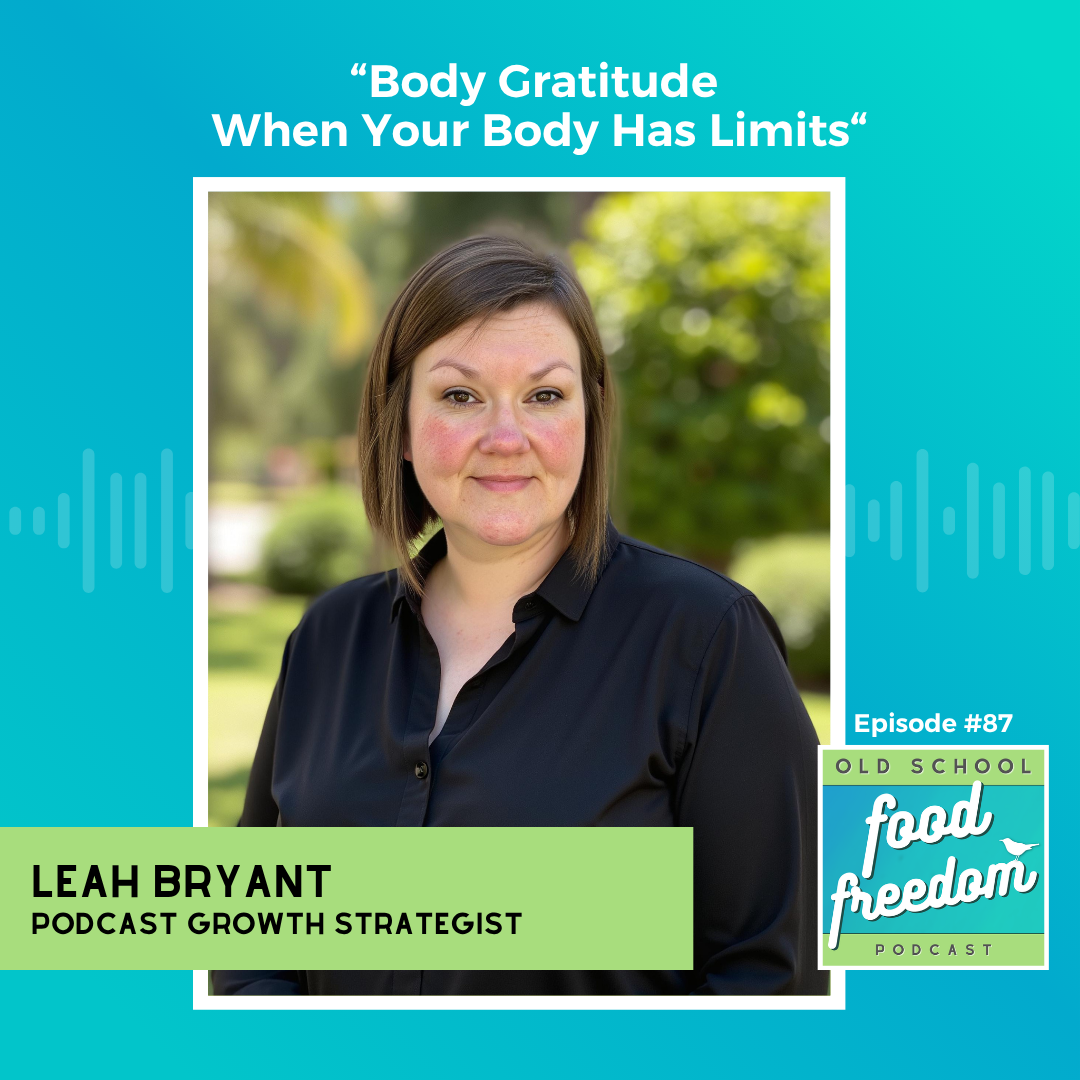
"If the desire is there to move, then move in whatever way feels good for you. Grab your friend Jesus and do it!"
Maybe you've been in a season where moving your body feels like one more thing on a long list of things you're supposed to be doing but aren't. Or maybe the relationship with movement has always felt complicated, tangled up with body image struggles, shame, and the pressure to be doing more. If that's where you are, this conversation is for you.
Today, Chrissy sits down again with Leah Bryant, podcast growth strategist and the producer behind Old School Food Freedom, for a very honest conversation about body gratitude and the gift of movement. And it starts somewhere most people wouldn't expect: with a young woman in her early thirties who woke up from a nap and couldn't feel anything from the waist down.
What God did next, and what Leah had to relearn, rebuild, and surrender along the way, is the kind of story that shifts something in you. Not because it wraps up neatly, but because it's still unfolding. She still has partial paralysis, and yes, there are still hard days. But, underneath all of it, there is faith that keeps getting back up.
Here's what we cover:
What cauda equina syndrome is, and what it means to lose feeling from the waist down overnight
The emergency surgery, complications, and the thirty-day stay in the rehab wing, where Leah had to relearn how to sit up, roll over, get into a wheelchair, stand at a sink, and eventually walk
What it looked like to move from wheelchair, to walker, to cane, to walking unassisted, and why letting go of the cane was harder than it sounds
The moment a doctor challenged her in a way she didn't expect, and how that became a turning point in her recovery
What body gratitude really looks like when your body has limits you didn't choose
How chronic illness and partial paralysis quietly shape the way you move through the world, and the grace it takes to honor that
Why shaming yourself into movement has never worked, and what really helps
What Chrissy has learned about her own body gratitude through watching Leah's story, and through her own journey with endometriosis, perimenopause, and body image
The gentle movement message that is right for every woman, wherever she is right now: one small step, with Jesus, is enough
Friend, if you have ever looked at your body with frustration because it can't do what you want it to do, or avoided movement altogether because it felt too hard or too loaded, Leah has something to say to you. Movement is a gift. Not a punishment, not a performance, not something you earn when your body looks a certain way. And on the days when all you can do is one step, that step counts.
"One small step. One foot in front of the other. You don't have to do the whole staircase." — Leah Bryant
Body gratitude is a practice you return to, especially on the hard days when hormones tank, body image crashes, and the enemy gets loud. It is a choice to look at what your body can do and say thank you, even through tears, imperfectly, and with help from the furniture along the way.
If this episode spoke to something you've been sitting with, pass it to a woman in your life who needs the reminder that movement doesn't have to be perfect to be a gift.
And if you haven't heard her first episode, go back to Episode 74 to hear how God used this podcast to do some unexpected healing work in Leah's own life.
We’d love to hear your thoughts, so please drop us an email at admin@findingbalance.com, send us a voice message via SpeakPipe, or you can also subscribe for more practical episodes coming your way.
More About Leah Bryant
Leah Bryant is a Podcast Growth Strategist and Coach, known as the Sherlock Holmes of podcast strategy, who helps entrepreneurs and small business owners turn their podcasts into powerful tools for visibility, authority, and lead generation. She also serves as the producer of the Old School Food Freedom podcast. With over 2,000 produced episodes and more than 50 successful launches, Leah brings strategic insight, storytelling, and production expertise to every show she touches. When she's not decoding growth patterns, you'll find her homeschooling her son Ezra or spending quiet time with Jesus.
Hello Freedom Community
Our Hello Freedom community is launched! This is a Christ-centered space to find connection, encouragement, and gentle steps toward freedom from food and body-image struggles. No pretending, no fixing yourself first, come just as you are. If you want in, your next step is to join us at findingbalance.com/community.
You were not meant to walk this alone. We're saving a seat for you!
Related Episodes
She Came to Produce, But Jesus Came to Heal
Mentioned Scriptures
Philippians 4:13
Connect with Leah Bryant
Facebook
Instagram
SpeakPipe – Send us a voice message!
CHRIST-CENTERED RESOURCES TO HELP YOU FIND FREEDOM
The Daily Vitamin eDevo: A free devotional with bite-sized truth emailed 5 days a week
Community Groups: Find connection with prayer groups and our Hello, Freedom! community.
Christian Treatment Finder: Connecting you with Christian providers experienced in treating eating issues.
Lasting Freedom Online Course: A Christ-centered, non-diet course to work through false beliefs about food and weight so you can live free from disordered eating and body image issues.
CREDITS
Interlude music by “Hotham” – Morning Thoughts
Intro music by “MokkaMusic” – Old Jeans (Funk)
Wrap-up music by Jesse Quinn – Christian Instrumental
Production & Editing by Leah Bryant Co
The content in this podcast is for informational purposes only and is not intended to diagnose, treat, or prescribe a particular course of action. If you have, or suspect you may have, an eating disorder, please consult your healthcare provider. If you desire to receive faith-based care, visit ChristianTreatmentFinder.com to browse professionals with a Kingdom campaign against eating disorders.
More about the Old School Food Freedom Podcast
In today’s diet-culture society, food issues and body hatred have become the norm. But you were created to be FREE. Welcome to Old School Food Freedom, where we go back to the basics, God’s basics, for how we view food, our bodies, and our worth.
Hosted by FINDINGbalance Executive Director Chrissy Kirkman, this podcast features Biblically-sound experts, thought-leaders, artists, and everyday people who will inspire you to interrupt negative cultural soundtracks and rediscover God’s original design for your relationship with food and your body.
This show will deliver practical, faith-filled insights on how to break free from diet culture and body shame through the lens of scripture. If you’re looking for guidance on how to heal your relationship with food while deepening your faith, you're in the right place.
We’ll answer questions like
What does the Bible say about food freedom?
How can I overcome an eating disorder or disordered eating with Jesus?
What is the biblical perspective on diet culture?
How can I find peace with food as a Christian?
What does it mean to treat your body as a temple in relation to eating?
How can I break free from diet culture with Jesus?
How can I align my eating habits with biblical teachings?
What are the first steps to finding food freedom in Christ?
This podcast is for anyone ready to walk away from diet culture and into the freedom that Christ offers. Whether you’re recovering from an eating disorder, disordered eating, wrestling with body image, or simply craving a more peaceful relationship with food, this space was made for you.
If you want to experience true food freedom with Jesus, this podcast will give you the encouragement, truth, and tools to do just that.
The unedited transcript for this episode of Old School Food Freedom
Leah Bryant [00:00:24]: Well, thank you so much for having me back. I am really excited to be here today.
Chrissy [00:00:29]: Yeah, I'm happy to have you. I say welcome back. Like you're not part of every single episode. Anyway, behind the scenes, friends, she is our fabulous producer of the Old School Food Freedom Podcast. So if you haven't heard her episode on episode 74 where she shares her story about what it has been like to work with, finding balance with Old School Food Freedom Podcast. How she came to just produce was what she thought, but God had other plans and he did some healing work in her. So really good. Episode 74.
Chrissy [00:01:00]: Check it out. But let me tell you a little bit about Leah Bryant. She is a podcast growth strategist and coach, known as the Sherlock Holmes of podcast strategy, who helps entrepreneurs and small business owners turn their podcasts into powerful tools for visibility, authority, and lead generation. She also serves as the fabulous producer of the Old School Food Freedom podcast. With over 2000 produced episodes and more than 50 successful launches, Leah brings strategic insight, storytelling, and production expertise to every show she touches. When she's not decoding growth patterns, you'll find her homeschooling her son Ezra, or spending time quietly with Jesus. Leah.
Leah Bryant [00:01:48]: Hi.
Chrissy [00:01:49]: Hi. Oh, friends, behind the scenes, we are both going through the fun times we call perimenopause. And it is just so much fun. And it's nice to. That was snarky, if you didn't know already. It's really nice to have. If you have to go through hard things, right. To go through them with someone who gets it and makes you feel less alone.
Chrissy [00:02:14]: We took the first 30 minutes we planned to record. We planned to talk through some things, and so now we feel a little bit better, a little more reset. I'm still tongue tied, but it's okay. Thank you, Leah, for being that.
Leah Bryant [00:02:26]: Thank you, friend.
Chrissy [00:02:30]: I still need to hear your story about that remix of the Golden Girls theme song. Thank you for being a friend. Travel down the road Starting from the bottom now we're here, girl, you know what I mean?
Leah Bryant [00:02:44]: I gotta find it.
Chrissy [00:02:45]: Please do. So much fun. Okay. Hey. Every episode we kick off the show with a question of what old school item or experience do you miss from back in the day. But you have already answered that. So today I want to know. Tell us about like some of your first old school jobs, like back in the day jobs.
Leah Bryant [00:03:07]: Oh, my gosh, I love this. So I am originally from Kentucky and grew up on a farm. So if you are a farm kid, you know that your first job was on said farm. Yes, outside of that, my first job was at a. Rally’s.
Chrissy [00:03:26]: Rally’s. Okay, hold on. Is that a. That sounds familiar.
Leah Bryant [00:03:30]: It's like a burger joint.
Chrissy [00:03:31]: Okay. I don't think we had those in Kansas City area.
Leah Bryant [00:03:35]: Not many of them exist. And if they do, they're probably down more down south.
Chrissy [00:03:41]: Okay.
Leah Bryant [00:03:42]: And then it was the movie theater.
Chrissy [00:03:45]: Did you come home smelling like popcorn ever since? Oh, my gosh.
Leah Bryant [00:03:49]: Everything. Yes.
Chrissy [00:03:50]: Oh, buttery.
Leah Bryant [00:03:51]: It was my all time favorite, favorite. The most favorite job I ever had.
Chrissy [00:03:56]: Isn't that cute? Why was it your favorite?
Leah Bryant [00:03:59]: Because I get to socialize with people. Of course you get to make popcorn. Who doesn't love popcorn and smelling like popcorn and all the things. And then maybe got to bus kids trying to sneak into movies they shouldn't be sneaking into.
Chrissy [00:04:15]: Back to your investigative days from the past, right? Yeah. No one's coming in here, you know,
Leah Bryant [00:04:21]: holding down the law here.
Chrissy [00:04:24]: Enforce the rules.
Leah Bryant [00:04:26]: Right. Just making sure people do what they're supposed to do. But it was just a lot of fun. Like get to see any movie I wanted to for free. It was just really great. It was so much fun. I loved it.
Chrissy [00:04:35]: That's super fun. Were you a ticket taker, a food person, or did you get to like rotate all of it?
Leah Bryant [00:04:40]: All of it, yeah. The only thing that I didn't do was up in the projecting area. Because you had to be over 18 to do that.
Chrissy [00:04:47]: Oh, yeah. I always have a question. I know there's somebody out there listening, wondering this. When you see that projection room, I'm always wondering, does someone sit in there the whole time the movie's going for every movie, or do they start, it looks like we're good, and leave?
Leah Bryant [00:05:03]: They start it and then they leave.
Chrissy [00:05:05]: And so if something goes haywire.
Leah Bryant [00:05:07]: Because that's why if there's something happens, somebody always, like, there's something wrong.
Chrissy [00:05:10]: And then like, they paid good money to see this movie and it's not working, they're gonna let you know. This is true. Yeah.
Leah Bryant [00:05:17]: I mean, now things may change now because, you know, technology, but back then, at least that's back, way back then.
Chrissy [00:05:26]: Back in the 1900s, in the 1900s, because it was. That's so fun. So rally and a movie theater.
Chrissy [00:05:36]: Aw. So cool. Well, that was fun. I liked that. I would have loved to see you in the theater. I might have been smuggling snacks. Did you bust people for that? Could you look through their stuff?
Leah Bryant [00:05:48]: You know, I didn't really bust people for that, but we could have. Yeah, because.
Chrissy [00:05:52]: Yeah, Listen, I'm not proud of my shady past. Everybody's done something they're not proud of. I'm just courageous enough to tell you all.
Leah Bryant [00:06:00]: Done something.
Chrissy [00:06:01]: Some kind of snack in there.
Leah Bryant [00:06:03]: All right, we get it.
Body Gratitude and the Gift of Movement
Chrissy [00:06:05]: Well, enough about my shenanigans, my 90s shenanigans. So here's today's episode. We're talking body gratitude and the gift of movement. So what happened here is a few months ago, I learned a part of your story, Leah, that I had never heard before. And it really moved me. And just the way that God worked in your life through such a difficult, really difficult health situation was nothing short of remarkable. And it was hitting especially close to home because of a health concern my husband was going through at the time. And so in both of your stories, I just found myself really overwhelmed with gratitude for the gift of being able to move my body and, you know, however it looks, whatever size it is, that size in those moments didn't matter.Leah Bryant [00:06:57]: Right?
Chrissy [00:06:58]: That man. I can walk and I can brush my hair. I can do these things on my own. I can take care of my husband who isn't able to. To walk well right now or whatever. And so hearing your story, it was so powerful and motivating, and I just felt that our listeners here, they could really maybe see themselves too. I know a lot of us struggle at times to, you know, like, we want to move our bodies, but we just can't seem to find our way there. It's like, what is gonna be the thing that helps us get up and move? It's not shaming, because that doesn't work.
Chrissy [00:07:35]: That's just, you know, set up for disaster. And so. So that's kind of what we're looking at today. So, Leah, I guess just take us back. Take us back and start with your story.
Leah's Story: Chronic Back Pain and Spinal Emergency
Leah Bryant [00:07:46]: I would love to. So if you can picture it. So this is serious. I don't know. Part of how I deal with trauma and what I've gone through is to be funny. So please know that as I'm telling this story, that this is very serious. So if you find yourself or know someone who's having back pain, that back pain is very serious. And please know that my joking about it is just how I deal with it.Leah Bryant [00:08:14]: I just wanted to say that first. Yeah.
Chrissy [00:08:16]: You're not making light of this at all. It was serious.
Leah Bryant [00:08:18]: Not at all. Yes, but.
Chrissy [00:08:20]: And there are also some, like, God has a sense of humor. Right.
Leah Bryant [00:08:24]: I agree.
Chrissy [00:08:25]: Right. So do we. And so it's joy and laughter.
Leah Bryant [00:08:30]: Yes.
Chrissy [00:08:30]: To help balance. Like this is helping you find balance for something that's really heavy. Okay.
Leah Bryant [00:08:36]: Yes. Thank you. All right. So it was 2011. I was living as, quote, unquote normal, as I was, you know, active and healthy and all the things And I had always had back pain, you know, growing up on the farm, doing all the things, lifting all the things I could do, anything you can do and I could do better type of thing. And in my 20s, it progressively started to get worse. And one day, you know, it started to get a lot worse.
Leah Bryant [00:09:14]: And if you know me, you know that I really don't listen to my body really bad about that until it's to the point where it's like screaming at me like, hello, there is something definitely wrong. So I just kept saying, I'm fine, totally fine. This back pain, totally fine. I'm okay, I'm okay, I'm okay. Well, it got to the point where I was indeed, in fact, not okay. And I finally went to a doctor on a Monday morning and he looked at me like all of 2.5 seconds and was like, okay, we're going to send you next week in for an injection of steroids to help with inflammation, your pain, all the things, great. Anything that will help, I am here for it. So I had an action plan.
Leah Bryant [00:10:16]: I went home. So the couple days had passed and then Thursday morning I had woke up and I was in so much pain. When I say excruciating pain, like I have never felt pain like this before in my life. I would almost say it was worse than having a child, that I've had a child. It was worse than that. It was really bad. It was so bad, like I couldn't move. I was doubling over, like the whole nine yards.
Leah Bryant [00:10:46]: I was questioning all life decisions. So bad. And at that point I was like, leah, let's be smart about this. You cannot drive down the interstate being in this pain. So I did what any sensible person would do. I called and sick to work and I took some pain medication that they had prescribed to me that Monday and took a nap. Because, you know, naps solve everything, right? And when I Woke up from said nap. I could not feel anything from the waist down.
Leah Bryant [00:11:24]: Like, nothing. I, like, was like, what? Wait a minute. What? Couldn't feel anything.
Chrissy [00:11:33]: Terrifying.
Leah Bryant [00:11:34]: Like, it was like, where is my body? What is happening right now? Here is where you get to meet my infamous wisdom. So most people in this incident would immediately call 91 1.
Chrissy [00:11:55]: Oh, yeah. Can't feel anything from the waist down. Someone come and help me. Yeah.
Leah Bryant [00:12:00]: Leah calls her parents, who live an hour and a half away.
Chrissy [00:12:07]: Oh, right. Okay.
Leah Bryant [00:12:11]: So my dad picks up the phone. I'm upset. Obviously I'm upset. Freaking out. I explain the whole situation. God rest his soul. He was like, leah, why are you not calling 91 1? I was like, but, Dad, I don't have any pants on because I was in pajamas.
Chrissy [00:12:40]: Sleeping in your night shoes.
Leah Bryant [00:12:41]: Very modest person. Yes. So this is where we are.
Chrissy [00:12:46]: I mean, so. Yeah.
Leah Bryant [00:12:49]: Of all times to be modest. Right?
Chrissy [00:12:52]: And we know that that's the thing our. Our brains can't process. We know that these first responders have seen so much worse. They've seen it all. It's not a big deal. And the modesty.
Leah Bryant [00:13:04]: The modesty.
Chrissy [00:13:05]: The sheer, like, embarrassment. Yeah, okay.
Leah Bryant [00:13:08]: Right. And so I waited the hour and a half for my mom to drive. We successfully acquired pants.
Chrissy [00:13:18]: Yay.
Leah Bryant [00:13:19]: Now, that was interesting. When you can't feel anything, you're still, like, freaking out. My mom is freaking out. I'm freaking out. My dog was freaking out. But 911 was called. The ambulance came, we went to the hospital, off we went. So we get to the er and, you know, they're like, what happened? Telling them all the things, and I'm laying there and I'm like, oh, my gosh.
Leah Bryant [00:13:48]: I'm telling them this story, and then I'm like, did I just pee myself? It feels like I just peed myself. I have no idea what's going on. And my dad later tells me that as I'm telling them the story of what's happening, he says that a nurse that I didn't see this walks over and grabs a needle, takes it out of a package, walks to the bottom of my bed and sticks it into the bottom of my foot. And when I didn't jerk, when I didn't make a sound, when I didn't do anything, like, he said, her face, like, she actually went a little white. And, like, he knew that the severity at that point, that there was like, oh, gosh. Like, there's no faking here.
Chrissy [00:14:32]: Yeah, right. Ugh.
Leah Bryant [00:14:34]: And so they called, like, the neurosurgeon that was on call because he wasn't at the hospital at this time. And they were like, take her to get an mri. So they put me in the MRI machine. They sent him the results, and like, literally five minutes later, he's like, prepper for surgery. And I'm on the way in.
Chrissy [00:14:54]: Wow.
Leah Bryant [00:14:54]: And so they prepped me for surgery because what had happened was that my disc at the base of my spine at L4, L5 had slipped into my spinal cord and had compressed those nerves. And that's why I couldn't feel anything, couldn't move, couldn't do anything. And so then I had that emergency surgery that night. Wow. And so, yeah, I mean, that's intense.
Chrissy [00:15:23]: It was.
The Diagnosis: Cauda Equina Syndrome and Partial Paralysis
Leah Bryant [00:15:24]: It was intense and unexpected. Oh, so unexpected. And so, you know, when I woke up the next day, the surgeon, it was him and another surgeon, they came in and he told me two things. I will never forget the rest of my life, and I will try not to get emotional. I feel it building. First he said, had I waited six more hours, I would have been permanently paralyzed. I was like, well, I'm grateful. My mom.Leah Bryant [00:16:02]: We lived an hour and a half away. No, I'm kidding.
Chrissy [00:16:05]: Right? Right. Oh, man.
Leah Bryant [00:16:08]: But the second thing he said was that with nerve damage, there's no definitive way to, like, tell how bad it really is. So he said, you know, I've done everything that I can do, and right now it's up to God what happens next. Wow. And he says, I don't know if you'll ever walk again.
Chrissy [00:16:37]: Oh, my gosh.
Leah Bryant [00:16:39]: And I looked at him and all my medicated state, being very stubborn self, and said, well, you don't know me very well. And you may or may not know God very well because we've got this.
Chrissy [00:16:59]: Nice, right? Yeah. Yeah.
Leah Bryant [00:17:01]: And I love a good challenge. His face was a little shocked when I said that. And I think that probably because when most people receive news like that, they may not have received it as a challenge like I did. They may have received it in a different way.
Chrissy [00:17:18]: Yeah.
Leah Bryant [00:17:19]: And that is all the Lord's doing. There was no Leah there. That was definitely all the Lord.
Chrissy [00:17:24]: But let me pause here. Yeah, that was the Lord and Leah together. Because I never heard this before until just now. I was like, you could have made an agreement with the enemy.
Leah Bryant [00:17:37]: True.
Chrissy [00:17:38]: Oh, my gosh, I'm never gonna walk again. And just went down that road. But your first response, your Christ centered agency, was like, no. Like. And also, let me say that I know that sometimes God has plans.
Leah Bryant [00:17:52]: Yes.
Chrissy [00:17:52]: And his Plans could involve that you would never walk again. And if that happened, I feel like knowing you as well as. I mean, I don't know you, like. Like, we're sisters or something. But, like, just knowing you as well as I do, I feel like you would have processed that, grieved that, and pivoted and, like, okay, how's God gonna use me next? So just.
Leah Bryant [00:18:15]: Most definitely.
Chrissy [00:18:16]: Yeah.
Leah Bryant [00:18:17]: Yes. I will agree with you, too. And I think, though, too, that all my life I had also heard, you know, I could do all things in Christ who strengthens me.
Chrissy [00:18:28]: Yeah. Yeah.
Leah Bryant [00:18:29]: And that just kind of like, really. Just like, neon sign flashing.
Chrissy [00:18:33]: Yeah.
Leah Bryant [00:18:34]: For lack of better words. Right. Just like, that's instinctively, like, the first thing that came to mind. It's like, no, I. No, no, no, no, no, no, no, no. I can't. I can't accept this. We will give this a try.
Faith, Lament, and Overcoming Challenges
Leah Bryant [00:18:47]: Right. Like, granted, like you said, if it is God's will that I don't walk, we will face that when that time comes. Now, I have to be honest, because it was not all rainbows, kittens and butterflies. Yeah. Right. Like, there was a morning while I was in the rehab wing, because I was there for about 30 days.Chrissy [00:19:12]: Wow. Wait, you were in the hospital in the rehab wing for a month?
Leah Bryant [00:19:18]: Yes.
Chrissy [00:19:19]: Oh, man.
Leah Bryant [00:19:20]: After surgery. Yeah. And this was probably maybe a week after I had been in there. The whole point of going into that rehab wing was I had to learn to, like, do everything all over again. And I'll talk about that here in a minute, but I wanna tell this part first, because this talks about, like, the mindset stuff that we were talking about. So, you know, every morning they would come in and. Because I couldn't feel my legs and. Because I'm not moving around, because all the things.
Leah Bryant [00:19:51]: They would come in and they would feel my legs and all the things. Because they were worried about blood clots. All the things. Right, right, right. So they would come in and do their normal test. And that morning they came in and they did their test, and they were like, oh, gosh. And I could see it in their face. And I was like, goodness gracious.
Leah Bryant [00:20:07]: And then they were like, you have a blood clot. And I was like, what? And then later that afternoon, they came in, they're like, oh, and you have MRSA staph infection.
Chrissy [00:20:18]: That's super hard to treat. Yeah.
Leah Bryant [00:20:20]: Yes. In my incision. And I was like, oh, gosh. Oh, man. And I. I had been very chipper every day up until it was like, bam, bam, bam. Right. And I remember asking the nurses, the occupational therapist, the physical therapist.
Leah Bryant [00:20:46]: I was like, ladies and gentlemen, I said, I. I. I just need a day. I'm gonna need. Can you please close the blinds and just shut the light off and just let me. Just let me feel my feels. Yeah. And I felt those feels, let me tell you.
Leah Bryant [00:21:12]: I cried, I wailed. I let myself ask, why me? And I don't do that a lot. You know, I was like, why all of this? And looking back, I think that God knew that I needed all those things to happen.
Chrissy [00:21:35]: Needed to lament as well. Yeah.
Leah Bryant [00:21:38]: It's lamenting because he knows I'm the kind of person that I try to find the good in everything. And I think that in that moment, he was like, hey, Leah, I also need you to feel this. I need you to lean on me even more than you usually do.
Chrissy [00:22:00]: Like, full surrender. Yeah.
Leah Bryant [00:22:04]: So, like, leaning into the Lord never really meant that I was pretending I was fine. It meant that I was being honest with myself and just feeling everything. Yeah. And then choosing not to stay in it.
Chrissy [00:22:25]: That both. And this is hard. This is a lot of stuff, and it's difficult, and it's painful. And I'm in this hospital for a month, and I know my God, and he is good, and he is faithful, and I trust him. And it's hard, both and yes.
Leah Bryant [00:22:44]: And it's, like, just being able to feel all of that. And I feel like sometimes I sit back and I think about everything. And the one thing that really stands out to me about all of this is at the end of the week, the first week that I was down in the recovery rehab, the neurosurgeons came in, and they had handed my mom and I this giant packet, and on the top of it, I saw these letters, C, E, S. And my mom took the packet really fast and shoved it in the. In the. Like, the nightstand next to the bed. And she was like, we'll look at those later.
Chrissy [00:23:34]: Yeah.
Leah Bryant [00:23:34]: And I think that that one choice that she made, Such a wise woman.
Leah Bryant [00:23:42]: I was like, I always hope that I could be that way someday.
Chrissy [00:23:45]: Yes.
Leah Bryant [00:23:46]: I think that that set the tone for. We're not gonna focus on a diagnosis. We're gonna focus on the recovery instead. And I'll take a side tangent here and just talk about the CES piece. So CES is cauda equina syndrome.
Chrissy [00:24:04]: Okay. For anyone listening that can't see a piece of paper or our show notes. Cauda aquina. C, A, U, D, A, E, Q, U I N a equina cauda equina syndrome. Okay.
Leah Bryant [00:24:19]: Yes. So at the base of your spine you have your nerves look like a horse's tail. So that's why it's called a cauda equina.
Chrissy [00:24:30]: Oh, equina, equine horse.
Leah Bryant [00:24:33]: Exactly.
Chrissy [00:24:34]: Okay, there we go.
Leah Bryant [00:24:35]: Yes. So like when the nerves are compressed for, you know, any amount of time, you could have partial or permanent damage like I did, like others do. And that's what they call the cauda equina syndrome. And it ranges from severe, like as in permanent paralysis, to mine gratefully, where I have partial paralysis, meaning I can't feel like the backs of my legs or my feet, but I am still able to walk.
Chrissy [00:25:07]: Wow. Yeah, that must be hard.
Leah Bryant [00:25:11]: It is.
Chrissy [00:25:11]: Yeah.
Relearning to Walk: Recovery After Spinal Surgery
Leah Bryant [00:25:12]: But we make a do. I think that like as far as like recovery was very humbling because this is where I wanted to talk about like relearning to do things because you don't ever think you're gonna have to learn to walk more than once again in my life.Chrissy [00:25:33]: Right. Yeah.
Leah Bryant [00:25:34]: It's a baby. You learned to walk. Yeah, right, Totally got it.
Chrissy [00:25:38]: Or like sitting up, putting on socks and shoes.
Leah Bryant [00:25:41]: Yeah, all of it. Right. Like transitioning from like the bed. Yeah, Rolling over. You know, I had to like teach myself how to transition from like the bed to a wheelchair. How to transition from a wheelchair to like how do I get myself into a shower?
Chrissy [00:26:00]: The toilet. Yeah. Oh my gosh.
Leah Bryant [00:26:02]: Right. Or sit on the toilet or even have to use the bathroom again because all of that was affected by all of this. And so being able to give myself grace because let me tell you, I was frustrated with myself. Like come on. Body, muscle memory, we know, uh.
Chrissy [00:26:25]: Oh yeah, you know what you're doing. The performer comes out the micromanager part of our brains. Like you've got this. What are you doing? What's why. It's not that hard, but it is. Yeah.
Leah Bryant [00:26:37]: Right.
Chrissy [00:26:38]: If you've been wondering if your struggles with food are normal or if you need help but you're just not sure where to start, we have created a brand new free eating issues check in just for you. So this is a confidential tool that helps you understand your relationship with food and eating. And when you're done, you'll get instant personalized results showing where you are now and what kind of support might help you. Plus we're going to connect you with Christ centered resources matched to your specific needs. So this just takes about 10 minutes and it could be the brave first step toward the freedom you're seeking. So if you are ready to find out where you stand, take the eating issues, check in at findingbalance. Com.
Leah Bryant [00:27:20]: And then just like trying to be patient. And I remember like trying to learn to stand at the sink to balance myself well enough. Because if you think about if your feet have ever fallen asleep, like the next time your feet go to sleep, try to safely. Maybe I shouldn't tell people to do this.
Chrissy [00:27:40]: Caution, warning.
Leah Bryant [00:27:41]: But just caution at your own risk. But like just imagine trying to go do something, you know, if your feet were asleep. Like that all the time. Right. Like, yeah. So like trying to balance myself at the sink, to brush my teeth and all the things. Right. Or to fix my hair or to do this or that.
Leah Bryant [00:27:56]: And it just was just. It just puts things into a whole new perspective of just having way more patience with myself and with other people.
Chrissy [00:28:06]: And gentleness. Yeah.
Leah Bryant [00:28:08]: Uh huh.
Chrissy [00:28:08]: Understanding, compassion. Yeah.
Leah Bryant [00:28:10]: Yes. Because just because we see somebody, because you could look at me walking, you would never know that I have partial paralysis.
Chrissy [00:28:20]: Like now.
Leah Bryant [00:28:21]: Yeah, like now. No, you wouldn't know. I mean, unless it was a bad day. I may have a little limp or a walk slower. But you know, just being able to have that, you know, for other people. But like, I think that thinking about the recovery too, like it came in stages because, you know, I was in the wheelchair for a long time and then it was wheelchair and it progressed to wheelchair and walker and then it was walker and the cane and then it was just the cane. And then I used the cane for a long, very long time. And then, you know, from the cane I was finally able to go walk on my own.
Leah Bryant [00:29:00]: But it was kind of like slowing down and just kind of like going through each of those stages and just really, I don't know, I don't wanna say appreciating those stages, but just being in the moment each time.
Chrissy [00:29:11]: Yeah.
Leah Bryant [00:29:11]: But I think that like when I look back at that, the lesson for me was just really staying positive in each of those phases. And then just like every morning, regardless of what my attitude may have been.
Chrissy [00:29:26]: Right.
Leah Bryant [00:29:28]: Just making a conscious decision to keep saying, to choose, you know, that I can do this, I can get up. I was given this opportunity. The circumstances can be completely different. I don't want to say that, I don't want to waste it, but I have to be able to have. Just be grateful. Right. Just be grateful to the fact that a. I can get up regardless of what this looks like.
Chrissy [00:29:57]: Yeah.
Leah Bryant [00:29:58]: However messy it is, that I can get up and I can do it. And so, like, every single day, it's like, just trying to remember that and just, like, get up and, like, work on that. Like, whatever that was during that time, it was like, you know, whether it was, like, five minutes, just, like, holding onto this and walking, or whether it's like using some arm weights to make my arms stronger or whatever it was. But yeah, so that's what kind of like what that. Going through all of that was.
Chrissy [00:30:26]: And I can see that you are taking every thought captive. The thoughts might come that this is hard. Like, will I ever be able to just do things normally, Normally with air quotes, but, like, will I ever be able to walk on my own again, have proper balance and not feel pain or discomfort? And taking those thoughts, yes, the thoughts come, but taking them captive, they have to obey Christ. Right. And so then. And just changing your mindset of, like, with Jesus, all things are possible. I can walk. I can do these things.
The Doctor's Challenge and Letting Go of the Cane
Chrissy [00:30:59]: Now, I remember you saying a doctor said something to you that got you all fired up. I really, really wanted to hear that.Leah Bryant [00:31:08]: Yes. So after maybe even a year after surgery, I went in for a checkup with McCain, you know, thinking I was doing so good. I was so proud of myself. I was like, he's gonna be so happy to see me. And I'm doing so good. And I'm walking. Yes.v Chrissy [00:31:25]: Yeah. A year later. Yeah. Right.
Leah Bryant [00:31:28]: And I go in, and he looks at me and he goes, why are you still walking with a cane? And I was like, you know that
Chrissy [00:31:39]: he thought it was this victory and.
Leah Bryant [00:31:41]: Right. And I was like, you know that audio, this, like, do you see me? I see you. You see me. It's like. I was like, wait a minute. What? Like, does he not realize? But then I had to stop myself. And I was like, but wait, why am I using this cane? Right? Like, is it a habit? Is it my safety blanket?
Chrissy [00:32:11]: Yeah.
Leah Bryant [00:32:12]: Oh, is it out of fear? Like, instead of trusting heavenly Father and leaning on God that he will take care of me, and while I'm not, quote unquote, healed and made whole, like, as far as, like, all is well with my body, but, like, I am able to walk unassisted.
Chrissy [00:32:37]: Yeah.
Leah Bryant [00:32:37]: Like, yeah. So in Trulia fashion, I went home. And in my stubborn self, I was like, okay, well, we're gonna do this. So I went home, and if you think about it, like, I surfed the furniture.
Chrissy [00:32:54]: Yeah.
Leah Bryant [00:32:55]: So, like, I would walk, but, like, I would, like, touch furniture or, like, put my fingers out, touch the wall or, like, whatever was around just to kind of, like, hold Myself, like just balance or morality. Yes. Like moral support.
Chrissy [00:33:11]: Right. Thank you, recliner, for supporting me in this journey.
Leah Bryant [00:33:16]: Right.
Chrissy [00:33:16]: Thank you.
Leah Bryant [00:33:17]: Thank you very much.
Chrissy [00:33:19]: Right.
Leah Bryant [00:33:19]: Just to, like, kind of, like, be there or just. It's just more or less, like, reassurance, right? Yeah, because it's like, you know how, like, when a baby is learning to walk and they, like, they hold your fingers? It was like, kind of like that. Right. Like, I'm just reaching out to hold my furniture's finger
Chrissy [00:33:34]: for a time.
Leah Bryant [00:33:35]: Right. Just for a time. And so within, like, I would say a month or so, because I also did that at work, too, when I could, like, I would take my cane, I would leave it at my desk. And so, like, when I would go to the restroom or go to the cafeteria, I would surf at the office, you know, like the wall or other people's desk or things like that. And people didn't think it was weird because they knew me and they knew what was going on. And. Yeah. You know, they were really supportive and cool.
Leah Bryant [00:33:58]: You go. And that sort of thing. And so, like, you know, I was able to, like, let the cane go and be able to walk unassisted, all because, you know, he lit that fire under me. Why are you still walking with a cane? Right. And really pushed me to, you know, let go of that safety blanket. Cause that's really what it was. Wow.
Chrissy [00:34:21]: I mean, that's really good. It brought me into the picture of, you know, do you want to be healed?
Leah Bryant [00:34:27]: Yeah.
Chrissy [00:34:28]: Right. And, like, to get up and walk. I mean, I know that's. It's a different thing, but that's what I was thinking of. So now fast forward, and I don't want to be, like, fast forward and breeze over everything. It took time for you to get there. What did it look like from there until now? Like, you know, what does movement look like for you today, and how did you get there till today?
What Movement and Body Gratitude Look Like Today
Leah Bryant [00:34:50]: Yeah, it's always slow and steady. It's very much cautiously. But I. You know, as long as I've got some good tennis shoes on and I can get someplace ahead of time and scope out the place.Chrissy [00:35:05]: Yeah, right.
Leah Bryant [00:35:07]: As far as, like, the ground, is it flat? Do I need to, like, prepare myself, or do I need a walking stick? Maybe sometimes I just do need a walking stick or something. Right?
Chrissy [00:35:16]: Yeah.
Leah Bryant [00:35:16]: But, yeah, I try to not take it for granted. I mean, granted, there are days where I do get in my feels because it. I think it happens. The enemy does what the enemy does. And if I were to sit here and say, oh, everything is great. And I am moving every day. And very grateful. I think that that would be not very truthful of me.
Leah Bryant [00:35:40]: Yeah. Right. And so thank you for that.
Chrissy [00:35:43]: Thank you for your honesty.
Leah Bryant [00:35:45]: Yeah. I think that, you know, there are days where I don't move as much as I should, but I think that it's important that in having conversations like this, it reminds me again of how grateful I am that I can move. Yeah. You know, and to not take that for granted. Yeah.
Body Image, Chronic Illness, and the Christian Perspective on Body Acceptance
Chrissy [00:36:02]: Yeah, that's good. And to like, just again hearing your story. The days when I'm like, really, I'll just say it this way. When hormones are tanking because of perimenopause and it's like the end of the month slash, beginning of the month, they will tank, they'll just drop low. And I'm like, it's just all of a sudden I'm. I'm really sad and self loathing out of nowhere. And just body image is through the rift is absolute hatred and disappointment and shame just out of nowhere because those hormone levels drop. And so it's.Chrissy [00:36:43]: In those moments it helps to try to bring back memories, if I can, of your story or what my husband went through or like back in the day when I struggled with endometriosis, chronic, chronic pain, horrible, horrendous pain that people couldn't see from the outside. And like you, I was good at faking it. It was excruciating and it was hard to move. I couldn't do the things that I would normally do in the way that I used to do them. And so fast forward to where we are now. My body doesn't look the way sometimes I wish it looked or the way society says it should look. But whose lens am I looking at? Like I have to keep turning and remembering that the Bible isn't talking about the size and shape of our body, what it should be, that it needs to be. There's no requirements there that Jesus loves me as I am in this body.
Chrissy [00:37:40]: I can move right now. I can do work for him and I can turn to him and seek him right. Like, so I have to like go through this list almost like a checklist in my mind to get me back there. And some days that's really hard to do. And so stories like yours are another helpful reminder of my body is a gift just the way it is. Movement is a gift in this body, in this vessel, in this temple that I get to care for. And I'm caring for it in better ways than I used to when my body was smaller. And it's a process, friends.
Chrissy [00:38:20]: Listening like this is a process. And I pray that when you have heard Leah's story that you will have some compassion for your own body, for what it can do for you, what you are able to not just achieve, but experience the joyful things that you can do with family, with friends, with Jesus, just you and Jesus, by yourselves. It doesn't have to be fast and all or nothing. It can be slow and gentle and easy. It can be fun, it can be simple. It can be whatever it needs to be in the moment, in the season that you're in. And Leah, I want to know, as we wrap this up, what would you say to the woman who really is like that, who desires to move her body but can't seem to find the way there? You know, we hear the whole, a body in motion tends to stay in motion. A body at rest tends to stay at rest.
Chrissy [00:39:21]: And that really is true. Cuz I get there, I get stuck. So what would you say to that woman?
Gentle Movement and Eating Disorder Recovery: One Small Step at a Time
Leah Bryant [00:39:27]: You know, I think I said something similar in the last episode. And not to be cliche for this episode, considering the topic, hey, it bears repeating.Chrissy [00:39:37]: It must be important because I can't even remember, so yay.
Leah Bryant [00:39:41]: But I would say one small step. One foot in front of the other, right? Like literally one step. If all you can do today is one step here and one step there, then that is what you can do and be grateful for that. Right? Like it doesn't have to be some giant production or what some influencer is doing on social media. What can you do in this moment with Jesus? With Jesus just being able to not discredit what you can do. Because I think sometimes, and I'm speaking to myself too when I say this, I think that sometimes we get into our own headspace.
Chrissy [00:40:29]: Yes.
Leah Bryant [00:40:30]: And like, well, I can't do that, so why should I do this?
Chrissy [00:40:34]: Agreeing with the enemy, right?
Leah Bryant [00:40:37]: Like, and then what happens when we do that? We get into the shame thing and then we start to all the things, right? And so like. Yep. Yeah. So like if the desire is for you to move, then move in whatever way that that feels good for you and that feels aligned with you. Grab your friend Jesus and do it.
Chrissy [00:41:02]: Hey. Yes.
Leah Bryant [00:41:03]: Right. And I really believe that that prompting is there for a reason. It's always there for a reason. So pray over it, obviously. And then take the literal step.
Chrissy [00:41:15]: Yeah.
Leah Bryant [00:41:15]: And trust him. Right. With everything else. And you don't have to do the whole staircase.
Chrissy [00:41:23]: Right.
Leah Bryant [00:41:23]: Literally you could do like this step and then step back down. Yeah, maybe tomorrow you do two steps.
Chrissy [00:41:29]: Love it. I mean, it's just like eating disorder recovery. There's so many years of lies and years of, you know, struggle that you've gone through and thinking and behaviors that we have to undo, and it's just. It's impossible to undo it all at once. And it takes those repetitive little steps that add up over time, just like you're saying, that make the difference and sort of. It's. One day you look back and you're like, man, I can't believe what life used to look like and what it looks like now and what I've overcome. And I didn't do it alone.
Chrissy [00:42:03]: I had, you know, a team, friends, Jesus with me. And just what a victory. What a testimony to overcome. Thank you so much for being here and sharing that story. I'm so excited that my friends got to hear you as well. And, friends, you can find links to connect with Leah in the show notes. We got her website and Instagram and LinkedIn for you to connect. So, Leah, thanks again for being here.
Leah Bryant [00:42:28]: Thank you so much for having me. Yeah, it's been a pleasure, as always.
Chrissy [00:42:32]: Yay. Of course it is.
