
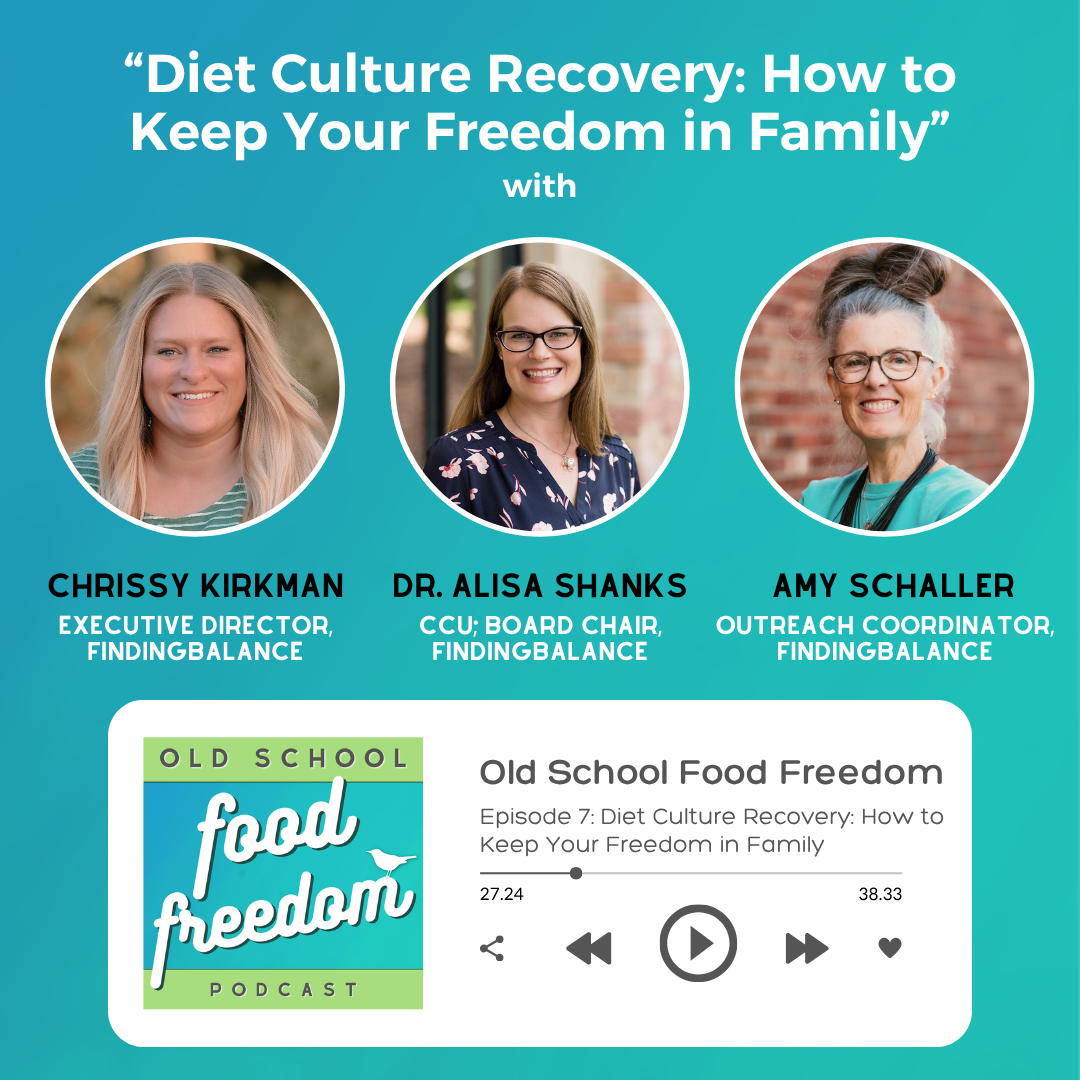
Diet Culture Recovery: How to Keep Your Freedom in Family with Dr. Alisa Shanks and Amy Shaller
"No matter what size you are, God can use you right here, right now."
If you have finally stopped dieting and now you are the only one at the table who has, this episode is for you. The people who love you keep bringing up your weight, or theirs, or the new plan they are trying. Family dinners come with commentary. Health conversations are really weight conversations wearing a different shirt. And even when you know you are free, the pressure to justify why you are eating what you are eating, or why you stopped trying to shrink, does not stop just because you decided to stop playing along.
Today on the Old School Food Freedom Podcast, Chrissy sits down with Dr. Alisa Shanks, clinical psychologist and FINDINGbalance board chair, and Amy Schaller, FINDINGbalance Outreach Coordinator, for a Q&A mixtape built entirely from listener questions. These are the questions women wrote in with: How do I handle my mom, my husband, my in-laws, the friend who keeps commenting on my body, the doctor who keeps commenting on my weight? Alisa brings her clinical psychology training. Amy brings lived experience and years of walking with women in recovery. Together they answer the questions most of us are afraid to ask out loud.
Here's what we cover:
What to say when family and friends keep telling you that you need to lose weight, and how to hold the line without cutting people off
Why the nutrition science we grew up trusting was itself shaped by diet culture, and what that means for the advice we keep hearing
Why yo-yo dieting is harder on your body than staying at a larger weight, and what the research actually says
How to stay free around people who are still caught in the old rules, including when those people are the ones you love most
The specific move of stepping away from New Year's conversations and leaving events early when the talk turns to bodies
Where medical reality fits into the health-at-every-size conversation, because listeners keep asking and the answer is not simple
Friend, if you have been dieting your whole life and someone has finally told you that you do not have to, this conversation is for you. If you are standing at the table watching your family stay stuck in what you just got out of, this is for you, too.
"Our Lord is looking at our heart, not our size and shape. It doesn't disqualify us from life and service." — Amy Schaller
Getting out of diet culture is one kind of work. Staying out when the people around you are still in it is a different kind of work, and it is the harder one. It asks you to hold two things at once: love for the people who keep pulling you back and clarity about what you are no longer going to do. Their fear is not yours to manage. Their choices are not yours to fix. You still get to sit at the table, and you still get to eat.
Send this to someone who has been told to shrink and is tired of the rules, who is finally ready to stop trying to earn the right to eat.
We’d love to hear your thoughts, so please drop us an email at admin@findingbalance.com, send us a voice message via SpeakPipe, or you can also subscribe for more practical episodes coming your way.
More About Dr. Alisa Shanks
Dr. Alisa Shanks has been a licensed clinical psychologist in Colorado since 2004, having built her career around three deep passions: her faith, eating disorder recovery, and university mental health. She has served at Biola University and the University of Colorado at Boulder, and currently serves as Director of the Larry Crabb Center for University Counseling at Colorado Christian University in Lakewood. Dr. Shanks believes wholeheartedly in full eating disorder recovery and brings that conviction to everything she does. She also serves as Chair of the FINDINGbalance Board of Directors and brings over two decades of clinical expertise to her role. Alisa has been married for 25 years and has 2 teenage sons.
More About Amy Schaller
Amy has been involved with FINDINGbalance since 2006 as a volunteer, donor, and friend to the ministry. Like our Founder, Constance Rhodes, Amy’s personal experience with finding freedom from food issues served as a catalyst for the work she has done as Outreach Coordinator, using her gifts to connect and encourage many of the people FINDINGbalance serves. Amy lives in California with her husband, Mark. They have one son.
Scripture References:
Body Image: Ephesians 2:18-10, 1 Timothy 4:8, 1 Peter 3:3-4
Weight Loss: Matthew 6:25, Colossians 3:2, Galatians 1:9-10, Ephesians 6:10-12, Galatians 5:22-23, Mark 7:15, Ephesians 9:7, Lamentations 3:19-24, Isaiah 55:1-2
Intuitive Eating: Romans 14:1-3,6b, 2 Corinthians 3:17, Galatians 1:9-10
Connect with Dr. Alisa Shanks:
Christian Treatment Finder Profile
FINDINGBALANCE:
Facebook
Instagram
SpeakPipe – send us a voice message
CHRIST-CENTERED RESOURCES TO HELP YOU FIND FREEDOM
The Daily Vitamin eDevo: A free devotional with bite-sized truth emailed 5 days a week
Community Groups: Find connection with prayer groups and our Hello, Freedom! community.
Christian Treatment Finder: Connecting you with Christian providers experienced in treating eating issues.
Lasting Freedom Online Course: A Christ-centered, non-diet course to work through false beliefs about food and weight so you can live free from disordered eating and body image issues.
CREDITS:
Intro music by “MokkaMusic” – Old Jeans (Funk)
Production & Editing by Marketing With Wisdom
_
The content in this podcast is for informational purposes only and is not intended to diagnose, treat, or prescribe a particular course of action. If you have, or suspect you may have, an eating disorder, please consult your healthcare provider. If you desire to receive faith-based care, visit ChristianTreatmentFinder.com to browse professionals with a Kingdom campaign against eating disorders.
More about the Old School Food Freedom Podcast
In today’s diet-culture society, food issues and body hatred have become the norm. But you were created to be FREE. Welcome to Old School Food Freedom, where we go back to the basics, God’s basics, for how we view food, our bodies, and our worth.
Hosted by FINDINGbalance Executive Director Chrissy Kirkman, this podcast features Biblically-sound experts, thought-leaders, artists, and everyday people who will inspire you to interrupt negative cultural soundtracks and rediscover God’s original design for your relationship with food and your body.
This show will deliver practical, faith-filled insights on how to break free from diet culture and body shame through the lens of scripture. If you’re looking for guidance on how to heal your relationship with food while deepening your faith, you're in the right place.
We’ll answer questions like
What does the Bible say about food freedom?
How can I overcome an eating disorder or disordered eating with Jesus?
What is the biblical perspective on diet culture?
How can I find peace with food as a Christian?
What does it mean to treat your body as a temple in relation to eating?
How can I break free from diet culture with Jesus?
How can I align my eating habits with biblical teachings?
What are the first steps to finding food freedom in Christ?
This podcast is for anyone ready to walk away from diet culture and into the freedom that Christ offers. Whether you’re recovering from an eating disorder, disordered eating, wrestling with body image, or simply craving a more peaceful relationship with food, this space was made for you.
If you want to experience true food freedom with Jesus, this podcast will give you the encouragement, truth, and tools to do just that.
The unedited transcript for this episode of Old School Food Freedom
Chrissy Kirkman [00:00:42 - 00:00:55]: We're so glad you're here with us today. Let's get into today's episode. Hey, ladies, welcome to the show. Yeah.
Mixtapes and Nostalgia
Dr. Alisa Shanks [00:00:55 - 00:00:55]: Hello.Chrissy Kirkman [00:00:55 - 00:01:21]: Hello. So much fun. If you have listened to our first 3 episodes, you're going to be familiar with today's crew. If not, let me do some quick introductions. So first, we have Dr. Elisa Shanks. She's a clinical psychologist, our Finding Balance board chair and resident expert. She's the director of the Larry Crabb Center for University Counseling at Colorado Christian University.
Chrissy Kirkman [00:01:21 - 00:01:41]: In Lakewood. And we have Amy Schaller. She's our Outreach Coordinator here at Finding Balance. She uses her gifts to encourage those we serve. She loves connecting with current and future donors. She's a prayer team leader and a community group leader, all the things. And so, girls, I'm so glad to be here with you today.
Dr. Alisa Shanks [00:01:41 - 00:01:42]: Awesome.
Amy Schaller [00:01:42 - 00:01:43]: We're excited to be here.
Chrissy Kirkman [00:01:43 - 00:01:43]: Super fun.
Dr. Alisa Shanks [00:01:43 - 00:01:45]: I'm excited.
Chrissy Kirkman [00:01:46 - 00:02:04]: Well, today's episode is called Q&A Mixtape. Because we're old school, we really liked mixtapes back in the day. Do you both remember mixtapes? Did you make mixtapes of your own? Did you receive a mixtape from a guy? Like, I want to hear it.
Dr. Alisa Shanks [00:02:06 - 00:02:16]: Well, I guess I'll start. I still have mixtapes. Maybe they're not on cassette, but I got them on my— what is it? iPod? Yeah, iPod. Oh yeah. iPod still.
Amy Schaller [00:02:16 - 00:02:16]: Yes.
Dr. Alisa Shanks [00:02:17 - 00:02:32]: Yeah. Yeah. And on my phone too, with mixtapes for finding balance about body image songs and prayer songs, scripture songs, lots of fun stuff. I even made one for my husband, but he hasn't heard it. So—
Chrissy Kirkman [00:02:33 - 00:02:37]: Aw, like you made one back in the day and you never shared it with him, or you've made one recently?
Dr. Alisa Shanks [00:02:39 - 00:02:51]: I have one that I collect songs and I add to it and I add to it. One for my son as well. songs that share the love, I guess, that make me— when I hear the song, I think of them or experiences with them.
Chrissy Kirkman [00:02:51 - 00:02:53]: So that's the heart of it.
Amy Schaller [00:02:53 - 00:02:57]: That's the heart of a mixtape, right? When I hear— when I hear this song, I think of you.
Dr. Alisa Shanks [00:02:58 - 00:02:58]: Totally.
Amy Schaller [00:02:59 - 00:03:35]: I, yeah, I'm a, you know, '70s, '80s, '90s girl, so I had like the REO Speedwagon and just the Duran Duran, all the classic stuff on my mixtapes and Chrissy, as we were talking, right, it was such a different time. We would sit listening to our radios, waiting for the first few notes of the song in order to hit record. Because as all these youngins don't understand, we didn't have music available at our fingertips per our every little whim and wish, right? So we had to wait patiently.
Chrissy Kirkman [00:03:36 - 00:03:36]: Yeah.
Amy Schaller [00:03:36 - 00:03:46]: Hope that we knew the opening. you know, 3 chords of the song and could hit record as soon as it came on in order to get our music.
Chrissy Kirkman [00:03:48 - 00:03:49]: It's so true.
Dr. Alisa Shanks [00:03:49 - 00:03:49]: Exactly.
Chrissy Kirkman [00:03:50 - 00:04:37]: And I remember my cousins and I, I had some cousins who I would direct, like we were gonna be DJs, and I would ha— I had this whole like setup where I could record and then you'd pause and then you'd record, like, Either, like, we would record ourselves as the DJs, and this is Kansas City's hit radio station, whatever it was. And I'd be— and I remember just saying like, sorry about that mistake, folks. And then I just, I have flashbacks now, like I'm doing a podcast. What is different? It's really nothing is different. Somebody else is doing the editing maybe, or there was no editing back then. And oh, it was just so cute. And so we would put our Like wait for our favorite songs to come on, maybe in order. Like we wanted this particular song.
Chrissy Kirkman [00:04:37 - 00:04:42]: Oh yeah. And so it's like Milli Vanilli or some weird stuff. I don't, I don't even know.
Amy Schaller [00:04:42 - 00:04:49]: I, I went to a Milli Vanilli concert before we knew they were lip syncing.
Chrissy Kirkman [00:04:50 - 00:04:51]: Are you?
Dr. Alisa Shanks [00:04:51 - 00:04:51]: Could you tell?
Amy Schaller [00:04:51 - 00:05:03]: No, we had no idea. Kansas City. I was, I went to Milli Vanilli in Kansas City. Yeah. Before the big scandal that they weren't actually singing. Right. Wow.
Chrissy Kirkman [00:05:04 - 00:05:34]: That was actually pretty heartbreaking too. I, I mean, what I, and I feel like a lot of people probably do that still in real life because I don't know. Um, yeah. So interesting. Back in the day we had some good times back then and there's great times happening now. And I still, I think I still have a couple of cassette tapes. I know I have the one with me and my cousins, but it's, I, I listened, listened to it back in May when we were cleaning. cleaning our basement, it was cringe city.
Chrissy Kirkman [00:05:35 - 00:05:55]: I could not handle it. My husband's like looking at me like, please turn it off. This is so like, it started out real cute when we were maybe like 7 and 8. Then it changed to like middle school when everything's falling apart in your life and you're just like this weirdo. Like, it's so sweet.
Dr. Alisa Shanks [00:05:55 - 00:05:56]: I don't know.
Chrissy Kirkman [00:05:56 - 00:06:15]: I thought I was— I can't speak for everyone. I was a— it was tough in middle school. Anyway, it's a hard season. All right, well, it's so, so hard. Well, friends, we want you to know that you're not alone in your struggles with food and body image. You're just not alone. We get you. We understand.
Opening Up About Food and Body Image Struggles
Chrissy Kirkman [00:06:15 - 00:06:46]: And here at Finding Balance and the Old School Food Freedom Podcast, it's our heart's desire to help you find the truth and know freedom in Christ. So we've put together this Q&A Mixtape episode to answer your questions from a Christ-centered, biblical perspective. We've got really some great questions that have come in, so we're going to kick it old school, Food Freedom style. So, Elisa, question number 1, is it okay to be a Christian in a larger-sized body?Amy Schaller [00:06:47 - 00:07:49]: Yes, yes, and yes. It breaks my heart that this question is our first question. And it breaks my heart that in Christian circles and our culture, that people have been told that it's not okay to be in a larger body. If you listen to our Diet Culture Soup episode, we talk about the scarcity model, and we talk about that it is difficult to be in a culture that values a certain shape and size as beautiful and admired and desired. But it is absolutely okay because God made us unique. God made us diverse. And you know the little bell-shaped curve, right? There is a bell-shaped curve for height, for eye color, for hair color, and for weight. And even— this is crazy, there's science behind this— if every person on this planet ate the exact same diet every day, there would still be a bell-shaped curve of weight distribution in the population.
Amy Schaller [00:07:49 - 00:08:18]: And that has to do with our genetics, whether or not we're moving our bodies, all these things. So, of course, of course, it is okay. It should be celebrated that God made us diverse, and that we show up in different sizes and shapes. And it makes my heart so sad that men and women that are in larger bodies are subject to shame. for not falling within the culturally acceptable range of weight?
Chrissy Kirkman [00:08:20 - 00:08:40]: Yeah, it is. It's hard. It is very sad that this is our first question. And it was, to me, I can relate to this. I remember the times when I would future cast in my head and feel like, well, once I lose this weight, then God can really use me. If I can just drop X number of pounds, Then I will be acceptable.
Dr. Alisa Shanks [00:08:41 - 00:08:42]: Yes.
Chrissy Kirkman [00:08:42 - 00:09:27]: And ready for service. But I'm, I can't, he can't use me the way I am now. And let me be here to tell you that that is a lie from the pit of hell because he chose to use me in the role, this role at Finding Balance, to continue leading this ministry at the largest weight I have ever weighed. And that was post-heal, like through my healing, breaking free, overcoming the lies. It was a lot of work. It was a lot of— it was hard, but it was worth it. And, and now trying to lose weight isn't the focus because we're God's masterpiece. Amy, I know you, you, you found some verses.
Chrissy Kirkman [00:09:27 - 00:09:28]: You've got this.
Biblical Truths on Body Image
Dr. Alisa Shanks [00:09:29 - 00:09:48]: Ephesians 2:10. We— I will say, we are each God's masterpiece. Ephesians 2:10 says, for we are God's handiwork, created in Christ Jesus to do good works, which God prepared in advance for us to do. No matter what size you are, God can use you right here, right now.Chrissy Kirkman [00:09:48 - 00:10:10]: So good. We have another question that's very similar. This person says, I struggle with accepting my body with extra weight. No matter how hard I try, I am struggling to let go of the dream of being smaller again, and not having guilt and shame over my current size. How do I let go?
Overcoming Body Shame and Letting Go
Amy Schaller [00:10:11 - 00:11:07]: That— it's hard. And it's hard because of the culture we live in. It's hard because we have, by swimming in this soup, we've absorbed the flavor, right? We've absorbed the marinade. And so We are subjecting ourselves to the fat prejudice of our culture, and that is not freedom. And so, um, it might require, like, clinical intervention, like a therapist. It might be that the Lasting Freedom course through Finding Balance would be a blessing and a support, but it's going to take some undoing of the cultural programming. And some immersion in the Word of God, in faith. And Chrissy, maybe this is a piece of you sharing a little bit of your story of finding freedom and hope and acceptance and just being able to let go of that constant desire to lose weight.Chrissy Kirkman [00:11:09 - 00:12:09]: Yeah, and I'll tell you, I feel like I'm walking in freedom in many ways. And I still struggle because we're still part of this diet culture. And I see these messages come through. You know, I'll be downstairs watching TV and like I took my lunch break and the TV was on and it goes from this weight loss ad to the next weight loss, 3 in a row. And I have a hard time just sitting there and ignoring it because that— so I'm having to speak out and say, No, this person was just as worthy at this weight before they lost all. And I'm like speaking this out. My husband just, he's used to it by now. But, but to, to feel that, that I need to lose weight, there are times when I still find myself wishing I could or feeling like, like we had a, a Finding Balance fundraising strategic planning in California, went to visit Amy and And I still had hesitation.
Chrissy Kirkman [00:12:09 - 00:12:38]: Like, this is, these are my, the, y'all, y'all are my people. Like, you love me and I know that you're not gonna, like, reject me. I'm not gonna reject you. Body size shouldn't matter. We've seen each other 3 times. Like, we all live across, um, United States. So, you know, it's kind of harder to get into pers— in person together as much. But, um, but still there was like part of me felt like I wanted to hide and shrink and those old Habits, now I'm— I can more quickly turn them around.
Chrissy Kirkman [00:12:39 - 00:13:00]: And these verses can come to mind easily. And I know the enemy I'm fighting. I know that Satan wants me to get stuck in that. And I'm not, I'm just not having it. Like, I'll go there for a second, but it's a quicker turnaround. But it wasn't always that way. So just hear me say, have hope that it can happen for you. It is possible for you.
Chrissy Kirkman [00:13:00 - 00:13:04]: Jesus cares about this. He He's here for you. He's waiting for you.
Dr. Alisa Shanks [00:13:04 - 00:13:23]: I want to say 2 things to that. The first is surround yourself with people who love you, who love you unconditionally, and you can find them. The other is, Chrissy, you should have spoken to Liesl and I last week and let us know how you were feeling so we could speak truth into you and tell you those are lies.
Creating Boundaries and Curating Our Feeds
Amy Schaller [00:13:23 - 00:14:30]: And I was gonna just add that considering what comes in, right, you have no control, Chrissy, about the weight loss ads over lunch television. But we do have the ability to curate a lot of what comes our way. If that's on Snapchat or Instagram or Twitter or wherever your social media feeds are, you can stop following people that are promoting their eating disordered or weight loss stories or promoting dieting and transformation pictures. Like, it is a good choice to change what is coming into your system in the ways that you can, and do what I'm going to call a purge, but purge the people whose messages are not about loving yourself no matter what. And cut off the messaging that talks about constantly needing to lose weight or eat clean or those kinds of things.Chrissy Kirkman [00:14:32 - 00:15:08]: Yeah, that's great. It's very helpful. I did a total purge a while back, years ago, with Instagram, Facebook, sometimes even friends I had to just unfollow. Like, we're still connected. I just had to unfollow. Like, I can't— it's too hurtful for me, or it's too triggering at times. It, it would trigger, trigger me into want to do things that I don't need to do that aren't beneficial for me. So that is, that is a way to let go and then to replace, because it's a, it's called a feed and we're consuming it.
Chrissy Kirkman [00:15:08 - 00:15:33]: It's, it's feeding us. What is feeding us? I'd rather be fed with seeing people that maybe dress more like me or have a similar body, but I don't wanna just be only focused on people with a body size that's like mine. Because it's not that our body— all bodies are good. All bodies are good. So there needs to be variety.
Dr. Alisa Shanks [00:15:33 - 00:15:33]: Yeah.
Amy Schaller [00:15:34 - 00:16:29]: Absolutely. And one of the quotes I use all the time in therapy is good old Teddy Roosevelt. I don't know which president number, but he was one of our presidents a long, long time ago. And he said, comparison is the thief of joy. And that's a piece of what we're talking about, whether it's comparing your now body to your before body, or your now body to your idealized, presumptive, where you think you want to go, your goal body. Comparison is the thief of joy. And, and our God gives us rich, deep, bubbling up reserves of joy But this body image stuff is a joy thief. And when you're comparing yourself to other people, to yourself, to your ideal, to your prior body, that is stealing your joy.
Amy Schaller [00:16:29 - 00:17:28]: And those messages are not from God in heaven. Those messages are from hell and the devil. And so being able to break free and immerse yourself in the Word of God— we are God's workmanship. We are fellow heirs through Christ, right? God loves us no matter our shape and size, no matter whether we are able-bodied or anything. He loves and adores us, and he has prepared, prepared good works for us to walk in. And when we inhibit ourselves by saying, well, I won't volunteer, I won't serve, I won't, you know, whatever that thing is, until I've lost X amount of pounds, then we are not allowing God to use the good gifts that he gave us because of this comparison struggle.
Chrissy Kirkman [00:17:29 - 00:17:35]: Amy, what other verses can help us to change our thinking about in this area?
Focusing on the Heart, Not the Appearance
Dr. Alisa Shanks [00:17:37 - 00:17:55]: Well, there's 1 Peter 3:3-4. Your adornment must not be merely external, braiding the hair and wearing gold jewelry or putting on dresses, but let it be the hidden person of the heart with the imperishable quality of a gentle and quiet spirit, which is precious in the sight of God.Chrissy Kirkman [00:17:56 - 00:18:16]: So good. So good. And Elisa, when you were talking about the thief of joy, And here we've been talking over at Finding Balance about the joy of the Lord is our strength. So if, if we're praying for joy rather than strength, like God's gonna— we're praying, God, give us joy.
Amy Schaller [00:18:16 - 00:18:17]: We have joy.
Chrissy Kirkman [00:18:17 - 00:18:43]: And there's, you know, like our friends over at Joyful Movement, like that's not just movement. I've gotta like work out all the time and it's gotta be, you know, no pain, no gain. No. What about joyful movement where you're having fun moving your body and it's joyful. And that becomes our strength, you know, the joy of the Lord is our strength. But when that's being taken away by the thief, whoa, that's detrimental, debilitating.
Addressing Weight Loss Desires
Dr. Alisa Shanks [00:18:44 - 00:18:44]: Okay.Chrissy Kirkman [00:18:45 - 00:18:57]: So next is, it's just kind of like moving into weight loss. Someone asked or said, I'm afraid of weight gain. How do I let go of the desire for weight loss? Is losing weight not acceptable?
Amy Schaller [00:18:58 - 00:20:23]: This is hard, right? Because we live in a culture that values bodies in a certain size and shape range. And so it's very natural for us to also, you know, subscribe to those ideas. At Finding Balance, right, our name is about balance. And so it is okay, right? We honor that as human beings, as men and women, In our bodies, there are times and seasons where we want to lose weight. I think what is key, because we're an organization that believes in food freedom, it's the name of the podcast, that the desire to lose weight kind of— you navigate that in a nuanced way, right? Because a lot of weight loss efforts are actually consistent with eating disordered behaviors. And so there is nothing that we would want to promote or condone that would suggest that eating disordered behaviors are good or healthy or something we would want you to do. But we also— it's a both/and, right, which is hard. We also recognize that sometimes people are told by their physicians that they need to lose weight for health reasons, Um, sometimes people are just grappling with, with different life seasons.
Amy Schaller [00:20:24 - 00:20:37]: So it is both okay to want to lose weight and to figure out how to not want to lose weight. Um, I'm walking a fine line here, right?
Dr. Alisa Shanks [00:20:37 - 00:20:37]: Yeah.
Amy Schaller [00:20:37 - 00:21:11]: It's a tightrope. Um, because we wanna honor, of course, the feeling is there, right? I mean, we've all had that feeling. But figuring out how to navigate it in a healthy, non-eating disordered way, that is important where you're not starving yourself because actually starving yourself then promotes binging on the flip side and can get really out of control. I also advocate— you were talking a second ago about joyful movement, right?
Dr. Alisa Shanks [00:21:11 - 00:21:11]: Yeah.
Amy Schaller [00:21:12 - 00:22:40]: When I get to teach and speak about exercise, I talk with people about moving your body for strength, endurance, and stress relief, right? Instead of approaching your workout as, you know, I'm gonna whip this body into shape and I'm gonna shave off these extra pounds, or I'm gonna sculpt this or sculpt that. That feels stressful and sometimes judgmental and really intense. And so if we can move towards, again, freedom, we want food freedom, exercise freedom, honoring our bodies, move our bodies, get out, go for walks, go for runs, do what feels good to your body within balance, right? If you need to run a marathon every day, that's a little out of balance. And frankly, your body won't put up with that for any length of time, right? That's not feasible. But thinking about how can you both honor your desire to lose weight and also move towards maybe not having that desire to lose weight, but accepting and loving yourself. So what does it mean to want to lose weight? And what is the method by which you're trying to do that? And then navigate that in a way that is as healthy and balanced as possible. What do y'all want to add to that?
Dr. Alisa Shanks [00:22:42 - 00:23:53]: I would love to add something because I was a personal trainer for 25 years. And I worked with people who were frail, elderly, special populations like developmentally disabled seniors, chair exercise. And it's just about moving, moving your body through air, moving, riding your bike and feeling, feeling the joy of having the, the wind blow through your hair, the I don't know, the wind go through your ears, just things that make you feel alive. And buffeting your body is not necessarily the way to go. Yeah, it's just enjoying movement. And if you're having struggles with that, maybe find somebody who can exercise with you or move with you, or You know, contact a fitness association and see if they have local personal trainers who specialize in working with people who have disordered eating or eating disorders. They're out there. Matthew 6:25 says, therefore I tell you, do not be anxious about your life, what you will eat or what you will drink, nor about your body, what you will put on.
Dr. Alisa Shanks [00:23:54 - 00:24:02]: Is not life more than food and the body more than clothing? And Colossians 3:2 says, set your minds on things above, not on earthly things.
Chrissy Kirkman [00:24:03 - 00:24:16]: So good. So helpful. Okay, here's another question. I'm afraid of losing control around sweets. How do I find peace? Oh, been there.
Navigating Sweets, Restriction, and Bingeing
Amy Schaller [00:24:18 - 00:25:26]: Yeah, that, that's hard. And, you know, there is debate around whether people can struggle with sugar addiction. I've— I know people personally who feel like sugar just, you know, sends their body up into the stratosphere. And I've worked with clients who felt like they just could not trust themselves around sugar and sweet foods. Again, balance is always going to be our message. So thinking about what does that food do to your mind and what does that food do to your body? Um, when I worked at CU Boulder, there's this lovely downtown area called Pearl Street. It's a walking mall. And with my student clients, we would talk about when you have an urge for something, right? How do we navigate that? If you've had a bad day and you want a treat, I mean, honey, we've all been there, right? We, we all have that, right? We, we want it.Amy Schaller [00:25:26 - 00:25:27]: We feel like we've earned it.
Chrissy Kirkman [00:25:27 - 00:25:28]: We deserve it, right?
Amy Schaller [00:25:28 - 00:25:29]: It's a little something something.
Chrissy Kirkman [00:25:30 - 00:25:56]: But if you've had a bad day and you're wanting to turn to food for comfort, what I would recommend to my clients at that time was to call a friend and then go to the Häagen-Dazs or the Ben and Jerry's that were on Pearl Street and get a scoop or 2 and walk up and down the walking mall and share the ice cream and share the burden. Right.
Amy Schaller [00:25:56 - 00:27:01]: The Bible talks about carrying one another's burdens. So if you want to turn to food for comfort, that's not inherently bad. But let's also add a little community and connection so that you both have the soul-to-soul moment of, I had a really hard, bad day. And also you get that comfort food. So what we sometimes talk about in therapy is we don't want eating to be your only response to emotion, right? If you feel sad and you eat and mad and you eat and lonely and you eat and happy and you eat, right, then that's, then that's not a balanced approach to food. So we want— there will be times, right, in our culture, we do a lot of socializing around food. We meet with people for meals, we meet with people for coffee, we meet with people for ice cream, right? Dessert, whatever, appetizers. But we do a lot of connecting around food, which is fine.
Amy Schaller [00:27:01 - 00:27:25]: But we don't want your only response to emotion to be that I comfort myself with food. So add in that bear one another's burden part, bring in the community. And also what I like about the metaphor or the idea of going to the ice cream store is then you're not alone on your couch with a tub of ice cream, right?
Chrissy Kirkman [00:27:25 - 00:27:25]: Mm-hmm.
Amy Schaller [00:27:26 - 00:28:11]: So you can go get a serving, a portion, and then the losing control around sweets isn't as easy to do because you just have that portion for that moment. And there are times where people have certain binge foods or trigger foods Cereal, ice cream, whatever it is, homemade cookies, and where we say, you know what, right now in your therapy journey, we're going to put those foods on hold. Because you have found that right now you can't quite exactly be trusted to not lose control. And so we're going to do some work, we're going to unpack some stuff to help you find that hope, healing, and freedom. And then we're going to reintroduce some of that into your home and your environment in ways that promote success.
Chrissy Kirkman [00:28:14 - 00:29:16]: So what would you say about, is someone feeling like they're an absolute addict around sugar, like they've got a sugar addiction because as a direct result of tons of restricting and saying, I absolutely, I can't be trusted, I don't have the willpower? Because I'm speaking from Chrissy's experience. I used to feel like an addict, like I would do anything to get sugar, especially the more I said I couldn't have it, the more I restricted, the more stern I was in my food rules. I tell myself, you can't have these things. That's all I wanted. And I would try to stuff that down for so long. And then I would find a way to get it to where I was doing weird things, eating things that were still in the mixed form and not even prepared as they were supposed to, like ridiculous. And I was like, Why can't I just stop, Lord? Like, what is wrong with me? And then the shame cycle would go deeper.
Amy Schaller [00:29:17 - 00:29:59]: But that's what restriction does, right? So when you rule out food groups or food types or sweets or sugar, then it creates— we call it pulling back the pendulum of restriction. And when you restrict something, then you want it, right? When I'm in therapy, I'm gonna— today we're gonna use my, my glass of water. So those of you that are listening and not seeing us, just imagine Imagine a Mason jar of water. But when I'm in therapy, I talk about when I have— when you have smaller kids in your environment, they would never notice a Mason jar of water until I say, hey, don't touch that. That's off limits.
Dr. Alisa Shanks [00:30:00 - 00:30:00]: Yeah. Right?
Amy Schaller [00:30:01 - 00:30:07]: So as soon as this Mason jar of water is off limits, ooh, right?
Chrissy Kirkman [00:30:07 - 00:30:08]: Why?
Amy Schaller [00:30:08 - 00:30:09]: Why is it off limits?
Chrissy Kirkman [00:30:09 - 00:30:10]: It looks so pretty.
Amy Schaller [00:30:10 - 00:30:12]: I'm feeling thirsty. I think I need some water.
Chrissy Kirkman [00:30:12 - 00:30:12]: Right?
Dr. Alisa Shanks [00:30:13 - 00:30:13]: Right.
Amy Schaller [00:30:13 - 00:31:04]: So, as soon as it is ruled out, it is against the rules, unavailable, it's interesting, it's enticing, and it is desired. And that is the same thing when we create food rules. Food rules create bingeing because you're pulling back that pendulum of restriction, you're telling yourself you can't have it, and then suddenly it's the only thing. It's the only thing that has your attention. So with our constant theme of finding balance, right, if you are gonna have a hard time with, you know, a bag of miniature Snickers in your house, then don't buy a bag of miniature Snickers right now, right? But if you want like a Snickers, then you can— it's hard to lose control on a Snickers.
Chrissy Kirkman [00:31:04 - 00:31:04]: Yeah. Mm-hmm.
Amy Schaller [00:31:05 - 00:32:14]: Right? So a piece of finding the balance is curating what's available to you so that there's not space for the binge eating, right? If you can go with a friend and get the ice cream and talk about the hard day, there's not a tub sitting in your freezer waiting for you to devour it and then feel miserable Because you just lost control and that was too much in your stomach. Mm-hmm. So that is very real. When, when we say this is off limits, then it's the first thing we want, right? It takes, it takes all of our time and energy and attention. So again, it's finding that how do we allow for sweets and treats? in a way that doesn't create a binge, um, and doesn't create that craving and that overemphasis. Um, and the reality where you, it's like a self-fulfilling prophecy. I cannot be trusted. Right.
Amy Schaller [00:32:14 - 00:32:30]: We want you to trust. We want you to come back into unity, heart, mind, soul, and body. And when you feel like you cannot trust yourself, Then, then that's out of balance. And it's hard.
Dr. Alisa Shanks [00:32:31 - 00:32:59]: Now, I don't know if the term would be delayed gratification. But it's also that allowing yourself the time to drive to the ice cream shop, or that 5 minutes to think about it. Do I really, really want it? Do I really want to do this? What, what's, what's an alternative? Or what is something else I can do instead of going to the food? And having that delayed, delayed response of thinking about it before just grabbing it and running.
Amy Schaller [00:32:59 - 00:34:13]: And doing that internal inventory of what am I hungry for, right? Not, well, I'm hungry for ice cream, right? Or I'm hungry for whatever that food is. But what am I really like? What is my soul hungry for? Right? Your soul may be hungry for a rest, it might be hungry for a run, you know, those kinds of things. What do you need is different from I must get my hands on sugar, right? That kind of compulsive approach. So taking that moment to pause and take a deep breath and really acknowledge I am craving This, and then to maybe dissect it a little bit. Why did I have a stressful day? Was it hard? Do I feel lonely? Was my boss unkind? Were my kids super overwhelming? Like, what's happening in my marriage? Like, do the inventory. What am I hungry for? What does my soul need right now? And is that going to be met with an ice cream sandwich? Or a hug, right? Or a listening ear, right?
Chrissy Kirkman [00:34:13 - 00:34:13]: Is—
Amy Schaller [00:34:13 - 00:34:28]: can you phone a friend and get those same needs met? Can you go for a walk, right? But also, sometimes what happens is, um, when you have like a craving, um, pick a food. Chrissy, what would be a good craving food?
Chrissy Kirkman [00:34:29 - 00:34:30]: Crawfish pies.
Amy Schaller [00:34:30 - 00:34:34]: All right, so you've got a craving for crawfish pies.
Chrissy Kirkman [00:34:34 - 00:34:35]: Love it.
Amy Schaller [00:34:35 - 00:35:29]: Um, but in your mind you think, well, maybe I shouldn't have the crawfish pies. Um, and so then what you end up doing is you're like, well, I should have the apple. I should eat a banana or a handful of grapes or whatever, right? Maybe the granola bar or the fat-free yogurt, right? So what you can do is you end up eating around the craving, but because you didn't take in that which you really wanted, that amazing crawfish pie, You may even yet end up going and eating the crawfish pie because the banana, the peanut butter, the apple didn't do it, right? So you may just be better off to nourish yourself with that which you're craving, within reason, within your hunger and fullness cues, than to eat around the craving and then go eat the craving too.
Chrissy Kirkman [00:35:29 - 00:35:38]: Amazing advice. And one should always eat the crawfish pie. Let's be honest, they are so good.
Amy Schaller [00:35:38 - 00:35:39]: We're gonna have some crawfish pie.
Chrissy Kirkman [00:35:40 - 00:35:48]: I'm excited about this. Girl, I make them homemade, like hand pies, like crawfish hand pies. So it's gonna be great. Amy, I mean, uh, it's scripture time.
Scripture on Satisfying Hunger and Craving
Dr. Alisa Shanks [00:35:49 - 00:36:19]: I got one that matches with that, with that crawfish pie, which I have never tried, and I need to because you always talk about it. Okay. Come, all you who are thirsty, come to the waters. And you who have no money, come, buy and eat. Come, buy wine and milk without money and without cost. Why spend money on what is not bread and your labor on what does not satisfy? Listen, listen to me and eat what is good, and you will delight in the richest of fare. And that's Isaiah 55:1-2.Chrissy Kirkman [00:36:20 - 00:36:56]: So good. Okay, there are 2 more questions that are kind of similar. So I don't know if there's a different answer for these, or maybe one answer covers, covers them both. But how do you approach, in love, someone who doesn't approve of your body size and tries to get you to lose weight? And then the other question, how do I best relate to my friends and family who are still caught up in diet culture? And do you have tips on how to pray for and encourage them without being triggered? These are really good.
Navigating Triggers, Judgment, and Setting Boundaries
Amy Schaller [00:36:56 - 00:38:29]: Yeah, these are. And they're so— that is just the felt experience of so many of us, right? How do you navigate it when somebody in your life keeps telling you that you need to lose weight for your health or for whatever reason, for the aesthetic? And then everyone who's swimming in that diet culture soup, That is hard. So we talked a minute ago about, you know, managing your social media and your connections. Um, I think also engaging in, um, in education, right? Helping people know that what we are told about weight and shape and size is not actually grounded in science in the ways that we think it is. And, um, a piece of that connects with health at every size and figuring out how do we navigate this culture that links weight and health? And how do we also acknowledge that there are some health issues that are impacted and, and meant sometimes created by having extra pounds on the body? So, um, I think, you know, you can always pray and encourage your friends and also set boundaries. Huge fan of boundaries. Um, and that's knowing when to just leave the situation. Um, whether that's, you know, we talked about in our last episode, the New Year's and sometimes preaching about weight loss and things like that.Amy Schaller [00:38:29 - 00:39:53]: Um, knowing what those triggers might be and trying to keep yourself safe. Also setting the boundary like, hey, if you guys are gonna be You know, making fat jokes or talking about people's shape and size. I don't want to participate in that, so I may just leave the event early. And that can feel awkward, but it's also you standing up for what's important to your heart and your soul and not exposing yourself to things that are going to be really hard. Um, in terms of the person who you love and who hopefully loves you that is trying and trying to get you to lose weight, Um, I think helping to educate them about, um, the realities of our science being impacted by diet culture and not always being as strong of science as we want it to be. Um, there are a lot of resources out there on that, but that's really complicated because that means that person is invested in diet culture and invested in trying to help you drop into that scarcity model, hard to achieve size and shape. And that may not even be realistic with genetics and time and energy and money and opportunity. And so I think health concerns, yeah, health concerns, all of it.
Amy Schaller [00:39:53 - 00:40:34]: But I think trying to help that person understand that their messaging about your need to lose weight is actually harmful to you. And, um, you know, part of what the science has shown is that the yo-yo dieting is actually worse for people than just being and maintaining a larger body. And so when we dive into more of the science that supports a health at every size perspective, that can sometimes help people that are very worried about size and shape and worried about medical concerns. And there are, for some people, there are medical ramifications.
Chrissy Kirkman [00:40:34 - 00:40:34]: Yeah.
Amy Schaller [00:40:35 - 00:41:55]: But for a lot of people, the medical ramifications are not present in certain ranges. And so maybe helping them, helping them understand what their concern about size and shape is doing to you. And also helping, like seeking to understand why they're so concerned. And what is that? Is that, you know, just the way that culture has conditioned them to believe that bodies should look? Or is there something different or deeper? Sometimes we work with clients who their eating disorder roots out of having parents that had health struggles due to weight issues. And so that there's an eating disorder agreement around, I will never, you know, allow myself to be in that space. And that's, that's not a healthy agreement, right? Um, but there can be some causation around, oh, you know, my father had a heart attack, so now I need to engage in these behaviors in order to never have a heart attack because that was hard or scary for me. So that's rooted in trauma. And you know, if you can engage in healthy behaviors and healthy movement and great nutrition with outstanding foods, that's awesome.
Amy Schaller [00:41:55 - 00:42:03]: But when it's coming from that place of fear or panic, Um, then it may not be coming from the right space.
Dr. Alisa Shanks [00:42:04 - 00:42:32]: And that speaks to me because my dad was 65 years old when he had a major heart attack on a treadmill at a gym where he had been relig— a religious exerciser for like 10 years, you know, and died right there at the gym. So, um, that speaks to me because that's a great fear. I'm getting close to the 65 mark, and I think about that all the time. So, Thank you for, for answering the question that way.
Chrissy Kirkman [00:42:32 - 00:42:40]: And Amy, what scripture— do you have scriptures that would help us see what God's Word has to say?
God's Acceptance and Looking Beyond Outward Appearance
Dr. Alisa Shanks [00:42:41 - 00:43:26]: Well, about the how do I best relate to my friends and family who are still caught up in diet culture, it says, accept him whose faith is weak without passing judgment on disputable matters. One man's faith allows him to eat everything, but another man, whose faith is weak, eats only vegetables. The man who eats everything must not look down on him who does not, and the man who does not eat everything must not condemn the man who does, for God has accepted him. He who eats meats eats to the Lord, for he gives thanks to God, and he who abstains does so to the Lord and gives thanks to God. Romans 14:1-3, 6b. Mm-hmm.Amy Schaller [00:43:26 - 00:44:02]: The one that I was just thinking of was 1 Samuel 16:7, where the Lord is speaking to Samuel about choosing David as the new king. And he says, do not look on his appearance or on the height of his stature, because I have rejected him. For the Lord sees not as man sees. Man looks on the outward appearance, but the Lord looks on the heart. And that's— our Lord is looking at our heart, not our size and shape. It doesn't disqualify us from life and service.
Chrissy Kirkman [00:44:02 - 00:44:35]: Wow, that's good. I don't know if we could end on a better note. Like, that is so encouraging. And I feel like so many of us believe a lie that we are disqualified, that we cannot be used. Until we get these things fixed. But God wants us to show up just as we are. He doesn't say, when you get these things together, then I'll listen to your problems. No, actually, this letterboard behind me, I always do different lyrics on it.
Chrissy Kirkman [00:44:35 - 00:45:01]: And it says, you don't leave us where you found us. Like, A, he's— you're good. You can show up just as you are, just as I am. No matter how that looks right now. And when he finds you there, because he already sees you there, he's waiting for you to say, Daddy, hold me. Like, here I am, I'm coming back to you. And then he's not going to leave you where he found you. Like, that's not the God we love and the God we serve.
Closing Thoughts and Resources
Chrissy Kirkman [00:45:02 - 00:45:46]: Wow, I am so excited to do another Q&A mixtape. This was great. You gotta love the mixtape. Thank you for listening to the Old School Food Freedom Podcast. For over 20 years, Finding Balance has been helping people walk in freedom by discovering where Jesus fits into their struggles with food and body image. If you want more biblical truth and encouragement, head on over to findingbalance.com and subscribe to our free daily vitamin devotional. While you're there, explore our Christ-centered Lasting Freedom online course and small group tools. You can help keep this ministry going by donating today at findingbalance.com.Chrissy Kirkman [00:45:47 - 00:46:08]: See you next time. The content in this podcast is for informational purposes only and is not intended to diagnose, treat, or prescribe a particular course of action. If you or someone you care about is battling an eating disorder or is If you're experiencing unmanageable thoughts or feelings, please call 911 if in the US, or visit your nearest emergency room.
