
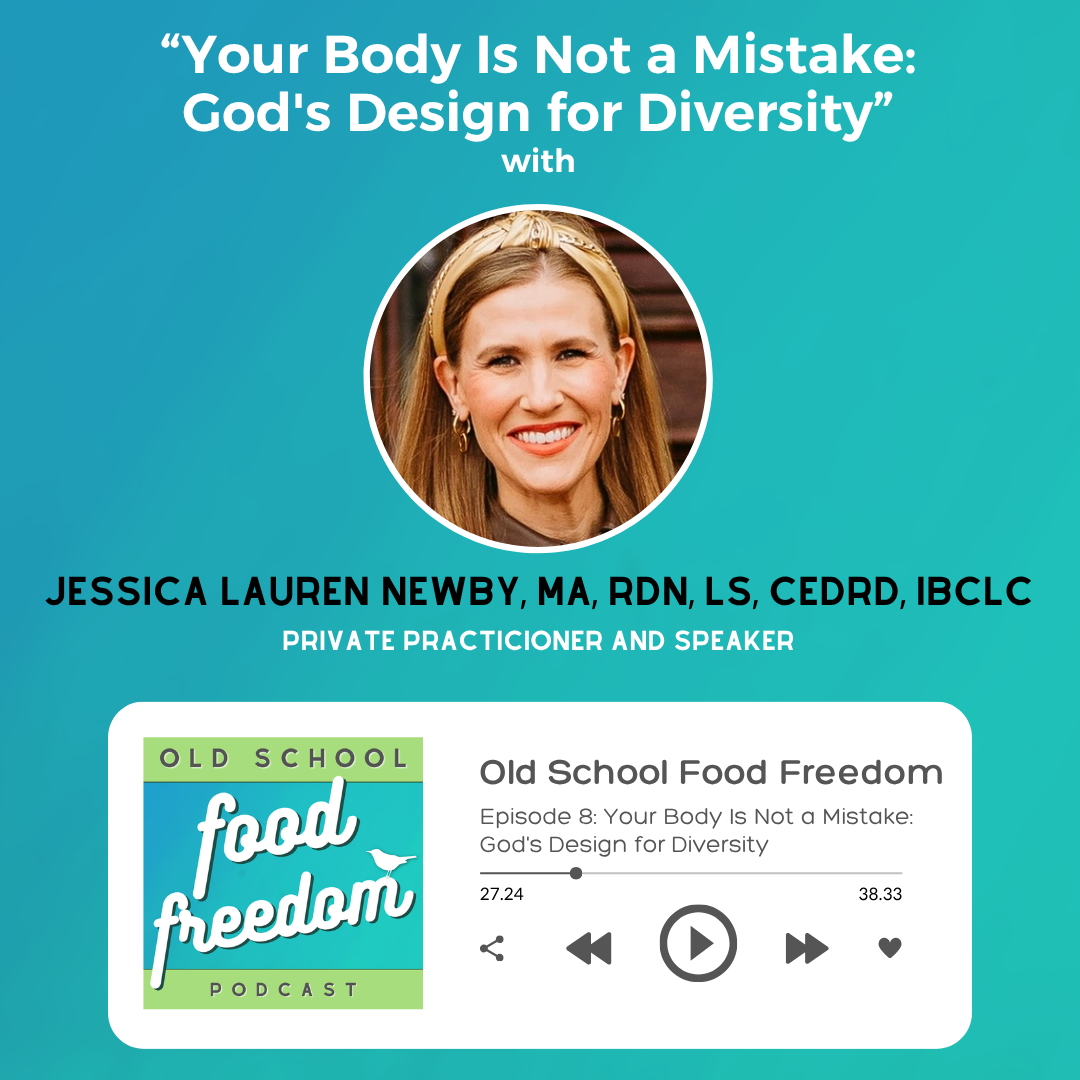
Your Body Is Not a Mistake: God's Design for Diversity with Jessica Lauren Newby
"In the kingdom of God, there is this thing we're supposed to move towards in unity. We are supposed to all be striving to look more like Christ. And I think sometimes we misinterpret that as uniformity."
If you have grown up in a Christian environment, you've probably heard the call to unity. Look like the body of Christ. Act like the body of Christ. And somewhere in there, that got tangled up with your body. Your body became the thing that needed to be controlled, too; the size it had to be, the shape it had to hold, the discipline it took to keep it that way. And if your body didn't fit that picture, well, you had work to do.
God made diversity on purpose. Not as an accident. Not as something to apologize for or fix. He made it intentional. Birds and fishes and dogs and humans, scattered across the earth in ten thousand different configurations. Colors in our eyes, sounds in our voices, builds that don't match anyone else's. God made your body a design. And the fact that it looks like your body, not someone else's, was the point.
But we live in a world, and often in churches too, that whispers a different story. There is a right way to look. A right way to move. A right way to eat that will finally make you acceptable. And when you believe that, you stop listening to the voice inside you that knows what your body actually needs. You hand that knowledge over to external rules. You trust diet culture more than you trust what God put inside you.
Today on the Old School Food Freedom Podcast, Chrissy sits down with Jessica-Lauren Newby, a registered dietitian who specializes in eating disorders and has come out of diet culture herself. Jessica-Lauren brings both clinical expertise and deep faith to the conversation about what it means to reclaim diversity, to listen to your body again, and to keep walking free when everyone around you is still bound by the old rules.
Here’s what we cover:
Why unity in the body of Christ was never meant to mean uniformity in bodies
What it looks like to trust your body's signals again after years of overriding them
How fasting and nourishment fit together in a way diet culture never taught you
The difference between knowing about God and knowing Him personally, and why that changes what you believe about yourself
What freedom actually looks like in the small, everyday moments (not just the big breakthroughs)
How to keep walking free when the people you love are still following the old rules
The scripture that anchors your identity in what God sees, not what the mirror shows
Friend, if you're tired of trying to fit into a mold God never made you for, and you're ready to know what He really says about you instead of what culture demands, this conversation is where you land.
"I fought so hard for this freedom so that my body could recover and so that I could sit here and revel in this moment." - Jessica-Lauren Newby
Walking into freedom means knowing what God says about you. That you were knitted together in your mother's womb. That He sees you and doesn't make mistakes. When the enemy whispers you're not enough, you can turn it back and say, "Did my God really say that?" Because you know He didn't. It's the difference between knowing about God and knowing God personally. And when you know Him personally, you know His voice. You can tell the difference between what He says and what the world is telling you.
Send this to someone who grew up believing there's one right way to look and act, who is tired of trying to fit into a mold God never made her for, who is ready to know what God really says about her instead of what culture demands of her.
We’d love to hear your thoughts, so please drop us an email at admin@findingbalance.com, send us a voice message via SpeakPipe, or you can also subscribe for more practical episodes coming your way.
More About Jessica-Lauren Newby
Jessica-Lauren is a Registered Dietitian, Certified Eating Disorder Specialist-Supervisor, and International Board Certified Lactation Consultant. She owns “With Milk and Honey,” a nutrition therapy practice rooted in meeting clients exactly where they are in their journey.
Mentioned Scriptures
Psalm 139:14, Psalm 139:13, Psalm 139:16, Genesis 3:1, 2 Corinthians 2:15, Ephesians 6:10-18
Connect with Jessica-Lauren Newby:
Christian Treatment Finder Profile
FINDINGbalance:
Facebook
Instagram
SpeakPipe – send us a voice message
CHRIST-CENTERED RESOURCES TO HELP YOU FIND FREEDOM
The Daily Vitamin eDevo: A free devotional with bite-sized truth emailed 5 days a week
Community Groups: Find connection with prayer groups and our Hello, Freedom! community.
Christian Treatment Finder: Connecting you with Christian providers experienced in treating eating issues.
Lasting Freedom Online Course: A Christ-centered, non-diet course to work through false beliefs about food and weight so you can live free from disordered eating and body image issues.
CREDITS:
Intro music by “MokkaMusic” – Old Jeans (Funk)
Production & Editing by Marketing With Wisdom
_
The content in this podcast is for informational purposes only and is not intended to diagnose, treat, or prescribe a particular course of action. If you have, or suspect you may have, an eating disorder, please consult your healthcare provider. If you desire to receive faith-based care, visit ChristianTreatmentFinder.com to browse professionals with a Kingdom campaign against eating disorders.
More about the Old School Food Freedom Podcast
In today’s diet-culture society, food issues and body hatred have become the norm. But you were created to be FREE. Welcome to Old School Food Freedom, where we go back to the basics, God’s basics, for how we view food, our bodies, and our worth.
Hosted by FINDINGbalance Executive Director Chrissy Kirkman, this podcast features Biblically-sound experts, thought-leaders, artists, and everyday people who will inspire you to interrupt negative cultural soundtracks and rediscover God’s original design for your relationship with food and your body.
This show will deliver practical, faith-filled insights on how to break free from diet culture and body shame through the lens of scripture. If you’re looking for guidance on how to heal your relationship with food while deepening your faith, you're in the right place.
We’ll answer questions like
What does the Bible say about food freedom?
How can I overcome an eating disorder or disordered eating with Jesus?
What is the biblical perspective on diet culture?
How can I find peace with food as a Christian?
What does it mean to treat your body as a temple in relation to eating?
How can I break free from diet culture with Jesus?
How can I align my eating habits with biblical teachings?
What are the first steps to finding food freedom in Christ?
This podcast is for anyone ready to walk away from diet culture and into the freedom that Christ offers. Whether you’re recovering from an eating disorder, disordered eating, wrestling with body image, or simply craving a more peaceful relationship with food, this space was made for you.
If you want to experience true food freedom with Jesus, this podcast will give you the encouragement, truth, and tools to do just that.
The unedited transcript for this episode of Old School Food Freedom
Chrissy Kirkman [00:00:42 - 00:00:51]: We're so glad you're here with us today. Let's get into today's episode. Jessica Lauren, welcome to the show.
Jessica Lauren Newby [00:00:52 - 00:00:56]: Thank you so much for having me, Christy. I'm so excited to be here.
Chrissy Kirkman [00:00:56 - 00:01:14]: I am so thrilled to have you. You have played a big role in my recovery when you were in the Lasting Freedom course. And so I just want to thank you for that. I've listened to your episode multiple times. And I, every time I hear it, it's— I get something new out of it. So thank you for showing up for God there.
Jessica Lauren Newby [00:01:14 - 00:01:19]: Thank you so much for sharing that with me. That absolutely just warms my heart through and through. Thank you.
Chrissy Kirkman [00:01:20 - 00:02:24]: Oh, you're welcome. Well, let me introduce our listeners to you. Jessica Lauren Newby received her Bachelor of Human Environmental Sciences and Master of Arts in Health Studies from the University of Alabama. While pursuing her PhD at Auburn University, she pioneered nutrition services for students, faculty, and staff, championed weight inclusivity across campus, and expanded care for eating disorders. In 2017, she opened her virtual private practice as a certified eating disorder registered dietitian through IAEDP. Jessica Lauren relocated to Oxford, Mississippi in 2018 and began working as a pediatric specialist and board-certified lactation consultant for Children's of Mississippi. She now works full-time in private practice. Jessica Lauren enjoys partnering with student organizations and ministries nationwide to bring a gospel-centered message of how to care for our bodies so we can rightly focus on building God's kingdom now and enjoying it forever.
Old School Nostalgia
Chrissy Kirkman [00:02:25 - 00:02:39]: She is a featured expert in our Lasting Freedom course, and she and her husband Andrew have 4 wonderfully wild kids. So we like to kick off our show with a question. What old school item do you miss from back in the day?Jessica Lauren Newby [00:02:41 - 00:03:22]: I really loved all of my old cassette tape collection and my Walkman. I had one with like the old school Trolls before the new Trolls movie. Like, it had the, the troll on the front of the cassette player, um, that I would like take in the car on long trips or whatever. And then of course I had a CD player eventually, but I just loved music. And so I was always dropping in tapes and then like I'd make a new tape for my friend, you know, off the radio, things like that. Um, but most recently I reflected on all that because we went to the beach and I was buying up floats for my kids. And there was a cassette tape float. So I bought this cassette tape float for my kids and like introduced it to them.
Jessica Lauren Newby [00:03:22 - 00:03:32]: I was like, guys, this is how Dad and I used to listen to music. And they're like, what? What is that? Right? Like they're used to saying, Alexa, play such and such, right?
Chrissy Kirkman [00:03:32 - 00:03:33]: Yeah.
Jessica Lauren Newby [00:03:33 - 00:03:49]: And so we floated around on the little cassette tape in the pool and reflected on how we used to listen to music when Mom and Dad were, you know, Back in the old days, they actually also asked if we had cars and if we had color TV. So that was funny. Wow.
Chrissy Kirkman [00:03:50 - 00:04:00]: Nothing will make you feel old, older than your kids asking questions like that. I remember asking my parents questions like that, and here we are. Yeah.
Jessica Lauren Newby [00:04:00 - 00:04:00]: The parents.
Chrissy Kirkman [00:04:00 - 00:04:00]: Yes.
Jessica Lauren Newby [00:04:01 - 00:04:03]: Yes. My kids are asking me that.
Chrissy Kirkman [00:04:03 - 00:04:23]: You know what else I like is that when it comes to the cassette tapes, like Kids today are not gonna know, like actually adults today wouldn't, some adults, young adults wouldn't know the relationship of a pencil and a cassette tape. Yes.
Jessica Lauren Newby [00:04:23 - 00:04:26]: Cuz you have to wind it back if it messes up. Yes.
Chrissy Kirkman [00:04:26 - 00:04:28]: Right. Do you remember doing that?
Jessica Lauren Newby [00:04:28 - 00:04:41]: Totally. I also remember like praying that the person who like checked out a VHS actually rewound it before they returned it to the store. So that we could start it when we got home, right? Like Friday movie nights with your girlfriends. Yeah.
Chrissy Kirkman [00:04:43 - 00:04:45]: Be kind, rewind. Yes.
Jessica Lauren Newby [00:04:46 - 00:04:48]: Nobody knows what that means nowadays. No.
Chrissy Kirkman [00:04:49 - 00:05:07]: Oh my gosh. Do you rewind anything? No, no, I don't think so. I don't think we, I don't think we rewind anything. Oh, I miss Blockbuster, Blockbuster and Friday nights and going and just the selection and just browsing and the smell of popcorn. Oh, that is very nostalgic. That is so old school.
Jessica Lauren Newby [00:05:07 - 00:05:10]: Yes, very nostalgic. The good old days.
Chrissy Kirkman [00:05:10 - 00:05:12]: Right, right.
Jessica Lauren Newby [00:05:12 - 00:05:12]: All right. Diversity in the Kingdom of God
Chrissy Kirkman [00:05:12 - 00:05:27]: Well, today's interview, we're going to be talking about a lot of different things, a variety of things. But, um, but what I'd like to start with, Jessica Lauren, is the diversity in the kingdom of God. Can you, like, take us there?
Jessica Lauren Newby [00:05:28 - 00:06:27]: Yes, absolutely. I love that God in his creation of everything created so much diversity, right? So if we look at birds and fishes and, you know, dogs and whatever, like there's so much diversity. So you have Chihuahuas and you have Great Danes and you have all these different pieces and parts of creation. And then we look at the human race and we have so so much diversity there scattered across the face of the earth. And that diversity is in, you know, skin color and hair color and the sound of our voices, our intonation and how we sound when we sing and how, you know, our eyes are shaped and then the color of our eyes. You know, I just had another baby. And so I'm just in awe looking at her as to how God knitted her together and how she looks kind of like my other kids, but also like her own separate person. And so I think in the kingdom of God, there is this thing we're supposed to move towards in unity.
Jessica Lauren Newby [00:06:27 - 00:06:42]: We are supposed to all be striving to look more like Christ, right? To be spreading that sweet aroma of Christ everywhere we go. And I think sometimes we misinterpret that as uniformity, right? That like we're all supposed to look the same, act the same, et cetera.
Chrissy Kirkman [00:06:43 - 00:06:43]: Mm-hmm.
Jessica Lauren Newby [00:06:44 - 00:08:06]: Meanwhile, in the culture, Diversity is celebrated, right? Like we celebrate diversity as far as race or ethnicity or even gender or whatever the case may be nowadays. And in addition to that, it's juxtaposed because we also want everyone to look the same, right? Like we want everyone to be the same size, look the same kind of healthy, wear the same size clothes or appear to be the same size. And I think we unfortunately, in the— especially in the American church, the big C church, we have taken that piece of culture and even translated it into what does it look like to be a Christian? What does it mean to be a follower of Jesus? And instead of celebrating our diversity and how God knitted us together in the womb from the start, we're all trying to figure out how we can be a size whatever, right? And I won't say those specific sizes, but just knowing that there is a number usually that we are thinking, oh, if I were that size, then I would be normal, or I would fit the bill. And so, I think we lose, one, this beautiful picture of the diversity that God built into his kingdom when we're all trying to be the same thing. And I also think we waste our life in the process.
Our Identity in God's Image
Chrissy Kirkman [00:08:06 - 00:08:07]: Yeah.Jessica Lauren Newby [00:08:07 - 00:08:59]: Right? I talk a lot of times about how in the beginning when God created man, he said, we are making man in our own image, right? And we believe that the triune God was present in that moment, and he's of course talking about himself and Jesus and the Holy Spirit, and they're all present, and we're making man in our image. And in that moment, God totally could have made all of us look like what Jesus would look like when he walked the earth, right? So we could have had long hair and looked Jewish and Assyrian and had darker skin and so on and so forth. However, when God made man in his own image, he put in man the thing that made us like God, which is that spirit, that thing that can live forever with him through Jesus, okay?
Chrissy Kirkman [00:08:59 - 00:08:59]: Yeah.
Jessica Lauren Newby [00:08:59 - 00:09:25]: So I think it's so important to think, okay, when God was doing the most important thing, he said the most important thing about us was our spirit, not the way we looked on the outside. Because clearly, I look nothing like Jesus, right? Like, I have strawberry blonde hair, and I'm a woman, I have green eyes. And so I love to reflect on when God was making us like him, what was important to him? The way we looked on the outside?
Chrissy Kirkman [00:09:25 - 00:09:26]: Right.
Jessica Lauren Newby [00:09:26 - 00:09:48]: or this thing we had on the inside that was gonna allow us to live forever with him. And so the spirit is the unifying part, right? And then the outside is like this beautiful display of God and all of his creativity, um, and the diversity in the kingdom. And we want diversity in the body as far as like, we don't need 100 singers, right?
Chrissy Kirkman [00:09:48 - 00:09:48]: Right.
Jessica Lauren Newby [00:09:48 - 00:10:21]: We need some singers and some guitar players, and we need some artists, and we need some people who love taking care of kids in the nursery. And we need women who love to cook to take meals to the sick, and we need men who can fix things for widows in the church. And so, we can celebrate diversity in all those ways, but unfortunately, I feel like we're really struggling in the current American big C church with this idea of, I have to look thin, appear thin. I also have to appear to really care about my health. I have to— health has almost, I think, become a qualifier of what it means to be a good follower.
Chrissy Kirkman [00:10:22 - 00:10:22]: Yeah.
Jessica Lauren Newby [00:10:22 - 00:10:40]: of Jesus. And it's just really sad to me because that's not promised to us. So I think we should all be celebrating the diversity on the outside and the inside, but holding fast to, gosh, I have that spirit that can live on forever in Christ.
Cultural Expectations vs. Biblical Truth
Chrissy Kirkman [00:10:41 - 00:10:58]: That's amazing. I— you're so right. Health is not promised to us. We are going to go through ups and downs. highs and lows. We're gonna be born with certain genetic makeup. Um, I don't know if that's how you say it. How would you say that?Jessica Lauren Newby [00:10:58 - 00:11:02]: Yeah. Genetic. Yeah. Yeah. Genetic makeup. Okay. Um, totally acceptable.
Chrissy Kirkman [00:11:03 - 00:11:29]: Okay. But, um, but we will have things that we have to overcome and sometimes it's, it's health issues. Um, other times it's our environment that we're in. There's all kinds of, of, um, challenges that we might have to overcome. And I don't remember seeing anywhere in the Bible where it talks about perfect health, or perfect— no, anything other than Jesus.
Jessica Lauren Newby [00:11:30 - 00:12:09]: Yeah. And there's also nowhere in the Bible that describes what it looks like to have a good body. There's no description. And in fact, we are told that Jesus is the opposite of what they would have expected in a king, right? That he was not flashy or attractive or, you know, warranting a second look. That's how he's described. And so I think about what we are all striving for versus how Jesus was described as the King of Kings, right? So it's very juxtaposed. And I feel like we've really missed something there when we're striving for this. Well, I want to be the most beautiful or the most—
Chrissy Kirkman [00:12:09 - 00:12:10]: Right.
Jessica Lauren Newby [00:12:10 - 00:12:18]: thin or the most, whatever the adjective is. And then we look at Jesus and we're like, but that's not at all what he was about.
The Truth About Our Bodies and Health
Chrissy Kirkman [00:12:19 - 00:12:52]: And you know what, that has actually helped me because I never really considered that. Even when I, when I heard that, I didn't really like put it into play in my life. And I think when I guess because I'm always looking at the pictures that I've seen, the artwork I've seen of Jesus, and how that looks, and he looks attractive to me, you know, like he, he looks beautiful and somebody I would wanna gravitate to just in a, a picture, an artwork, uh, or a, you know, yes, a drawing or something.Jessica Lauren Newby [00:12:52 - 00:12:52]: Yes.
Chrissy Kirkman [00:12:52 - 00:13:19]: But when I think about who he is on the inside and, and what, what attracted people to him, I think that helps me in my own life to kind of like let down some of the expectations that clearly are coming from our diet culture. Of you have to be that, like, I'm in a larger body, but I want to just thrive in the body I'm in and stop shaming myself and feel like I can't be used by God.
Freedom and the Fallenness of Our Bodies
Jessica Lauren Newby [00:13:20 - 00:14:03]: So I had one of my kids at the doctor this week, and she looked up at me through big teary eyes, and she goes, Mommy, I just wish there were no such thing as viruses anymore. And I was like, oh, I know, baby, I know. You know, she's almost 6. Like, she's really starting to have an understanding of, you know, just larger concepts like that. And I was like, I know, I know. And then I leaned into the moment and said, sweetheart, that's why, like, one of the million reasons that heaven is going to be so great. But the virus here and now that you have is part of, like, we just live in fallen bodies, you know, and Adam and Eve have struggled with illness and with hardship and with sin ever since the beginning of creation.Chrissy Kirkman [00:14:03 - 00:14:05]: And That's—
Jessica Lauren Newby [00:14:05 - 00:15:04]: we're like still experiencing the side effects of that, and then we're still in our own sin nature. And I said, but someday we're gonna get to heaven, and there's gonna be no more aches and pains, and no more viruses, and no more fevers. And she's like, okay, you know, like kind of went on about her little way. But I think again that the church has really fallen victim to this idea of, if I eat well enough, clean enough, organic enough, essentially expensive enough, If I exercise enough, if I lose enough weight, if I do all the right things, I can earn my health or protect my health, and I won't be sick, and I'm gonna live forever. And I'm like, we're all promised death, and we're also promised hardship and sickness and struggles in this fallen body. And so, by no means am I saying don't take care of yourself and don't, you know, wash your hands or don't eat food or whatever, but—
Idolatry and the Misuse of Scripture
Chrissy Kirkman [00:15:04 - 00:15:04]: Yeah.Jessica Lauren Newby [00:15:04 - 00:15:26]: I'm saying, you know, it doesn't— I think health can really be an idol. And I think it can really be something that we feel like we're responsible for, but our days have been numbered aright. I mean, like, that's already done and settled, right? So I don't know, I just think that's an important truth to hold on to.
Chrissy Kirkman [00:15:27 - 00:15:55]: Yeah, that's really good. And, and Talking about the, you know, health just being an idol, it's interesting how it can suck us in, bring us down. Yet it brings us down, but we're, we're looking at it as a, like, on a pedestal as an idol. And we don't even realize, we just think that we're doing the best that we can. And a lot of that is coming from within the church, well-meaning people.
Jessica Lauren Newby [00:15:56 - 00:15:56]: Yes.
Chrissy Kirkman [00:15:56 - 00:15:59]: Who think— we think we're taking care of our temple.
Jessica Lauren Newby [00:16:00 - 00:16:00]: Yes.
Chrissy Kirkman [00:16:01 - 00:16:18]: And on this show, we have talked about, you know, the, um, the verse about the temple, you know, your body is a temple, being taken out of context. It was, um, talking about sexual immorality. Um, yes, our body is the temple, but like, how do, how do you help us put them in the right context?
Jessica Lauren Newby [00:16:19 - 00:16:37]: Yes, great question. I absolutely love it when I'm doing like a big Speaking event with my, like, college girls most often, and they'll be like, but what about the verse that says your body is a temple? And I'm like, so that's talking about sexual morality. And then the whole room is kind of like, oh, wish I hadn't asked that question, right?
Chrissy Kirkman [00:16:37 - 00:16:39]: Right. Oh boy.
Discernment About Idolatry
Jessica Lauren Newby [00:16:40 - 00:17:16]: So, um, I'd love to clarify that. Glad you guys have already done that on the show. Um, I, I think it's important to, um, when you talk about separating and out Anything we love and anything God gives us, we can turn into an idol because we are prideful people and we lose track of Jesus in the midst of everything, right? We just do. That's our sin nature. So I think it's important to look at things and go, I mean, my kids can become an idol. My marriage can become an idol. My job, which is my ministry, can become an idol. My health can become an idol.Jessica Lauren Newby [00:17:16 - 00:18:37]: So when something has crisscrossed too far, you know, when it's gone from being this thing that I'm doing out of my love and, you know, desire to be part of God's work over into something that is wrong or bad or idolatrous, it's taken the seat or the position of Christ in my life, right? So where is my thought life? Where am I spending my time, my money? What am I worrying about? What am I giving up in order to pursue or seek or maintain that thing? And that could be a sport, that could be high grades in school, that, I mean, any good thing, right? And I would never tell you that it's bad for you to make straight A's, but that can be an idol. And so, In keeping kind of an open hand and thinking about all those other examples, I think it's easier maybe to think about those things versus the body and the health and temple. And when we think about, oh, well, I would know that this had become an idol if I was studying all the time and I would never go out with my friends and I was obsessing over my grades and I couldn't sleep at night even though I had straight A's and I felt worthless if I missed a, you know, a question on a test, then we'd be like, something's out of whack there. Right?
Chrissy Kirkman [00:18:37 - 00:18:37]: Yeah.
Jessica Lauren Newby [00:18:38 - 00:19:37]: But then when we look at our health, we easily get on that crazy train in that frenzy. And it's like, oh, but I'm just taking care of my temple. I'm just taking care of my temple. And it's gone too far. And so I'm always asking people, I'm like, how much room does it take up in your thought life? What is it doing in your relationship with the Lord? What is it doing in your relationship with others? Because often that care and keeping of the temple that has become so frenzied and obsessive will cause us to miss out on relationships. We can no longer go get coffee, or we can't go to a potluck dinner that all those sweet ladies made at our church, or, you know, so it's causing us to miss out, and it's really taking a seat where only Christ should be seated. Actually, the Bible directs us to feast twice as many times as it directs us to fast. The word for feasting comes up twice as many times as the direction to fast.
Jessica Lauren Newby [00:19:37 - 00:19:48]: And I think it's really important to pause on that and look and see that the feasting is just as important as the fasting, if not more so.
Chrissy Kirkman [00:19:48 - 00:20:28]: That's good. And having a balance, a balance of like, it's not— one's not going too far or further than the other one should be, just keeping them And, and the right priority. What is, what is most important in your life? It's, it really should be your relationship with, with Jesus, your relationship with the Father, the Son, and the Holy Spirit, number one. And then if you're in a, um, you know, a marriage, then your spouse and then your kids. I mean, and, and, and kind of prioritizing because I don't wanna admit that so many times in my life, my diet that I was on or the exercise that I was doing, or, you know, whatever I sh—
Jessica Lauren Newby [00:20:28 - 00:20:28]: Yeah.
Chrissy Kirkman [00:20:29 - 00:20:49]: strict thing that I was doing was number one. And it, and I, I can look back now and see how many times, like, I could not be present at a, at just at a restaurant on a Wednesday. Yeah. Or a Sunday. Wednesday, Sunday. I don't know why I said this, but, um, I could not be present with my family because I was so scared of what I was eating.
Jessica Lauren Newby [00:20:50 - 00:21:22]: Terrified. Yes. Yes. Or you're barely like paying attention to the conversation, you know, putting a forkful in your mouth and then like putting it down and, you know, just that's the focus of everything. you're doing, I think it's also really worthwhile to consider that if we don't nourish ourselves, we're not available for the Kingdom. So I don't get the pleasure of being active and alive in God's work, in His Kingdom work, if I'm not nourishing and caring for myself.
The Kingdom Doesn't Profit from Bondage
Chrissy Kirkman [00:21:23 - 00:21:56]: Yes. One thing I loved in the I wish I would have written down which episode or which lesson that you were in, in our Lasting Freedom course, and which module. I don't even have it in front of me. But you specifically said, the kingdom of God does not profit from our bondage to dieting, disordered eating behaviors, or self-loathing. You don't even know how much that meant to me that you said that. Like, it was this awakening, this lightbulb moment for me. Can you talk a little more about that?Jessica Lauren Newby [00:21:56 - 00:22:12]: Yeah, yeah. One of my favorite Barstool quotes that I said in a coffee hour with some college girls here at a ministry was that if the devil can't make you bad, he'll make you diet. And the whole room erupted.
Chrissy Kirkman [00:22:13 - 00:22:14]: Wow.
Jessica Lauren Newby [00:22:14 - 00:23:37]: But it fits right in line. It fits right in line with what you just read and quoted me on, because it is, I think it is the primary distraction for women, um, how we are in our bodies, how we feel in our bodies, what we're putting in our bodies. I think that— and in the American big C church, right? Um, and I think that when we are so distracted, or we are so brought down into the pit of self-loathing, um, when we are so diminished in our capacity from malnourishment and restriction, um, how, like, how does the, how does the kingdom of God benefit from that, you know? Um, and there's that lovely little quote about, like, you know, I, I want the— when I get out of the bed in the morning, I want the devil to feel like, oh crap, she's awake, you know? Right. Oh yeah, I've heard it. And so, so the way I think of it is, if we're in that other position, right, where restricting, we're malnourishing, we don't have enough energy to get through our day, we can't participate in our conversations, we're self-loathing, we're spending, we're doing the devil's work for him, right? Like, if I hate myself, I'm literally doing the enemy's work for him, making his job easier. And if I'm doing all of those things, when I get out of the bed in the morning, there is never an, oh crap, she's awake, right?
Chrissy Kirkman [00:23:37 - 00:23:37]: Right.
Jessica Lauren Newby [00:23:37 - 00:24:23]: And so, we have diminished ourselves to this fraction of who we are and what, you know, we're available to experience. And I don't mean just like working for the kingdom, because I don't want that to sound works-based, but the enjoyment that we get of being alive and living and having the Holy Spirit as our guide and feeling like, man, I am living out my calling and I am present with God. So yeah, The kingdom doesn't profit from any of that at all. We make the devil's job easier for him, and I don't know why we would wanna do that. And we suffer in the process. That's the thing. It's like, we're not even like getting the benefit either.
Church Culture and Body Image
Chrissy Kirkman [00:24:24 - 00:24:33]: So Jessica Lauren, what are some ways that we see this, or that you have seen this show up in the church, the big C church? Yes.Jessica Lauren Newby [00:24:34 - 00:25:18]: You know, I'm so fortunate to have been a part of many beautiful bodies of Christ in different states different cities, and have lots of nuggets tucked away in my heart from each of those places, and I can say that in some of those churches, you know, I heard a lot of things that hurt my heart because of the people I walk alongside of, and I mean hurt my heart from the stage, you know, from the pulpit, hurt my heart from, you know, hearing conversations on the pew or the row beside me, and then— So there's part of me that hurts and aches, and there's this other part of me that feels like has like set my pants on fire and I wanna like charge the, you know, the whatever.
Chrissy Kirkman [00:25:19 - 00:25:20]: Right.
Jessica Lauren Newby [00:25:20 - 00:25:55]: So I have to balance that, right? Like, can't go charging things all the time. But I think, you know, that one of the things that I so often hear by well-meaning pastors, Bible teachers, is there's a lot of joking about weight or size or laziness or fasting. You know, oh, well, when we do our annual fast, maybe I'll finally get those Christmas pounds off. Or— and I think, you know, I think joking is fine. Joking is so great. But we need to be careful about what we joke about, especially in the body of Christ.
Chrissy Kirkman [00:25:56 - 00:25:56]: Yeah.
Jessica Lauren Newby [00:25:56 - 00:26:46]: And I think that it plants a seed, right? And I can't tell you the number of times that I have sat alongside women in a corporate fast for a church, and they will tell me that they're so disappointed that 20 days into fasting, they haven't lost any weight, you know? And I'm like, But we were doing a fast to get closer to Jesus. Like, what? I don't understand how the weight got put on, like, as the goal, you know? I mean, the goal was to give up something that would help us lean into him. So I actually talk a lot often about not fasting from food. I do think fasting from food can be totally appropriate. But I also think in our current society that there are many things that distract us way more than nourishing ourselves 3 times a day.
Chrissy Kirkman [00:26:47 - 00:26:47]: Come on now.
Jessica Lauren Newby [00:26:49 - 00:27:30]: And that would probably cause us to lean into Jesus more. And I think for many of us that the fast would really be to sit down with our food and to enjoy God's creation and to partake of the Sabbath feast. feast, and to rest our bodies, and maybe to not be on our phones, or maybe to not be engaged with media that causes us to struggle, or, you know, this is very personal, obviously. But I think there's so much to consider there. When we think about fasting in biblical terms, I want you to think about how long it took them to prepare, to procure and prepare food.
Chrissy Kirkman [00:27:30 - 00:27:31]: Hmm.
Jessica Lauren Newby [00:27:31 - 00:28:47]: So fasting for them wasn't just about the amount of time that they like sat down and ate the meal, right? There was this whole labor that went into that. So if they were in a period of fasting, their time was spent drastically differently than yours and mine, right? Like, if I'm hungry, I go to the fridge, I pull off a thing, I put it together in a bowl, and I eat it, or I warm it up, or whatever. I'm not like going and gleaning in the fields and then harvesting and then breaking it down. And then, you know, that it's completely different. So when we think about our time, and we think about our focus, I think it's worth considering, is food really the thing that I quote unquote need to give up? Or do I need to practice nourishing myself in a way that honors God and cares for my body so that I can be available to hear him, see him, know him, and make him known? And I think in the church, we often are working against that. We are, you know, talking about obesity as a sin. We're talking about, you know, things that we wanna be breaking free from, you know, help us to break free from being overweight and obese. I've heard that prayed before.
Jessica Lauren Newby [00:28:47 - 00:29:40]: And I'm like, Hmm. that is not something that we are ever, ever going to agree with as being our sin, right? It's a body size factor. So I think it's really important that we lean into the church as a body is supposed to emulate Christ. And I can't find any place in any of his teachings, in any of the Old Testament teachings, where body size is an indicator of your closeness to Christ, your usefulness to Christ, your joy in Christ. And I also can't figure out if it's so important, why Jesus didn't talk about it. He talked about lots of other things that are really important. And he was never like, also make sure you don't get overweight.
Chrissy Kirkman [00:29:41 - 00:29:58]: I mean, you are dropping truth bombs right here. This is accurate. This is true. Where does it say? Help me see where it says that you need to be an average or whatever size, like any size. Like he doesn't say that. say that? No. Wow.
Jessica Lauren Newby [00:29:59 - 00:30:36]: There's zero reference to that. And so I— that's the question or the kind of litmus test I'll often posit when I'm talking to a group of pastors or Bible teachers. I'm very fortunate to be a part of a body of Christ here that is very tuned into that. And they address eating disorders as the problem instead of weight or size as the problem. from the pulpit, and I'm so grateful for that. And I want more pastors to engage with that, because the eating disorder problem is more significant than the quote unquote, like, overweight problem, right? So, and I say quote unquote, because I don't endorse that kind of philosophy.
Chrissy Kirkman [00:30:36 - 00:30:36]: Yeah.
Living As We Are—Not Waiting for Worthiness
Jessica Lauren Newby [00:30:37 - 00:31:17]: But, so when we're looking for that litmus test, like, does it serve the body of Christ? And am I honoring everyone in this congregation at all body sizes? Am I attaching body size to righteousness? Am I making people in the congregation uncomfortable because they live in a larger body, and now I've made a joke about how I'm going to use biblical fasting to help me get my weight under control? I just think we need to be much more intentional about doing the work of the kingdom. And in order to do that, we've got to stop talking about the things that don't matter and that are actually a huge hindrance.Chrissy Kirkman [00:31:17 - 00:31:39]: Yeah. Yeah. Because when someone in a larger body, or if we're talking, if we make a joke that could, um, hurt someone in a, a smaller framed body, it, it's, it, we, whoever are, you know, we're sitting in the, the rows or the pews, like we receive that, we hear that as I am not worthy.
Jessica Lauren Newby [00:31:40 - 00:31:40]: Exactly.
Chrissy Kirkman [00:31:40 - 00:32:07]: I am not worthy to, to be here, let alone for God to use me. So if this, this leader, church leader is making this joke and they maybe have a problem with their own size or shape or wanting to lose pounds, it makes us feel, leads us to feel like rather than being accepted here as we are, it says, you know, come as you are.
Jessica Lauren Newby [00:32:07 - 00:32:08]: Yes.
Chrissy Kirkman [00:32:08 - 00:32:12]: Not come after you've lost a bunch of pounds. Like, come on. Yes.
Jessica Lauren Newby [00:32:12 - 00:32:12]: Yes.
Chrissy Kirkman [00:32:12 - 00:32:15]: Yes. Yes. Yes. Come as you are. Exactly as you are.
Jessica Lauren Newby [00:32:15 - 00:32:15]: Yes.
Chrissy Kirkman [00:32:15 - 00:33:06]: And so let's, as church leaders, let's just be aware of that. Like, we're not here to shame you and condemn you. We're here to just help you understand, like, the— because I, and I've said it on another episode, I am the first to admit that I have made jokes because I was upset with my own body and size and feeling not worthy and feeling like God must be so ashamed of me. But, you know, is he ashamed of me? No. Like, I'm, I'm here. My heart is in the right place. I don't know that I'm making dieting an idol and body, you know, reduction an idol. But gently, he just, it's this gentle process that he just gently comes alongside us and he shows us these truths and he reveals, here's how the enemy is, is twisting things.
Chrissy Kirkman [00:33:07 - 00:33:31]: My word doesn't say that. And I love When I hear something new, I, I mean, I'm 44 now and like, I've read the Bible for a very long time, not always consistently, but I'm hearing things in a new way that are life-changing and freeing freedom. Like it's, it's the William Wallace freedom and you're like charging forward. Like, I wanna be like that.
Jessica Lauren Newby [00:33:32 - 00:34:05]: Yes, yes, yes. And amen. And I, you're so right. We wanna model in those positions. where we are teaching, where we are leading, we have an extra responsibility on our heads, right? That we're gonna have to answer for. I fully believe that. And when I take those positions and I make a comment that insinuates that I think this body or this size or a certain body or size is not appropriate and that God is not pleased with me, then I have now instilled that worry in others.
Jessica Lauren Newby [00:34:05 - 00:34:37]: Right? And so I'm passing on essentially, instead of, you know, a legacy of hope and an identity in Christ, I'm passing on this legacy of like, oh no, I can't actually come as I am. I can't actually show up in whatever body I possess, whether it's an able body or a disabled body, whether it's, you know, a size or a look or whatever. And we're supposed to be modeling that like there is acceptance and identity in Christ. Right? Not in any of those other things that the world looks at.
Women and Internalized Shame
Chrissy Kirkman [00:34:38 - 00:34:55]: Hmm. [00:34:39] Yeah. [00:34:39] And while men and women struggle with this, like, I don't know statistics about it, but it seems like women struggle in a completely different way and, uh, than men. [00:34:53] Is this true? [00:34:54] Like, what have you seen?Jessica Lauren Newby [00:34:56 - 00:35:37]: Yes. [00:34:57] Yes, I would say so. [00:34:58] I think because I think it's, we as women are more likely to think that if something is wrong, it's our fault. [00:35:08] That has a little bit to do with how the brain is wired, I think. [00:35:11] Dave Thomas and Sissy Goff talk about that in adolescent development and how boys are actually more likely to blame someone else if something goes wrong, and girls are more likely to blame themselves. [00:35:22] And so I think for women, when there's something quote unquote wrong with our bodies, we really are prone to internalize that. [00:35:29] Now, I'm not saying that men don't ever struggle with that, but I think by and large, just kind of how the brain is wired, that's why we're a little more prone to do so.
Chrissy Kirkman [00:35:38 - 00:35:39]: So thank you.
Jessica Lauren Newby [00:35:39 - 00:35:39]: Right.
Chrissy Kirkman [00:35:39 - 00:35:53]: Let me stop you. [00:35:40] Thank you for helping me feel like I'm not the only one, or there's not, cuz that is, you nailed it. [00:35:46] Like, that is me. [00:35:46] I will always be my, like, I always internalize it. [00:35:49] Yeah. [00:35:49] Like it's my fault. [00:35:50] So thank you for saying that that's a real thing.
Jessica Lauren Newby [00:35:53 - 00:36:05]: Yes, that's a real thing. [00:35:54] I mean, like, my, one of my kids forgot their gymnastics bag for gymnastics this afternoon, and I'm like, oh, it's my fault cuz I put it on the wrong door and they didn't see it. [00:36:02] And I'm like, they should know to grab their own gymnastics bag.
Chrissy Kirkman [00:36:05 - 00:36:06]: It's not my fault.
Jessica Lauren Newby [00:36:06 - 00:36:06]: You know?
Chrissy Kirkman [00:36:06 - 00:36:07]: Right.
Jessica Lauren Newby [00:36:07 - 00:36:53]: Um, but I was already making it my fault. [00:36:10] And so I think it's, you know, we just, there's so much there. [00:36:15] Obviously we could talk about women specifically for a long time. [00:36:18] I think, you know, it started with Eve in the garden. [00:36:21] And the serpent said, did God really say? [00:36:27] And I think we can take that question back from him, and we can actually use it to our advantage. [00:36:34] And so when culture says, you gotta be this size, or you gotta look this way, or you gotta have these certain clothes, or you've gotta be able to fix your hair this way, or you've gotta have this kind of skin, or no wrinkles, or no aging lines, or All of the things, right? [00:36:50] We're not even allowed to age anymore. [00:36:52] Don't get me started on that.
Chrissy Kirkman [00:36:53 - 00:36:53]: Right.
Jessica Lauren Newby [00:36:54 - 00:37:28]: But I think we can turn that question back on the enemy and say, but did God really say that that mattered? [00:37:01] Did God really say that my laugh lines or my crow's feet were any less desirable? [00:37:09] Did God really say that the extra pounds on any woman's hips as she grows with knowledge and stature, and in favor with God and man, like Jesus, because that's the goal, right? [00:37:21] That we would grow like Jesus grew. [00:37:24] Did God really say that that's a problem? [00:37:26] Because no, he didn't.
The Personal Nature of God’s Love
Chrissy Kirkman [00:37:28 - 00:37:29]: Yeah.Jessica Lauren Newby [00:37:29 - 00:38:16]: And we can turn that question on him and say, did God really say? [00:37:34] Because that's what the serpent said to Eve. [00:37:37] And I'll wrap up my rant with this. [00:37:41] When we look at the text, All the, all the time, it's the Lord God, the Lord God, the Lord God, the Lord God, which is the personal name for God in the original text. [00:37:52] Okay. [00:37:53] And then when the serpent says, did God really say, he took out the personal name of God. [00:38:03] And the way my husband describes it is, it's like if someone came into your house and said, Hey, somebody's at the door for you. [00:38:11] Then you'd probably be like, okay, I'll go check on it in a minute. [00:38:14] I'm in the middle of like tying my shoes, or I'm in the middle, okay.
Jessica Lauren Newby [00:38:16 - 00:38:31]: If someone walked in your house and said, someone really important to you, okay, someone who held a lot of weight in your life is standing at the door and they say it's important, you're gonna drop everything you're doing, right?
Chrissy Kirkman [00:38:31 - 00:38:31]: Yeah.
Jessica Lauren Newby [00:38:32 - 00:39:01]: And so that's the, a little bit of the equivalent there. [00:38:35] Is, did he— did someone really say you weren't supposed to eat this tree, eat fruit from this tree? [00:38:43] Or did the Lord God who made you say, don't eat from this tree? [00:38:52] And so I think if we can pull back into that personal nature of God and say, man, I know, I know what he says. [00:39:00] I know what he says about me.
The Enemy’s Lies and God’s Personal Truth
Chrissy Kirkman [00:39:01 - 00:39:01]: Yeah.Jessica Lauren Newby [00:39:02 - 00:39:23]: that I was knitted together in my mother's womb, and that he numbered my days before time began, and I can start listing all of these truths, then when the enemy says, you're worthless, you're not pretty enough, you're not small enough, you're not talented enough, you're not young enough, you're not whatever enough, then we can pitch it back and say, did my God really say? [00:39:21] 'Cause I know he didn't.
Putting On the Armor of God
Chrissy Kirkman [00:39:23 - 00:39:27]: Yeah, that's putting on the spiritual armor, the full armor of God.Jessica Lauren Newby [00:39:27 - 00:39:27]: Yes.
Chrissy Kirkman [00:39:28 - 00:39:46]: Come on now, we gotta get our weapons out and charge into the battle. [00:39:31] We're in a battle, it is a battle. [00:39:34] We are going to overcome. [00:39:35] The battle has been won. [00:39:37] Um, and if we put on the full armor of God and march into that battle, like we're not alone in the battle. [00:39:45] God's on our side.
Jessica Lauren Newby [00:39:46 - 00:39:46]: Right.
Chrissy Kirkman [00:39:46 - 00:40:02]: He's with us in it. [00:39:48] And to know, to, to, you know, armor up with the truth and use it, you know, back at him. [00:39:55] Oh, it's so good. [00:39:57] Oh, I love this. [00:39:58] I am just, Blown away. [00:40:01] What I needed.
Ending and Stories of Freedom
Jessica Lauren Newby [00:40:02 - 00:40:02]: Love it.Chrissy Kirkman [00:40:03 - 00:40:16]: So good. [00:40:04] Well, I say we are at a good stage to wrap up. [00:40:08] And the way we like to do that on our show is, would you describe the last time you experienced true freedom? [00:40:14] What did that look like in your life?
Jessica Lauren Newby [00:40:17 - 00:40:24]: Oh, goodness. [00:40:18] I think there are so many more moments of this the older we get, maybe because we care less. [00:40:23] I don't know.
Chrissy Kirkman [00:40:24 - 00:40:24]: Right.
Jessica Lauren Newby [00:40:26 - 00:40:55]: But I can remember just just brought home a newborn baby, and I was sitting at home on my couch, and, you know, your body changes when you have a baby, obviously, and that's a beautiful part of getting to participate in creation. [00:40:45] And my kids were crawling all over me, you know, and I hadn't fixed my hair. [00:40:51] I didn't look cute at all by the world's standards, right?
Chrissy Kirkman [00:40:55 - 00:40:55]: Right.
Jessica Lauren Newby [00:40:56 - 00:41:53]: But I remember just sitting there and looking at my kids and seeing them like, laughing and playing. [00:41:03] You know, they're all like infatuated with their new baby sister. [00:41:06] And I remember sitting there and thinking like, this is really all that's important to me in the world? [00:41:13] And, you know, like after you have a baby, your stomach is still very swollen for a number of days, weeks. [00:41:19] Like there was no— in that moment, the reason I would say that's the last time I can really recall thinking, gosh, this is so good to feel free, is because There was no urgency in me whatsoever to think, what did I eat today? [00:41:34] Or what am I not gonna eat today? [00:41:36] Or how can I manipulate or change my body to feel good? [00:41:40] You know, I'm, I'm, I can feel all the extra on me right now as my kids squish against me on this couch and they hold this new baby. [00:41:48] And it was like, in that moment, I just thought, I fought so hard for this freedom.
Chrissy Kirkman [00:41:54 - 00:41:54]: Yeah.
Jessica Lauren Newby [00:41:55 - 00:42:00]: so that my body could recover and so that I could sit here and revel in this moment.
Chrissy Kirkman [00:42:01 - 00:42:01]: Mm-hmm.
Jessica Lauren Newby [00:42:01 - 00:42:55]: And I'm gonna laugh and play, and I'm not gonna exercise today. [00:42:06] And I'm gonna eat tons of food because I finally have room in my stomach to eat more than like 5 bites at a time. [00:42:13] And, you know, it was this glorious, just like, oh, this is so good to like revel in this and not feel the pressure of getting back to anything, but just reveling in how good the Lord is and, you know, how faithful and gracious he has been. [00:42:35] So kind to me. [00:42:36] That's, you know, I say the Lord has been so kind. [00:42:40] And for years of damage and years of, of me putting everything before him in my own pursuit of righteousness, through thinness and appearance and everything else. [00:42:52] He redeemed me from that. [00:42:54] And he gave me this quiver full.
Jessica Lauren Newby [00:42:56 - 00:43:02]: And I get to rest in that. [00:42:59] I get to revel in it and really, really enjoy it.
Reflection and Gratitude
Chrissy Kirkman [00:43:03 - 00:43:30]: Oh, that's so beautiful. [00:43:05] I love that. [00:43:06] And it's freeing. [00:43:08] I like to hear everyone's stories of freedom, walking in freedom and experiencing freedom and joy. [00:43:14] And, and I, when I thought I'm gonna ask this question. [00:43:17] I kind of expected some to hear stories from the past. [00:43:22] But I like that. [00:43:24] And you're right, you kind of said it like, as we've grown, we care less what other people think a lot of times.Chrissy Kirkman [00:43:30 - 00:44:06]: And that is freeing in itself. [00:43:32] And so I think we can learn a lot just by hearing other people's stories. [00:43:36] So thank you, Jessica Lauren, for being on the show. [00:43:39] It was amazing to have you. [00:43:41] And I loved the talks. [00:43:42] Like, I'm— I am sitting here kind of pondering when you were talking about fasting and changing it to what if we nourish our body and actually sit there? [00:43:53] Because I still struggle to feed myself enough food and not skip meals because I get real busy and I focus on that. [00:44:02] And it's easy for me. [00:44:03] It's been an old habit that's very, very tricky.
Chrissy Kirkman [00:44:06 - 00:44:08]: And I never considered—
Jessica Lauren Newby [00:44:08 - 00:44:08]: Right.
Chrissy Kirkman [00:44:08 - 00:44:23]: What if fasting is what if I'm fasting from not eating and not undernourishing? [00:44:16] Like that, to me, my mind is just blown. [00:44:19] So thank you for that. [00:44:20] That was incredible. [00:44:22] Thanks so much.
Jessica Lauren Newby [00:44:23 - 00:44:27]: Thank you so much for your time, Chrissy. [00:44:25] I absolutely enjoyed being with you today.
