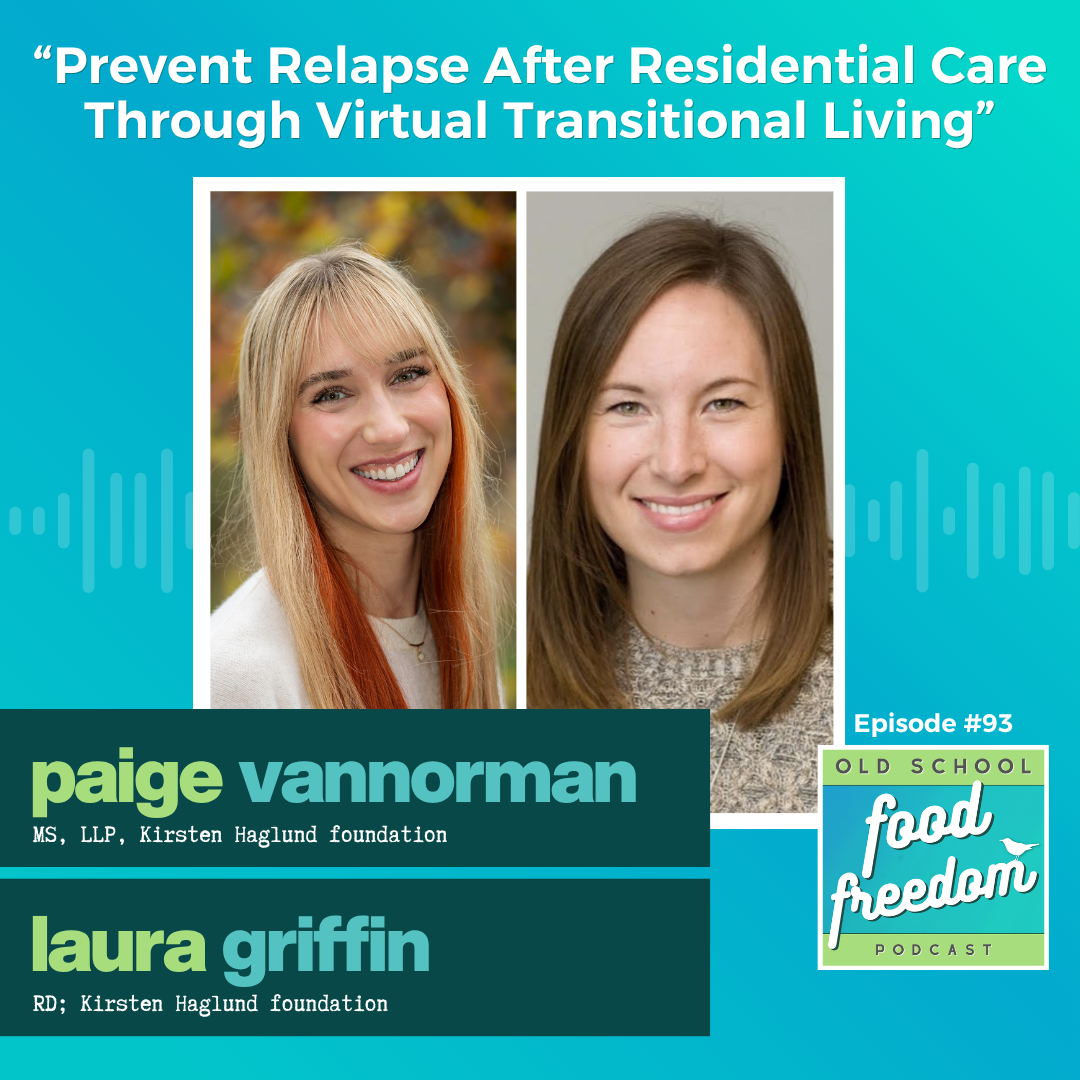
Prevent Relapse After Residential Care Through Virtual Transitional Living with Paige VanNorman, MS, LLP and Laura Griffin, RD
"I think of it as like the toolbox is next to you, but you can't find the key."
You did the hard work. Maybe it was residential treatment, or maybe it was months of weekly sessions with a therapist and dietitian, and you walked out knowing the tools. Then you got home, and the toolbox sat right there next to you, locked, while the old thoughts got louder by the day. If that gap between residential eating disorder treatment and regular life sounds familiar, for you or for someone you love, this episode is for you.
Chrissy sits down with Paige VanNorman and Laura Griffin from the Kirsten Haglund Foundation (KHF) to talk about the Virtual Transitional Living Program, a transitional living program for eating disorders built for the space between higher levels of care and "I'll see how it goes." Paige shares a piece of her recovery story and how the Lord softened her heart to tell it, and then the three of them walk through what the program looks like week to week, down to the cost and the scholarships that keep it within reach. It's faith-based, open to men and women 18 and older, and designed so people can keep their jobs and stay present with their families while getting eating disorder recovery support in real time.
Here's what we cover:
The revolving door between residential and outpatient care, and why so many people lose their progress within months of coming home
Why "I'll see how it goes" doesn't hold up as a plan after stepping down from treatment
Who the program is built for, including anyone facing a big life change like starting college, having a baby, a divorce, or a move across the country
How a support model works alongside your outpatient therapist and dietitian, and how KHF helps if you don't have a team yet
What virtual meal support for eating disorders looks like, from pacing and finishing a meal to bringing a fear food to the table with a dietitian present
The Thursday community group, an online eating disorder support group where people remember each other's goals and ask how things went
Taking the shame out of repeated struggles, with a look at Paul and the thorn in his side from 2 Corinthians
Why the first three months after stepping down carry the highest relapse risk, and how the 90-day commitment supports eating disorder relapse prevention
The phases of the program, from foundational support through sustainable maintenance, and why recovery never moves in a straight line
The summer Bible study built on “Transformed” and the new “Cook With Us” classes, both open to non-participants for a low cost
What the program costs and how the foundation's sliding scale and eating disorder treatment scholarships work
Friend, if you know the tools but can't reach them when it counts, or you're heading home from treatment to the same environment where the eating disorder grew, Paige and Laura want to hear from you. Christian eating disorder recovery was never meant to happen alone, and this program exists for the in-between season when a weekly session isn't enough to carry you through Tuesday afternoon. Laura put it this way near the end of the conversation: leaning into the fear keeps the fear in charge, and challenging it teaches your brain there's nothing there to be afraid of.
"God has equipped us with hands to open doors, too." - Paige VanNorman
If this episode spoke to you, would you share it with someone who's stuck in that space between treatment and everyday life?
We’d love to hear your thoughts, so please drop us an email at admin@findingbalance.com, send us a voice message via SpeakPipe, or you can also subscribe for more practical episodes coming your way.
More About Paige VanNorman
Paige is a clinical health psychologist with a decade of experience treating eating disorders in private practice and in higher levels of care. Paige also serves as program director of the Kirsten Haglund Foundation Virtual Transitional Living Program for eating disorders. Blending professional and personal interests, Paige has been a guest lecturer at churches, college campuses, and counseling clinics in the Metro Detroit area for topics related to eating disorders, mental health, and Christian perspectives on psychology.
More About Laura Griffin
Laura is a registered dietitian specializing in eating disorders, with 10 years of experience in outpatient treatment at a private practice, Nutrition Counseling Center, in Metro Detroit. Laura also serves as Associate Director of Nutrition at the Kirsten Haglund Foundation Virtual Transitional Living Program for eating disorders and has been part of the program since its start. As a non-diet dietitian, Laura is passionate about helping individuals struggling with eating disorders find a more peaceful relationship with food and their bodies.
Hello Freedom Community
Our Hello Freedom community is open! This Christ-centered space offers connection, encouragement, and gentle steps toward freedom from food and body-image struggles. No pretending, no fixing yourself first, come just as you are. If you want in, your next step is to join us at findingbalance.com/community.
You were not meant to walk this alone. We're saving a seat for you!
Mentioned Scripture
2 Corinthians, Exodus 14:14
Mentioned Resources
8 Keys to Recovery from an Eating Disorder by Carolyn Costin and Gwen Schubert Grabb
Transformed: Eating and Body Image Renewal God's Way by Jennifer Smith Lane
The Kirsten Haglund Foundation Virtual Transitional Living Program
Connect with KHF
LinkedIn - Lora Haglund
LinkedIn - Laura
Facebook
Instagram
SpeakPipe – Send us a voice message!
CHRIST-CENTERED RESOURCES TO HELP YOU FIND FREEDOM
The Daily Vitamin eDevo: A free devotional with bite-sized truth emailed 5 days a week
Community Groups: Find connection with prayer groups and our Hello, Freedom! community.
Christian Treatment Finder: Connecting you with Christian providers experienced in treating eating issues.
Lasting Freedom Online Course: A Christ-centered, non-diet course to work through false beliefs about food and weight so you can live free from disordered eating and body image issues.
CREDITS
Interlude music by “Hotham” – Morning Thoughts
Intro music by “MokkaMusic” – Old Jeans (Funk)
Wrap-up music by Jesse Quinn – Christian Instrumental
Production & Editing by Leah Bryant Co
The content in this podcast is for informational purposes only and is not intended to diagnose, treat, or prescribe a particular course of action. If you have, or suspect you may have, an eating disorder, please consult your healthcare provider. If you desire to receive faith-based care, visit ChristianTreatmentFinder.com to browse professionals with a Kingdom campaign against eating disorders.
More about the Old School Food Freedom Podcast
In today’s diet-culture society, food issues and body hatred have become the norm. But you were created to be FREE. Welcome to Old School Food Freedom, where we go back to the basics, God’s basics, for how we view food, our bodies, and our worth.
Hosted by FINDINGbalance Executive Director Chrissy Kirkman, this podcast features Biblically sound experts, thought leaders, artists, and everyday people who will inspire you to interrupt negative cultural soundtracks and rediscover God’s original design for your relationship with food and your body.
This show will deliver practical, faith-filled insights on how to break free from diet culture and body shame through the lens of Scripture. If you’re looking for guidance on how to heal your relationship with food while deepening your faith, you're in the right place.
We’ll answer questions like
What does the Bible say about food freedom?
How can I overcome an eating disorder or disordered eating with Jesus?
What is the biblical perspective on diet culture?
How can I find peace with food as a Christian?
What does it mean to treat your body as a temple in relation to eating?
How can I break free from diet culture with Jesus?
How can I align my eating habits with biblical teachings?
What are the first steps to finding food freedom in Christ?
This podcast is for anyone ready to walk away from diet culture and into the freedom that Christ offers. Whether you’re recovering from an eating disorder, disordered eating, wrestling with body image, or simply craving a more peaceful relationship with food, this space was made for you.
If you want to experience true food freedom with Jesus, this podcast will give you the encouragement, truth, and tools to do just that.
The unedited transcript for this episode of Old School Food Freedom
Chrissy Kirkman [00:01:05 - 00:01:09]: So Paige and Laura, welcome to Old School Food Freedom.
Laura Griffin [00:01:09 - 00:01:12]: Thank you.
Paige VanNorman Thank you for having us.
Meet the Guests
Chrissy Kirkman [00:01:13 - 00:02:19]: You're welcome, friends. Let me tell you a little bit about first Paige VanNorman. Uh, she is a clinical health psychologist with a decade of experience treating eating disorders in private practice. And in higher levels of care. Paige also works as the program director at the Kirsten Haglund Foundation Virtual Transitional Living Program for Eating Disorders. Blending professional and personal interests, Paige has been a guest lecturer at churches, college campuses, and counseling clinics in the Metro Detroit area for topics related to eating disorders, mental health, and Christian perspectives on psychology. And Laura Griffin is a registered dietitian specializing in eating disorders with 10 years of experience working in the outpatient treatment setting at a private practice nutrition counseling center located in Metro Detroit. Laura also works as the Associate Director of Nutrition at the Kirsten Haglund Foundation Virtual Transitional Living Program for Eating Disorders and has been a part of the program since its start.Chrissy Kirkman [00:02:19 - 00:02:33]: As a non-diet dietitian, Laura is passionate about helping individuals struggling with eating disorders find a more peaceful relationship with food and their bodies. Ladies, you are doing such great work. Thank you for doing this work.
Laura Griffin [00:02:33 - 00:02:34]: Absolutely.
A Shout-Out to Lora Haglund
Chrissy Kirkman [00:02:34 - 00:03:14]: I just want to also say, so Kirsten's mom, Iora Haglund, she connected us and I'm really grateful. Iora is a longtime friend of Finding Balance, and she was actually one of the first colleagues I met when I joined this team. Um, a few years ago, and she's such a special woman, so passionate about this work and about seeing women find help and healing from eating disorders. And through this foundation, she has helped make recovery possible for so many women at Finding Balance and elsewhere through scholarships and in other ways. So shout out to Iora. We love you. We're so forever grateful for you. All right, gals.
Old School Nostalgia—Lisa Frank and Saturday Mornings
Chrissy Kirkman [00:03:14 - 00:03:24]: So we kick off this show. With a question of what old school item or experience do you miss from back in the day? Laura, I'll start with you and then Paige, I want to hear what you say.Laura Griffin [00:03:25 - 00:03:38]: I was thinking about this and I wasn't sure where I wanted to settle. So there's a couple of things that come to mind. And one of them was, I was thinking about Lisa Frank stationery when I was younger. Do you remember Lisa Frank?
Paige VanNorman [00:03:38 - 00:03:39]: Yes.
Laura Griffin [00:03:39 - 00:04:02]: It was like the really like rainbow cheetah print. I don't really know what that was or why that was such a draw, but I was thinking about that. And then the other thing that I thought of was One Saturday Morning. Did you ever watch One Saturday Morning? I think it was run by Disney, but there were a few shows that would always play every Saturday morning. And like, I used to always be so excited to watch it and now we just have our own streaming.
Chrissy Kirkman [00:04:02 - 00:04:02]: What were the shows?
Paige VanNorman [00:04:03 - 00:04:03]: Yeah.
Chrissy Kirkman [00:04:03 - 00:04:04]: Uh, yeah, true.
Laura Griffin [00:04:04 - 00:04:08]: Recess and Doug. Uh, one was like Pepper Ann.
Paige VanNorman [00:04:09 - 00:04:09]: Oh yeah.
Laura Griffin [00:04:09 - 00:04:16]: And then it would phase into like Even Stevens, Lizzie McGuire kind of thing. So I miss that.
Chrissy Kirkman [00:04:17 - 00:04:23]: Oh, that's so fun. Oh, I love that. And you know, have you seen that Lisa Frank is making a huge comeback right now?
Laura Griffin [00:04:23 - 00:04:23]: Really?
Chrissy Kirkman [00:04:24 - 00:04:30]: Total comeback. I'm talking pencils, folders, clothes. It's nuts. Yeah.
Laura Griffin [00:04:30 - 00:04:35]: That's good to know. I haven't seen it yet. I probably will now that I, that I'm paying attention. Yeah.
Chrissy Kirkman [00:04:36 - 00:04:38]: At least buy some pencils or a folder.
Laura Griffin [00:04:38 - 00:04:39]: Yeah, absolutely.
Paige VanNorman [00:04:39 - 00:04:40]: At Staples, OfficeMax.
Laura Griffin [00:04:42 - 00:04:42]: Yeah.
Chrissy Kirkman [00:04:43 - 00:04:43]: Paige, how about you?
Paige VanNorman [00:04:44 - 00:04:44]: All right.
Childhood Treats and the Comeback of Gushers
Paige VanNorman [00:04:44 - 00:05:15]: So I was also thinking about that. You know what's so funny, Laura? You mentioned Lizzie McGuire. That is one of the old school things I miss is watching Lizzie McGuire. And then the other one I was thinking about was Gushers. It's funny, I did not get Gushers very often, but when I did, it was as if the heavens had parted. I would open up my lunchbox as an elementary kid and I'd just be like, my mom packed me Gushers. I'm just thrilled to pieces. And again, they probably didn't come around all that often, but that is like peak childhood to me.Chrissy Kirkman [00:05:16 - 00:05:22]: Fantastic. If someone is like, what are Gushers? Can you explain? Because I remember them, but explain what they are.
Paige VanNorman [00:05:22 - 00:05:42]: All right, so Gushers are about the size of your thumbnail, and they're kind of a like hexagon candy. They're usually fruit flavored, right? So it's not chocolate, it's fruit flavored. And like the outside is kind of gummy and the inside is like a squishy burst of juice. So you eat it and you're just like, gummy juice. Oh, so good. Kind of like a fruit snack.
Laura Griffin [00:05:42 - 00:05:42]: Gummy juice.
Chrissy Kirkman [00:05:42 - 00:05:42]: Yeah.
Laura Griffin [00:05:43 - 00:05:49]: That's kind of like a fruit snack. And, and Gushers also are in circulation still because those are a staple in our house. So.
Chrissy Kirkman [00:05:52 - 00:06:06]: And here we thought it was an old school item. What I like about that is that's what we remember. Like these are things we remember from back in the day and we even forget that maybe sometimes they still exist. So what could we have a little throwback experience. Like, now I just want to go buy some Gushers.
Laura Griffin [00:06:06 - 00:06:19]: I also feel like they just go away for a while and then come back because I don't— there was a period of time where I don't really remember Gushers, but then now I do see them. So it's kind of like the Lisa Frank stationery, you know, just everything cycles.
Chrissy Kirkman [00:06:19 - 00:06:20]: And Trapper Keepers.
Laura Griffin [00:06:20 - 00:06:24]: Comes back. Oh yeah, that's right, Trapper Keepers. That was on a school supply list. I remember that.
Chrissy Kirkman [00:06:24 - 00:06:26]: Oh yeah.
Laura Griffin [00:06:26 - 00:06:26]: Yeah.
Chrissy Kirkman [00:06:26 - 00:06:44]: Oh, see, that's super fun. I love that. I'm here for it. So before we get into like the whole thing, I would love to hear your stories of how you got into this work and, um, maybe just, you know, like 2 or 3 minutes. It doesn't have to be super long, but Laura, like, what's your story? How did you get into this?
Journey Into Eating Disorder Care—Laura's Story
Laura Griffin [00:06:45 - 00:07:20]: Um, I actually did, when I was in school to become a dietitian, we had to choose a specialty rotation. So not everyone had all of the same experience with that. You had to give like your top 3. different specialty areas as a dietetic student. And, um, I remember I decided to choose eating disorders because I never considered working in eating disorders. And so I said, you know, I'll give this a try. Well, I had interviewed for it, which it was only, I think it was one of the only options you had to interview for, which now I understand why. But once I went that direction, there was really no going back.Laura Griffin [00:07:20 - 00:07:24]: So I actually work for the practice today that I interned with as a student.
Chrissy Kirkman [00:07:24 - 00:07:25]: Wow.
Laura Griffin [00:07:25 - 00:07:29]: So now I've been With the practice and this is where I've settled. So.
Chrissy Kirkman [00:07:29 - 00:07:31]: That's so great. Paige, how about you?
Journey Into Eating Disorder Care—Paige's Story
Paige VanNorman [00:07:32 - 00:08:17]: So I got into this work partially because I had one, I had an eating disorder and I went through recovery all on my own and, you know, became a therapist and started working with people. And I kind of resisted that as being part of the origin story for why I chose this work. But after I don't know, several years, the Lord really softened my heart to that and said, you know, this is part of the testimony. And, you know, by keeping parts of your history quiet, you're doing a disservice to me, and me being the Lord Jesus Christ, right? And not sanitizing the work that he has done in my life. And so that has inspired my work to be a therapist, a psychologist, and now the program director of KHF.Chrissy Kirkman [00:08:18 - 00:08:35]: Oh, I love that. And To not sanitize. Wow. I mean, I've never even heard it put like that. That's so neat. So Paige, can you tell us a little bit? Um, so you said KHF. So if anyone hears that for the rest of the episode, that's the Kirsten Haglund Foundation. Okay.
Kirsten Haglund Foundation—Mission and History
Chrissy Kirkman [00:08:35 - 00:08:40]: So tell us what is the mission and give us a little history about the organization, please.Paige VanNorman [00:08:40 - 00:09:42]: So the mission of the Kirsten Haglund Foundation is to provide hope, networking, and financial aid. to those seeking treatment and freedom from eating disorders. And its roots are in scholarship and fundraising, kind of what Chrissy was saying at the top of the episode regarding Iora Haglund. And so, you know, when KHF was founded, it was, you know, birthed out in 2008 from her daughter Kirsten Haglund, who was Miss Michigan and then Miss America. And they worked on raising scholarship money for life-saving eating disorder care. But KHF heard story after story of individuals who wished they had more support in recovery on a daily basis, right? You know, so meeting with their therapist once a week was not enough. Meeting with their dietitian every other week was not enough. And in 2002, they founded the Virtual Transitional Living Program to connect that missing link for individuals who needed extended support at the outpatient level to meet their recovery goals.
Paige VanNorman [00:09:42 - 00:09:57]: And what is also so special about this program is that it is a first-of-its-kind program. We are truly pioneering what treatment, support, and recovery looks like for people who are suffering from eating disorders and wanting that freedom.
Value of Transitional Support in Recovery
Chrissy Kirkman [00:09:58 - 00:10:26]: That's so good. I mean, even just going through the recovery and ongoing, like, help that I, I'm getting, you know, with therapy going from week to week, sometimes it feels like a lot and other it's like, how am I supposed to know how to navigate the space in the middle? And so then just thinking of it in this context, what a life-changing scenario. And it feels like it would speed up the process somewhat. Do you see that? Is that true?Paige VanNorman [00:10:27 - 00:10:58]: I definitely think there's a part where we don't see as many revolving door recovery stories, right? Where you are going inpatient, residential, getting discharged outpatient, relapsing somewhat quickly, right? Because maybe you're going back to that same environment that you're struggling in or you can't afford consistent care, right? And so then you go back to a higher level of care. And so this is really helping people maintain their jobs, maintain their family relationships while still getting the support they need in real time.
Overview of the Virtual Transitional Living Program
Chrissy Kirkman [00:10:59 - 00:11:07]: Oh, it's so, so needed. Okay, so Laura, can you tell us a little more about the virtual transitional living program? What does it look like?Paige VanNorman [00:11:08 - 00:11:08]: Yeah.
Laura Griffin [00:11:08 - 00:12:08]: So, I mean, as Paige was saying, it's kind of that missing link that we have found, you know, really the goal would be to try to either prevent someone from needing higher level of care, you know, by giving them additional support while they're working with an outpatient team or people step down and they kind of get back into life. And it is a sudden change to come home from higher levels of care where you have so much support. And now you're going back into your everyday life, trying to figure out who is support and where I can turn to for that. So it's a support model where it's not a treatment model. It's a little bit different. So the support model is with the goal of progressive independence. So we really work with people on trying to strengthen their coping skills, try to adjust to some of those, you know, daily life and prioritizing, making sure they're having, you know, consistency with eating and continuing to build on their outpatient goals with their team. We really find that the community itself is very important.
Laura Griffin [00:12:08 - 00:12:47]: People who struggle with eating disorders often feel very isolated, like other people don't understand. And so the community aspect of our program is really beneficial for people who are looking for people who really kind of get it. And so we have that supportive community. It is faith-based. Depending on the individual's background and interests. So some of the things that we offer are going to be a little bit more geared for that. But it's certainly— anyone can reach out for support. And if people find that their faith and the spiritual aspect is an important part of their recovery, then they would certainly feel that our program is offering that.
Laura Griffin [00:12:47 - 00:13:27]: We do have certified eating disorder recovery coaches that have more of like the phone and text support. So if someone's really struggling, they can reach out. Whereas, you know, when you have an outpatient team, generally that's kind of set to those sessions. So this is additional support that someone can receive on a more ongoing basis throughout their week to continue to keep them on track with their goals with their team. We also have a licensed psychologist. We have registered dietitians on our team as well that we all kind of work together and contribute different things to the program. within our, our scopes. So that's a little bit more about it.
Laura Griffin [00:13:28 - 00:13:33]: It still feels like an overview, you know, but that is kind of the gist of, of what we provide as a program.
Who Is the Program For?
Chrissy Kirkman [00:13:33 - 00:13:44]: I mean, I know I'm hearing the high-level overview, but it sounds like it was so well thought out and you're covering so many of the potential struggles and helping. This is just for women, right?Paige VanNorman [00:13:45 - 00:13:46]: No, it can be men and women.
Chrissy Kirkman [00:13:47 - 00:13:51]: So what sort of person might reach out to this program?
Paige VanNorman [00:13:51 - 00:14:50]: So Laura and I thought about this a lot, you know, who might find themselves emailing us. So the first type of person is someone who's been in that revolving door of residential care to outpatient and back again a few times, you know? So again, the gains that they made in high level of care, they are struggling to maintain at the outpatient level. Another type of person, maybe you are going through a life transition, whether it's starting college, pregnancy or postpartum, a job change. Moving houses, moving states, marriage, divorce. Maybe you're an adult and you've got adult children moving back in the house or moving out of the house for the first time. Maybe you are starting or graduating school and you're really not sure how to implement recovery coping skills that have worked for you in the past in your new life circumstances, right? Because sometimes with recovery, you've dialed everything in so tightly and you're like, this is working for me. And then all of a sudden you have a baby in your arm. And you're eating one-handed.
Chrissy Kirkman [00:14:50 - 00:14:51]: Yes.
Paige VanNorman [00:14:51 - 00:15:05]: And all those mindfulness skills that we talk about for eating are out the window. Another type of person, maybe you are, again, discharging from that higher level of care, and I've alluded to this earlier, but you're returning home to an unhealthy home environment.
Chrissy Kirkman [00:15:05 - 00:15:05]: Yeah.
Paige VanNorman [00:15:05 - 00:15:20]: And you know your eating disorder is enabled in that environment. And deep down, you know the, I'll see how it goes, is really not an action plan. Right? Like you've tried the, I'll see how it goes method and you're being honest with yourself. That's not going to work.
Role of Community and Support—Why It's Needed
Chrissy Kirkman [00:15:21 - 00:15:50]: Yeah. And I'm sure that when you're in treatment, I mean, there's all these guardrails and all these healthy boundaries put into place and it then, so you start working through these things. They start at some point feeling safe and feeling like maybe, oh, this is the new way. And then, but you get back home into an environment that doesn't have those. And that probably, I haven't been in that situation. I'm just imagining that probably feels pretty terrifying.Laura Griffin [00:15:50 - 00:15:50]: Yeah.
Paige VanNorman [00:15:51 - 00:16:14]: And I guess another person that comes to my mind for this program would be, I kind of mentioned, you know, if you're going through changes in life, but one of those changes could be if you're an adolescent who is now a legal adult. So you had the treatment in your teens. Your parents are really involved, but now you need to take more ownership and independence of your recovery. And again, that kind of goes back to the, I'll see how it goes is not an action plan.
Chrissy Kirkman [00:16:14 - 00:16:15]: So true.
Laura Griffin [00:16:15 - 00:17:12]: A couple of other examples might be someone who is in recovery, but they're really just feeling like they need people who kind of get it. Like I was saying, you know, a community where there are other people who also struggle and really have more of that experience themselves. We also were considering a situation where Like I was saying, with the text support and the phone, you know, that phone support with coaches, maybe they really like their outpatient team, but they need a little bit more support in between those sessions. And then oftentimes people will find therapists or, you know, different outpatient clinicians who they really enjoy working with, but there's a missing piece there where maybe they're not specialized in eating disorders or they're not getting more of that more focused work. And so. Being able to do the program alongside that team would be helpful to someone. Ultimately, there are many people who know all of the things, if you know what I'm saying. It's like, oh, I've heard this.
Laura Griffin [00:17:13 - 00:17:55]: I know the tools. I've, you know, my team has been encouraging me to use my tools, but then ultimately in the moment, I have a really hard time accessing the tools. I think of it as like the toolbox is next to you, but you can't find the key. It's like locked. And so you have them there, but you're just having a hard time really accessing them in the moments that you need them. So really working on some of those skills in our program is beneficial. And lastly, really people who notice that they kind of make a lot of progress at a higher level of care, and it happens so quickly that then they can come home and almost feels like they plateau. And so kind of keeping them moving forward and really seeing full recovery as the goal.
Laura Griffin [00:17:55 - 00:18:08]: Because often we can see how far we've come and think this is so much better, but also, you know, really keeping in mind that continuing to move to full recovery is going to bring the best treatment outcomes for people.
Requirements and Recommendations for Participation
Chrissy Kirkman [00:18:08 - 00:18:20]: That's so good. So what about the listener right now who's like, okay, but how do I know, is this right for me? Is this right for my daughter or my son? Laura, what would you say to that?Laura Griffin [00:18:21 - 00:19:14]: Yeah. Well, in general, there are certain things we, that we would just find our program is best suited to provide support for. And so there are variables that we want to think about in terms of it being content that resonates with people and also is really aligning with where they're at in the recovery process. So in general, the ages 18 and over, and as we mentioned, both men and women can Reach out for support. This would be a person who, as we mentioned, it's not a treatment model, it's a support model. So it would not be in place of treatment. So we would generally recommend that they would have support outside of the program, outpatient team, therapist, or a dietitian, or both ideally, but not always accessible for everyone. But we just know that there's important work that they're doing outside of the program that we really can't provide.
Laura Griffin [00:19:14 - 00:19:57]: With it not being a treatment model. So medical stability is necessary for someone to be able to partake in our program. And that would also mean that someone is either weight restored, if that's something that they need to be doing with their treatment, or at least approaching the weight restoration. That is not the situation for every person, but I'm really referencing those situations where people are stepping down. Sometimes that's something they've been working on and we would wanna make sure they're far enough along in that part of the process. to be able to appropriately engage with our program. And so, as I mentioned, really trying to have a solid outpatient team as treatment and working alongside our program as support.
Paige VanNorman [00:19:57 - 00:20:36]: You know, just to like dovetail off what Laura is saying, we do want someone to have that outpatient team. And, you know, if you're listening and you don't have a team, you can always reach out to KHF. We have many connections and can typically You know, just like Old School Food Freedom and like you have so many resources for providers, we can also often work to try to find providers or other type of like affordable care for someone. So you might say, well, I don't have providers. I don't have a therapist. I don't have a dietitian, so I shouldn't reach out. No, no, no. Reach out and we can assist you in finding those providers if you don't have that person.
Paige VanNorman [00:20:37 - 00:21:17]: But we do still want someone to have that outpatient team because, and Not a treatment model. We're not creating meal plans from like a registered dietitian perspective. And we're not tackling root causes. That would be more of like the therapist role. But the coach is really walking with someone in their daily recovery, troubleshooting sticking points as they arise, and then keeping the focus in the present. And the coach is someone who kind of helps take their treatment goals and makes them into bite-sized actionable steps, right? And so you can text your coach every day, 7 days a week during daylight hours because stuff comes up. And so they're helping you troubleshoot that in the moment.
Differences from Other Support Models
Chrissy Kirkman [00:21:18 - 00:21:51]: That's so good. And so for anyone who has heard of our, at Finding Balance, our Hello Freedom community, or if you're part of the community and you're wondering, okay, what are the differences? There are huge differences here. The Hello Freedom community, it exists to walk together at a high level, bringing Jesus in, looking at scripture, reminding each other of truths. But we are not clinical, and it's not technically even a support group. It's a community.Paige VanNorman [00:21:51 - 00:21:51]: Mm-hmm.
Chrissy Kirkman [00:21:51 - 00:22:21]: And so if anyone was listening and wondering, well, can I still be, if I'm in Hello Freedom, can I still be part of this program, absolutely. It could be a good enhancement. And there could also be a scenario where you need to be in the virtual program until you get to a place where you could handle even just like being in Hello Freedom. I don't know if that helps anyone, but in case you had that question. So there's a weekly schedule, I'm sure. So what does it look like within the program?
Daily and Weekly Programming
Laura Griffin [00:22:22 - 00:23:38]: I can speak to part of that and then page is going to continue, but one of the things that we offer is meal support, and we offer a variety of different meal supports throughout the week. So, we have a Monday and Wednesday lunch meal support. Once a month, we have a Tuesday dinner. Often, people in different time zones reach out to be a part of the program, and so we try to have options for people that are going to hopefully overlap with one or both of those meals at some point to get them With the meal support because it is so important for them stepping down or even staying at an outpatient level, how can they really prioritize that during the week in a place where there's community? So a meal support is an opportunity to eat a meal together and we kind of can help them with some positive coping skills to implement during a meal. That being said, examples of things that people might be working on is pacing so that they can complete the meal in a normalized amount of time. They might find that they can practice strategies to redirect their thoughts. We can really get in our kind of in our heads with thoughts, whether we're feeling anxious about the food, anxious about the meal, or in the setting of other people, you know, eating with someone else. There's a variety of things that can kind of lead our mind elsewhere.Laura Griffin [00:23:39 - 00:24:29]: And so we really practice redirecting that and bringing it back into focus of what they're doing so that it can be an enjoyable time for them to connect with other people. We also help them work through completion. So everyone has a different area of focus with their outpatient team. If they're working on something with their dietitian, then oftentimes it is consistency and completion of meals, following a meal plan of some sort, and really working through any of those moments that maybe that it's really challenging on your own. So we really encourage people to complete their meals. And maybe challenge fear foods. So that would be an opportunity for someone to bring a meal that normally they would maybe shy away from on their own, but this is an opportunity to have in a supportive way. You have a dietitian or a coach or a therapist in the meal support with you.
Laura Griffin [00:24:29 - 00:25:00]: So we have a facilitator who kind of helps guide throughout. That being said, as much as we're working on those skills, we're trying to take the focus off the food. So we talk about things unrelated to food. Sometimes we might, you know, play some games, have just general conversation. The thoughts that can really interfere with the way we move through a meal, whether it increases anxiety, it gives us a way to redirect that and just by just engaging in conversation with other people. So we really try to keep that a lighthearted environment.
Chrissy Kirkman [00:25:01 - 00:25:50]: Can I just say in my mind, as you're talking and I'm like just envisioning what that looks like if I were to be part of that. As a participant, I would feel so supported. And I'm not a clinician, but if I had put on, you know, like a leadership hat, a clinician sort of hat, that would be such rewarding work. Y'all must just love walking with these people and just seeing them have these moments of, I am terrified to eat this. I'm terrified to put this in my mouth. Or, um, I don't know how to slow down, or I don't know how to pace properly. But then little by little, like when you watch kind of a light bulb moment for someone and you see that, oh, that I did eat that fear food and I didn't die and like nothing happened. It actually was okay.
Chrissy Kirkman [00:25:51 - 00:25:57]: And just to be able to celebrate wins like that with them, that must just be so, so rewarding and fulfilling.
Paige VanNorman [00:25:58 - 00:26:04]: Yeah, it is. And because people are in the program, Typically for many months, you get to walk with them and see that happen.
Other Support Programming: Community, Skills & Faith Integration
Chrissy Kirkman [00:26:04 - 00:26:04]: Yeah.Paige VanNorman [00:26:05 - 00:26:18]: So Laura mentioned our meal support groups, right? And we've got 2 other types of groups on a weekly basis. So on Thursdays, we have a community support group. Sometimes there's a topic, but usually it's participant-led.
Chrissy Kirkman [00:26:18 - 00:26:18]: Nice.
Paige VanNorman [00:26:19 - 00:27:39]: Again, you're developing real relationships with people, right? So participants are remembering details about each other's lives, their goals. Hey, how did that go for you? And it's really an opportunity for them to share recovery wins and struggles in a family-like environment. You know, some common struggles that someone might be facing, even just showing up to attend, is like the urge to isolate and to have silence when facing struggles, right? And instead say, hey, I'm going to take community group and put voice to that. Another one is reducing shame when you're feeding repeated struggles, right? You know, sometimes we can get into this bubble of, Well, I worked on it once. Why is it coming back? I thought I solved it, right? Or, I went through this recovery. I can't believe I'm dealing with this again in my life, right? But again, going back to, you know, maybe you went through a life transition, maybe things are going on where some of these old patterns are starting to reemerge again and say, like, how do we take the shame out of being a human? And, you know, it makes me think about Paul the Apostle when he says, you know, I do the thing that I don't want to do. And, you know, also in 2 Corinthians when he talks about how there's a thorn in the side and he asks the Lord to take it, but it's there, you know, for the long haul. And, you know, if Paul the Apostle can have these struggles, then we can also be soft-hearted towards, like, long-term struggles that someone might be facing, right? Or, like, when you're kind of facing that same barrier over and over again.
Paige VanNorman [00:27:39 - 00:27:52]: And then another thing that's shared is just encouragement, you know, encouragement for others. And that encouragement for others can help you give that encouragement to yourself. And it helps really reduce that comparison and competition that's ubiquitous in eating disorders.
Laura Griffin [00:27:52 - 00:27:52]: Mm-hmm.
Paige VanNorman [00:27:53 - 00:28:50]: Then on Fridays, we have our recovery skills workshop. And that's an opportunity to learn and discuss skills and day-to-day activities that might present a challenge in someone's recovery. Sometimes, you know, we'll pull from the 8 Keys book and workbook from Carolyn Kostin. 8 Keys to Recovery from an Eating Disorder. We might pull topics like grocery shopping or nutrition strategy, clothes shopping, budgeting, mindfulness. We just had a topic recently about education around GLP-1s, right? So, we want to touch as many topics in the food and body image realm as possible. And then, something that we're launching starting this year is Every once in a while, we're going to have a fall lineup and then a spring lineup, bringing in some guest speakers into our workshops. And that's just to really expose participants to more experts in the eating disorder field.
Paige VanNorman [00:28:50 - 00:28:53]: And so that's something that we've got coming down the pipeline and we're very excited for.
Faith-based Groups: Bible Study and Prayer
Chrissy Kirkman [00:28:54 - 00:28:56]: That's so good. Yes.Paige VanNorman [00:28:57 - 00:29:41]: And then some outside programming that may not be happening on a week-to-week basis, but are parts of the VTLP. Is in the summer, we run a Bible study. It's a 12-week summer course adapted from the book Transformed: Eating and Body Image Renewal God's Way, written by Jennifer Smith Lane. She's also one of our recovery coaches. And so that is, like I said, it runs throughout the summer, and a lot of individuals will take it multiple summers in a row because they are just continually edified. And come back with it with, you know, you don't step in the same river twice, right? So they come back and even though it's the same content, they have grown, they have matured, and they're engaging with the materials in a new way.
Laura Griffin [00:29:41 - 00:29:42]: Mm-hmm.
Paige VanNorman [00:29:42 - 00:30:00]: And then we are also going to be offering a prayer support that's going to be starting on an every other week basis. And so that'll start back up in September once Transformed wraps up. And it is an opportunity for participants to pray together. and incorporate spirituality into their recovery.
Additional Programming and Access
Chrissy Kirkman [00:30:02 - 00:30:14]: The more y'all talk about it, I mean, you have, I maybe not everything, but it feels like you've thought of everything. This is so good. So is there any additional programming in the VTLP?Laura Griffin [00:30:15 - 00:30:51]: We have, uh, it's kind of a newer concept that we've pulled together to do a Cook With Us class. And so we're going to be offering virtual live cooking classes in a webinar format where Participants can kind of learn different cooking skills and get familiar with the preparation process. So we, that will be run by dietitians within the VTLB. Those are things that are going to kind of be in addition, but all of the things that we mentioned on a weekly basis will continue and that, that cycles each week. So some of these other things are additional things that we've just found gaps in and just want to provide as many of those opportunities as we can.
Paige VanNorman [00:30:52 - 00:31:16]: And then just to add one more point on that front, when it comes to our Bible study and the Cook With Us classes and the guest speaker workshops, if you're a listener, you technically don't have to be a participant in the VTLP. You know, you can still sign up for those for a low cost and participate. It can be a way of getting your feet wet in our program, getting your feet wet with some of our staff members and seeing if it might be a good fit for you.
Application, Costs & Scholarships
Chrissy Kirkman [00:31:17 - 00:31:18]: Wow, that's so cool. I didn't know.Paige VanNorman [00:31:19 - 00:32:09]: But let's say you are curious about joining our Virtual Transitional Living program and you've, you've reached out, you've, you've got admission and you're asking, all right, once I'm in, what happens, right? What sort of expectations might you have? So one of the requirements that we have is a 90-day initial commitment. You know, typically what happens is after the first month, someone says, I don't know if it's helping. After the second month, they say, oh, I see how this is helping me. And so you do need to give yourself that time. Now, after 90 days, you're not kicked out of the program. I'd say the vast majority of people choose to stay longer because of the benefits that they're experiencing. You know, some people, I'd say they're in for 9 months. Some people might be in more like 18 to 24 months, depending on their own needs.
Paige VanNorman [00:32:09 - 00:32:18]: But you actually get to really be a part of the length of the stay conversation, as opposed to say higher levels of care, where insurance is dictating when you have to drop out.
Coordination and Payment Details
Chrissy Kirkman [00:32:18 - 00:32:19]: Yeah, that's good.Paige VanNorman [00:32:20 - 00:32:36]: When you're in, we also do a lot of treatment team coordination. That is something Laura and I have hands-on work in doing. So making phone calls, sending emails to your therapist, dietitian, sometimes your primary care doctor, just to make sure that we are always on board with them, right? So we're not going to go against their recommendations.
Laura Griffin [00:32:36 - 00:32:37]: Yeah.
Paige VanNorman [00:32:38 - 00:33:26]: Someone also does monthly check-ins with either Laura or myself, and that's just to ensure that Like there's a goodness of fit troubleshooting any issues that are arising. And then in terms of payment every week, right now the program is set at $200 per week, but it can be paid for with an HSA card or an FSA card. And if $200 a week is too steep for you, listener, you know, at the top of this podcast, we talked about how scholarship is at the heart of KHF, and we do offer sliding scales and scholarships to individuals who need it because affordability is so important. And part of mental health is financial health. Yeah. And so there's not a cap for that. You know, it's not as if, oh, well, you're taking someone's spot. No, every person is looked at as an individual and their unique needs.
Program Phases and Progression
Chrissy Kirkman [00:33:27 - 00:33:44]: That alone feels so supportive because I know there are so many listeners who feel the weight of the financial burden of just getting treatment. So Laura, how would someone expect to progress? Like, are there different phases in the program or how does that look?Laura Griffin [00:33:44 - 00:34:29]: Mm-hmm. Yeah. So as we talked about, there is earlier on, we're working on progressive independence. And so when someone reaches out or starts the program initially, they're really working on foundation. So the first phase is the foundational support. If it's someone who stepped down from higher level of care, they kind of generally know the areas that they have to work on to really prevent relapse. We know that in general, the highest risk for relapse after stepping down from high level of care is about 3 months from the time they get home. And so that also fits with, you know, that we really encourage people to stay within the 90-day initial part of the program so that they can really help them get through that part where they come home and they're really, really vulnerable.
Laura Griffin [00:34:29 - 00:35:21]: So that period of time is, you know, also a time where whether it's someone who stepped down higher level of care or not, they might have more frequent eating disorder behaviors, more frequent thoughts. Like it's maybe feeling like more of the back and forth with the eating disorder. So really working with them, one of the 8 keys is on the eating disorder self and the healthy self. And so really trying to help challenge a lot of those behaviors and thought patterns initially. And then we move into more of a transitional independence where maybe they're, you You know, for instance, their meal plan is pretty stable. They might be moving into the next phase where they're challenging fear foods, trying to incorporate variety with their meal plan. So the first phase would be following your meal plan, completing your meal plan. In that next phase, it's going to be more about challenging other kinds of like food rules and things like that.
Laura Griffin [00:35:21 - 00:36:19]: We would start to notice that the frequency of eating disorder behaviors would be decreasing in intensity and in frequency at that point. And then the, the last phase is really focused on sustainable maintenance. So we're, we're really in, in the rhythm of a normalized eating pattern most days, right? None of us are perfect eaters. That's not the goal. But really, for the most part, keeping things very consistent, normalized patterns of eating. Eating disorder behaviors could still be happening, but they're going to be more intermittent or sporadic. So we would be able to identify Like more closely understanding triggers for eating disorder behaviors at that level, where we could really hone in on that to help support, but that they're also working through that with their team. And then this is also going to be the phase where someone might be thinking about what it will be like to transition out of the virtual transitional living program, and that they would then resume their work with their outpatient team.
Laura Griffin [00:36:20 - 00:36:57]: Of course, that sounds very sequential. I will say that we know that eating disorder recovery is— It doesn't move like that, right? So if someone's listening going, well, gosh, can't even envision what it would be like to be sustainable maintenance. That's really, really understandable for someone who has struggled for a number of years or, you know, even a number of months. It's hard to envision letting go of some of that support long-term. However, you know, really just kind of keeping in mind that it's not a linear process. We would be with that person if they have a really hard day or a hard week. It doesn't mean they're back to square one. square one, you know, but that's, that can sometimes be really discouraging for people.
Laura Griffin [00:36:57 - 00:37:04]: So helping them move through those phases while also remembering we're not robots. It's not always going to look like that in practice. So.
How to Apply and Take Next Steps
Chrissy Kirkman [00:37:05 - 00:37:17]: Absolutely. This is all just so great. I mean, I love that this program exists. How can someone apply to the program or take a next step to, to research more and maybe pray over it or something?Paige VanNorman [00:37:18 - 00:37:24]: So if you want to apply to the program, You start by going to our website, thekirstenhaglundfoundation.org.
Chrissy Kirkman [00:37:25 - 00:37:26]: We will link it in the show notes, everyone.
Paige VanNorman [00:37:27 - 00:38:00]: Yep. Thank you. And then you go to the Transitional Living tab. Some of the things that we've said are on that website, and you type in your information and hit send. And then Iora and I will reach out to you and you'll meet with us for a 30-minute Zoom call so that we can get to know you. You can get to know us and we can get the ball rolling on what are the gaps in your care. Like maybe you do need help getting a therapist first before coming in, signing releases of information so that I can talk to your treatment team, and then we pick a start date.
Encouragement for Those On the Fence
Chrissy Kirkman [00:38:01 - 00:38:15]: That sounds so hopeful. What would a final word be if someone's just on the fence? Like, I'm scared to even submit my information because I mean, who knows what fear might be happening? What encouragement would you wanna give someone? What would you wanna tell that person?Paige VanNorman [00:38:15 - 00:38:35]: Chrissy, you said, if someone's feeling nervous about reaching out, like, should they, shouldn't they, right? I guess 2 things came to my mind. There's like a very spiritual side in my mind and a very natural side. My spiritually minded answer is, well, you have not because you ask not, right? The answer is no if you don't reach out, right?
Laura Griffin [00:38:35 - 00:38:35]: Right.
Paige VanNorman [00:38:35 - 00:38:45]: And so take that step. You can always back out later if you want to get cold feet, But take that first step, 'cause you don't know what that door will lead you to.
Chrissy Kirkman [00:38:46 - 00:38:47]: Yes. Yeah.
Paige VanNorman [00:38:47 - 00:39:10]: You know, God has equipped us with hands to open doors too, right? You know, in Exodus, he talks, uh, you know, to Moses about, you know, I will fight for you. You need only to be still. I think it's Exodus 14:14. And certainly there's a part of recovery of stillness that we need to have, but there's also a lot of action. That is required of us. Oh, and he's given us hands to open those doors too.
Chrissy Kirkman [00:39:11 - 00:39:33]: Yeah. And when you said that, it reminded me of at our church every year we have a theme with a verse, and this is kind of the theme that we sort of focus on. And this year it's ask, seek, and knock. Ask and it will be given to you. Seek and you will find. Knock and the door will be opened to you. Like, that feels right along those lines. Like, what do you have to lose by asking? Seeking and knocking.
Laura Griffin [00:39:34 - 00:39:34]: Yeah.
Paige VanNorman [00:39:34 - 00:39:42]: You know, I think a lot of people know that God can do things. God can do miracles. God can heal, but they often struggle with the fact that he wants to do it too.
Chrissy Kirkman [00:39:42 - 00:39:42]: Yeah.
Paige VanNorman [00:39:43 - 00:39:45]: And, but he also wants to partner with you to do it.
Laura Griffin [00:39:45 - 00:39:45]: Yes.
Paige VanNorman [00:39:45 - 00:39:57]: And so reach out to us and, you know, partner with the Lord in terms of moving forward in your recovery. Now, I will say the fleshly, like, natural side, you know, my mind was like, just do it.
Chrissy Kirkman [00:39:58 - 00:39:58]: Right.
Laura Griffin [00:40:00 - 00:40:00]: Just do it.
Paige VanNorman [00:40:01 - 00:40:02]: You can have doubts later.
Chrissy Kirkman [00:40:02 - 00:40:38]: For sure. I mean, all 3 of us, we know what freedom lies on the other side of that barrier in your mind of like, I'm scared to reach out and do I deserve this? And is, is this freedom and recovery just for other people, but not me? I mean, I know that everyone that has gone through this program and even the ones that are in the midst of it would probably cheerlead you on and say, do it. Do not wait. Do it right now. And like, no pressure, but do it. Yeah, please and thank you. Oh, that's good. Laura, anything else?
Addressing Fear and Shame
Laura Griffin [00:40:39 - 00:41:05]: I was just gonna say that, you know, that fear and shame drive eating disorders like that so often. Fear, shame, and guilt, you know? And so that fear in terms of things that maybe kind of scare us or the idea of letting go of some of that control. You know, when it comes to eating disorders, there's a fear of letting go of that when you seek support. And so I would just say that letting go of that control initially can feel scary.Chrissy Kirkman [00:41:05 - 00:41:05]: Mm-hmm.
Laura Griffin [00:41:06 - 00:41:11]: And you might notice some of that fear, but a big part of this process is really teaching our brain that this isn't something to fear.
Paige VanNorman [00:41:11 - 00:41:11]: Mm-hmm.
Laura Griffin [00:41:12 - 00:41:35]: I need to nourish my body. I want to be able to connect with other people. So things that scare us oftentimes end up leading to be the most rewarding when we end up doing it and follow through and we look back on it and we're really glad that we did. So I would say that, you know, leaning into the fear keeps the fear in charge versus challenging the fear is, is teaching ourselves this isn't something I need to be afraid of.
Final Thoughts and Blessings
Chrissy Kirkman [00:41:36 - 00:42:09]: Thank you both. This is so good. Thank you for being here. Thank you for having this program available. It's incredible. My mind is blown that this exists and I want so many people to hear about it. And I hope that when this airs that you will be flooded with inquiries, like people wanting to know and people Feeling the fear and sending that, that contact form anyway, and having that 30-minute Zoom call and getting the process going. Oh Lord, we have prayed over every listener before we hit record.Chrissy Kirkman [00:42:09 - 00:42:46]: We were praying over you who is listening right now to hear this message. And so just know the Lord sees you. He is there with you. He is holding your hand as you take that next step. And we're cheering you on. So friends, you can find links for the Kirsten Haglund Foundation, um, and to connect, to follow on social media as well in the show notes. And the resources that were mentioned, like the 8 Keys to Recovery from an Eating Disorder and Transformed, uh, Eating and Body Image Renewal God's Way, those links are in the show notes as well. Paige and Laura, thanks again for being here.
Chrissy Kirkman [00:42:47 - 00:42:47]: I am so grateful.
Paige VanNorman [00:42:48 - 00:42:49]: Thank you, Krissy.
Laura Griffin [00:42:49 - 00:42:50]: Thank you so much for having us.
Podcast Closing & Resources
Chrissy Kirkman [00:42:52 - 00:43:38]: Thank you for listening to the Old School Food Freedom Podcast. For over 20 years, Finding Balance has been helping people walk in freedom by discovering where Jesus fits into their struggles with food and body image. If you want more biblical truth and encouragement, head on over to findingbalance.com and subscribe to our free daily vitamin devotional. While you're there, explore our Christ-centered lasting Freedom online course and small group tools. You can help keep this ministry going by donating today at findingbalance.com. See you next time. The content in this podcast is for informational purposes only and is not intended to diagnose, treat, or prescribe a particular course of action. If you have or suspect you may have an eating disorder, please consult your healthcare provider.Chrissy Kirkman [00:43:38 - 00:43:46]: If you desire to receive faith-based care, visit christiantreatmentfinder.com to browse professionals with a kingdom campaign against eating disorders.
