How to Take Every Thought Captive in Eating Disorder Recovery with Dr. Alisa Shanks
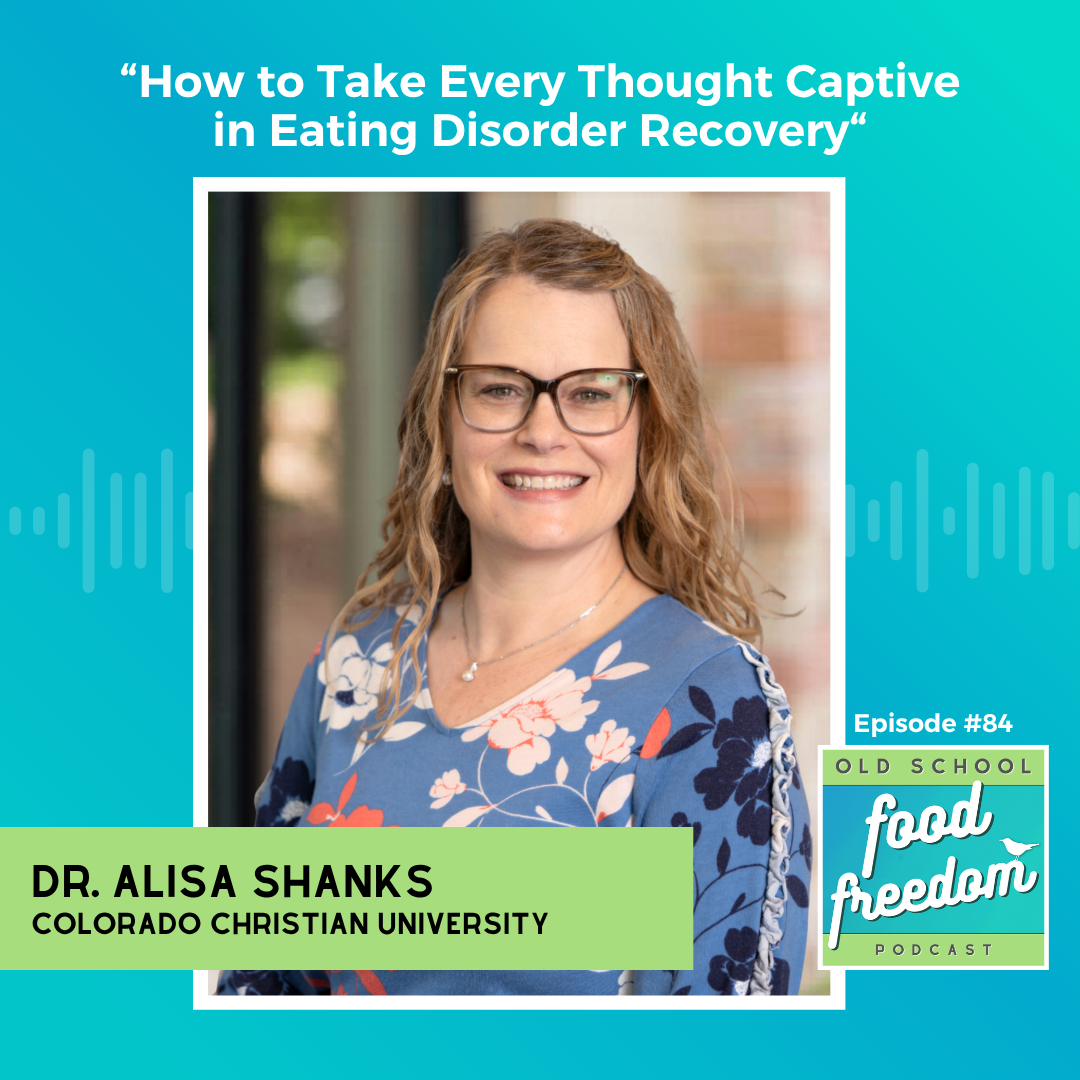
"We need to surrender and ask the Lord to root his fruit in us and ask him to show us where we need to uproot the weeds of that poisoned fruit."
You've heard it a hundred times: Take every thought captive. Maybe you've even written it on a sticky note, highlighted it in your Bible, whispered it to yourself in a hard moment. But if you've been walking through eating disorder recovery or struggling with body shame, you may know this verse and still feel completely at the mercy of the thoughts that won't stop coming.
Dr. Alisa Shanks is back, and friend, this one goes deep. Because the question Alisa is really asking isn't just about managing your thoughts. It's about what kind of fruit those thoughts are growing. Not the fruit you want to grow. The fruit that's actually taking root in the soil of your mind right now.
Dr. Alisa Shanks is a licensed clinical psychologist in Colorado with over two decades of clinical expertise in eating disorder recovery and university mental health. This conversation started not in a podcast studio, but in a therapy session, when the Holy Spirit planted something in the middle of a session with a client that Alisa couldn't stop thinking about. That's where the fruit of the Spirit versus the poisoned fruit of the enemy was born.
Here's what we cover:
What it means to take every thought captive, and why it's the hinge point between the fruit of the Spirit and the poisoned fruit of the enemy
Galatians 5 unpacked: love, joy, peace, patience, kindness, goodness, faithfulness, gentleness, and self-control, and the antonyms Dr. Shanks calls the poisoned fruit of the enemy
Why the fruit is singular, and what it means that you cannot manufacture it in your own strength
How unforgiveness can function like drinking poison and expecting someone else to die, and what the path toward forgiveness and healing looks like
Why self-forgiveness in recovery is often the hardest kind, and how to apply the fruit of forgiveness toward yourself when you feel like you should have been further along by now
What bitterness and unforgiveness do to the soul, and why staying on that treadmill gives the enemy a foothold
How to feel a hard emotion without planting its seed, and the difference between experiencing poisoned fruit and cultivating it
Why vengeance is so hard to surrender, and what it means that God's justice is not on our timeline
The closing invitation: surrendering, asking God to root His fruit in us, taking every thought captive, and leaving justice to the Lord
The Fruit of the Spirit vs. The Poisoned Fruit of the Enemy
Galatians 5:22-23, expanded by Dr. Alisa Shanks
| Fruit of the Spirit | Poisoned Fruit of the Enemy |
|---|---|
| Love | Hatred · Indifference · Selfishness · Fear · Disdain |
| Joy | Sorrow · Misery · Despair · Discontent |
| Peace | Conflict · Chaos · Anxiety · Turmoil |
| Patience | Impatience · Restlessness · Irritability · Frustration |
| Kindness | Unkindness · Cruelty · Harshness · Selfishness |
| Goodness | Evil · Wickedness · Corruption · Malice |
| Faithfulness | Disloyalty · Betrayal · Inconsistency |
| Gentleness | Harshness · Aggression · Rudeness · Violence |
| Self-Control | Impulsivity · Recklessness · Undisciplined · Chaotic |
| Humility | Arrogance · Pride · Egotism · Self-Importance |
| Justice | Oppression · Corruption |
| Hope | Despair · Hopelessness · Doubt · Discouragement |
| Forgiveness | Unforgiveness · Resentment · Bitterness · Grudge-Holding |
Friend, if you have ever found yourself cycling through shame, bitterness, or the quiet accusation that you should be over this by now, Dr. Shanks knows that place. So does Chrissy. And what this conversation makes clear is that the fruit of the Spirit is not something you muster up. It is something that grows in you when you stay grafted to the vine. Your job is to trust. His job is to fill you to overflowing.
"We're not trying to pull ourselves up by our bootstraps and manifest love, joy, peace, patience, kindness. This is being planted in us through the power of the Holy Spirit." — Dr. Alisa Shanks
Taking every thought captive is not a one-time victory. Alisa is honest about that. The poisoned fruit will show up again. The seeds will blow in. But you get to choose what you plant. And with Christ-centered healing as your anchor, you can feel the hard feelings, bring them to the Lord, and release them, without pitching your tent in them.
The thoughts will come. The fruit you grow is up to you. And Jesus is already in the soil, ready to help you tend it.
If this episode resonated with you, would you share it with someone who needs to be reminded that the fruit of the Spirit is already available to them?
This is part one of a two-part conversation with Dr. Alisa Shanks. In part two, she brings the science. We talk about what modern neuroscience says about the fruit of the Spirit, why your brain was designed to run on joy, and what neuroplasticity has to do with taking every thought captive. She also walks us through two beautiful, practical tools, including the Golden Memories exercise, that you can return to any time the poison fruit starts taking root. Come back for that one, friend. It is worth it.
We’d love to hear your thoughts, so please drop us an email at admin@findingbalance.com, send us a voice message via SpeakPipe, or you can also subscribe for more practical episodes coming your way.
More About Dr. Alisa Shanks
Dr. Alisa Shanks has been a licensed clinical psychologist in Colorado since 2004, having built her career around three deep passions: her faith, eating disorder recovery, and university mental health. She has served at Biola University and the University of Colorado at Boulder, and currently serves as Director of the Larry Crabb Center for University Counseling at Colorado Christian University in Lakewood. Dr. Shanks believes wholeheartedly in full eating disorder recovery and brings that conviction to everything she does. She also serves as Chair of the FINDINGbalance® Board of Directors and brings over two decades of clinical expertise to her role. Alisa has been married for 25 years and has 2 teenage sons.
Hello Freedom Community
Our Hello Freedom community is launched! This is a Christ-centered space to find connection, encouragement, and gentle steps toward freedom from food and body-image struggles.
No pretending, no fixing yourself first, come just as you are. If you want in, your next step is to join us at findingbalance.com/community.
You were not meant to walk this alone. We're saving a seat for you!
Resources Mentioned
Book: The Other Half of Church: Christian Community, Brain Science, and Overcoming Spiritual Stagnation by Jim Wilder and Michel Hendricks
Book: Life Changing Art of Self-Brain Surgery by W. Lee Warren
Mentioned Scriptures
Galatians 5, Galatians 5:22-25, Micah 6:8, Romans 15:13, Matthew 6:14–15, Colossians 3:12–13, 1 Thessalonians 5:16–18, James 1:5, Proverbs 2:6, Romans 12:2, John 10:10, Galatians 5:1, Romans 15:13, Philippians 4:4-7, Romans 12:19, Deuteronomy 32:35
Connect with Dr. Alisa Shanks
Christian Treatment Finder Profile
FINDINGbalance
Facebook
Instagram
SpeakPipe – Send us a voice message!
CHRIST-CENTERED RESOURCES TO HELP YOU FIND FREEDOM
The Daily Vitamin eDevo: A free devotional with bite-sized truth emailed 5 days a week
Community Groups: Find connection with prayer groups and our Hello, Freedom! community.
Christian Treatment Finder: Connecting you with Christian providers experienced in treating eating issues.
Lasting Freedom Online Course: A Christ-centered, non-diet course to work through false beliefs about food and weight so you can live free from disordered eating and body image issues.
CREDITS
Interlude music by “Hotham” – Morning Thoughts
Intro music by “MokkaMusic” – Old Jeans (Funk)
Wrap-up music by Jesse Quinn – Christian Instrumental
Production & Editing by Leah Bryant Co
The content in this podcast is for informational purposes only and is not intended to diagnose, treat, or prescribe a particular course of action. If you have, or suspect you may have, an eating disorder, please consult your healthcare provider. If you desire to receive faith-based care, visit ChristianTreatmentFinder.com to browse professionals with a Kingdom campaign against eating disorders.
More about the Old School Food Freedom Podcast
In today’s diet-culture society, food issues and body hatred have become the norm. But you were created to be FREE. Welcome to Old School Food Freedom, where we go back to the basics, God’s basics, for how we view food, our bodies, and our worth.
Hosted by FINDINGbalance Executive Director Chrissy Kirkman, this podcast features Biblically-sound experts, thought-leaders, artists, and everyday people who will inspire you to interrupt negative cultural soundtracks and rediscover God’s original design for your relationship with food and your body.
This show will deliver practical, faith-filled insights on how to break free from diet culture and body shame through the lens of scripture. If you’re looking for guidance on how to heal your relationship with food while deepening your faith, you're in the right place.
We’ll answer questions like
What does the Bible say about food freedom?
How can I overcome an eating disorder or disordered eating with Jesus?
What is the biblical perspective on diet culture?
How can I find peace with food as a Christian?
What does it mean to treat your body as a temple in relation to eating?
How can I break free from diet culture with Jesus?
How can I align my eating habits with biblical teachings?
What are the first steps to finding food freedom in Christ?
This podcast is for anyone ready to walk away from diet culture and into the freedom that Christ offers. Whether you’re recovering from an eating disorder, disordered eating, wrestling with body image, or simply craving a more peaceful relationship with food, this space was made for you.
If you want to experience true food freedom with Jesus, this podcast will give you the encouragement, truth, and tools to do just that.
The unedited transcript for this episode of Old School Food Freedom
Chrissy [00:01:20]: Yes. And you are here to talk about the fruit of the spirit versus the poisoned fruit of the enemy. And we're taking every thought captive. This is not just about eating disorders. This is not just about breaking free from diet culture and food and body stuff. This is like our lives, like how we can take every thought captive. So I am excited for this and to jump in. So let me first, if you are not familiar with Dr.
Chrissy [00:01:47]: Alisa Shanks, she is a licensed clinical psychologist in Colorado since 2004, having built her career around three deep passions, her faith, eating disorder recovery, and university mental health. She has served at Biola University and the University of Colorado at Boulder and currently serves as director of the Larry Crabb Center for University Counseling at Colorado Christian University in Lakewood. Dr. Shanks believes wholeheartedly in full eating disorder recovery and brings that conviction to everything she does. She also serves as chair of Finding Balance Board of Directors and brings over two decades of clinical expertise to that role. Elisa has been married for 25 years and has two teenage sons. Wow, you're doing a lot, girl.
Dr. Alisa Shanks [00:02:37]: Yeah, for sure. And the Lord through me.
Chrissy [00:02:41]: Yeah. Oh, yeah. You are definitely his vessel. I know that in my life and it's just such a joy to have you back here. Okay. You have done the kickoff many times. We've kind of changed it up today. I want to ask, what are some old school Jesus jams you still love to crank?
Old School Worship and Spiritual Reflections
Dr. Alisa Shanks [00:02:57]: Yes. You know, the first one that comes to mind is Shout to the Lord. Like classic worship. And then like, for real old school is like as the deer panteth for the water. So, like, just calm and mindful and like, I can't even come up with the lyric.
Chrissy [00:03:16]: Do you know, I still throw those two into our worship mix. I just think because. And as the dear panted for the wildest — it's so good. But in my mind, I'm just imagining a deer with their tongue out. Panting. And I think it's funny at first, but then when I stop to think my soul, I want to crave and thirst for the Holy Spirit in that way and for the Lord.
Dr. Alisa Shanks [00:03:45]: Absolutely.
Dr. Alisa Shanks [00:03:50]: And I knew all the sign language for Shout to the Lord so, like, I could go all in on that one.
Chrissy [00:03:56]: So, like, real ASL sign language.
Dr. Alisa Shanks [00:03:58]: I took sign language at Baylor for, I think, two semesters in order to sign while leading worship.
Chrissy [00:04:04]: That's so fun. I have a really close friend, Angie, who's an interpreter, and it's so fun. We like to ask her questions about different sign language. But I've never really learned much. Just a few to do in songs, and some of them I don't even know if it's real. It's just, you know, youth group hand motions or come and go with me to my father's house. Okay. Anyway. Oh, my gosh. Throwback jam.
Understanding the Fruit of the Spirit
Chrissy [00:04:29]: Okay, so like, here we go. Fruit of the spirit versus poisoned Fruit of the enemy and taking every thought captive.
Dr. Alisa Shanks [00:04:39]: Yeah, go.
Chrissy [00:04:40]: Let's get into this.
Exploring Emotions and Forgiveness in Eating Disorder Recovery
Dr. Alisa Shanks [00:04:42]: Yeah. So I'm a psychologist. I see clients and run a college counseling center. And I think it was October. It might have been before that, but my notes on my phone start in October on this content. I was working with a lady that I was seeing, and I have permission to just say about that much. But she was really struggling with bitterness and resentment and unforgiveness around some interactions that she had with her mother towards the end of her life when her mom was battling memory issues and dementia. And there were some really kind of heated experiences that led my client to be feeling resentment and unforgiveness toward herself in terms of the way that she had behaved before her mom passed.
Dr. Alisa Shanks [00:05:34]: And the Lord just planted this, like, just Holy Spirit working in the middle of a session in terms of looking at the bitterness, the resentment, the regret, the unforgiveness. Like that. Self disappointment. And the Lord just said, well, that's not the fruit of the Spirit. I was like, yes. And then we began a discussion about the fruit of the Spirit versus the poison fruit of the enemy. And that's really where this came from. Was in a therapy session, beginning to contrast that.
Dr. Alisa Shanks [00:06:13]: There is a dramatic difference between. Right. Galatians 5, love, joy, peace, patience, kindness, goodness, faithfulness, gentleness, and self control. And the antonyms, right. The fruit of the enemy, which are the opposite of those. So I began doing a deep dive on those fruit. And then I added a few more based on the scripture, because I was talking with a different client, and she's like, well, what about pride? And I'm like, well, then obviously we need humility as one of our fruit. So we added, I have several additional scriptures.
Dr. Alisa Shanks [00:06:51]: But my first expansion was Micah 6:8. So it says, he has told you, oh man, what is good and what the Lord requires of you, but to do justice and to love kindness and to walk humbly with your God. And I know that, at least for me and I think also for you, that we have those, like, deep justice needs. So that was kind of my first expansion. And then I had to add hope, of course. I could spin this camera around my office here at work, and you would see multiple words of hope in my office. And my license plate literally reads, have hope without the first E, because you don't get eight letters.
Dr. Alisa Shanks [00:07:34]: So that comes from Romans 15:13. May the God of hope fill you with all joy and peace, so that by the power of the Holy Spirit, you may abound in hope. And there's a couple different translations there. But it says, as you trust in him, so that by the power of the Spirit, you may overflow with hope and peace.
Chrissy [00:07:56]: So as you trust in him. I hear that. And I see as you trust in him. That is an ongoing thing. The more you do it, it's a continuum.
Trust, Hope, and the Power of the Holy Spirit
Dr. Alisa Shanks [00:08:07]: Yeah. And it says, so that you may overflow with hope by the power of the Holy Spirit. When we're thinking about the fruit, we're not trying to, like, muster this stuff up.
Dr. Alisa Shanks [00:08:31]: We're not trying to pull ourselves up by our bootstraps and manifest love, joy, peace, patience, kindness, et cetera. This is being planted in us through the power of the Holy Spirit. And that's why I love this verse that God is the God of hope, and he is filling us with joy and peace. And the part that we have to show up with is the trust. So as we trust in him that the Holy Spirit will fill us with overflowing hope.
Chrissy [00:09:01]: So our job is to trust, and then he will.
Dr. Alisa Shanks [00:09:05]: Yes, yes. He will fill us to overflowing. How lovely does that sound? And then, of course, had to add forgiveness, because unforgiveness was one of the original fruit of the enemy. So we had to make sure forgiveness was in our fruit. And of course, Jesus has a ton to say about forgiveness and 70 times 7 and all of that. And that is like, Jesus literally says, like, as you forgive, so I will forgive you. And I think that whether it's grief or an eating disorder or just regret or whatever it is, that we all know that not forgiving other people is a poor choice.
Chrissy [00:09:46]: Right.
The Power of Forgiveness for Self and Others
Dr. Alisa Shanks [00:09:48]: That we need to have that freedom. There's a Chinese proverb or adage that says living in unforgiveness is like drinking poison and expecting the other person to die. Right. It is that bad for our souls. And of course, they're not impacted. We're the ones that are impacted. But in this situation with my client, it was her mom, and we talked about this in therapy. I'm like, honey, your mom is in heaven with Jesus.
Dr. Alisa Shanks [00:10:16]: There's not an ounce. There's no tears, there's no crying, there's no mourning. She is in heaven in full freedom, full resurrected space. And she's not bitter. She's not feeling unforgiveness towards you. So my client was holding the unforgiveness towards herself.
Chrissy [00:10:36]: Yeah.
Dr. Alisa Shanks [00:10:37]: And I think as we think about this, with our audience who is potentially, you know, battling or fighting for recovery from an eating disorder, I think that there can be a huge struggle with not forgiving yourself around, like, well, I should have been over this by now, or, you know, I should have found freedom and to be able to apply that fruit of forgiveness towards ourselves. Right. One of the things I always say to my clients, for themselves, their parents, their people in their relationship, is you are doing the best that you can with the skills that you have.
Chrissy [00:11:15]: Yes. With what you know right now.
Dr. Alisa Shanks [00:11:17]: With what you know right now. And so, like, for our audience, for our listeners, right. There is hope, there is healing, and, like, don't hold yourself in unforgiveness for having walked this road. We all live in this world. We've talked in prior episodes about the soup that we are marinated in. We live in this culture where it's very hard as a woman to love and respect the body that you have. And I think forgiveness here as a fruit of the spirit is really core for just forgiving the parts of your story that aren't as you might prefer them to be. Does that resonate, Chrissy?
Chrissy [00:12:01]: It totally resonates. And I'm thinking this hits home to something I was having a conversation with, with a friend yesterday when it comes to movement, and it feels like a stronghold. What is this stronghold I have with working, working, working, working, working, putting my needs aside, struggling to get up and get away from here and move, and I'm still carrying a lot of shame. I have not forgiven myself for a lot of things. And so as you're talking through this, that's resonating. And I'm thinking, just reminding myself gently that we cannot change the past. If we could, of course, there are so many slates we would wipe clean and whitewash. It would just be so different.
Chrissy [00:12:43]: But we can't. And whatever we're going through right now, I mean, God is with us. We are not alone in that. So if there's some fruit that's being produced and it's wonderful, fruit of the Holy Spirit, and then there's some other fruit, like, I used to think that the poison fruit of the enemy was, like, shriveled and bad. But it could look good.
Dr. Alisa Shanks [00:13:04]: Yeah.
Chrissy [00:13:05]: You know, like, I'm thinking back to the Garden of Eden. You know, there's one guideline, one thing that God said.
Dr. Alisa Shanks [00:13:12]: Please don't, you know, one boundary, one boundary.
Chrissy [00:13:15]: Don't eat of this fruit. Like, if it looked shriveled and gross and worms coming out of it, Eve wouldn't have even been tempted. But it must have looked really good. And she proceeded to make that choice, and so did Adam. And so is there anything that comes to mind when you hear me say that?
Dr. Alisa Shanks [00:13:32]: No, I think that when we think about, like, some of our justice needs, and we think about, like, you know, God has placed it in our hearts that we want justice.
Chrissy [00:13:42]: Yes.
Dr. Alisa Shanks [00:13:43]: And it is really important that we lean into the verse from Romans and Deuteronomy. The quote is, vengeance is mine, declares the Lord, and honey bless. Like, that is so hard because we want, like, he put the justice needs in our hearts. And so we want justice. And for so many aspects of our stories, we have to surrender and leave that justice to God. And so. But being in a place of resentment or bitterness or unforgiveness, that is a place that is harmful to our souls, and it gives the enemy a stronghold.
Dr. Alisa Shanks [00:14:26]: And as you were talking about, like, the nasty, rotten, moldy fruit, right? The devil disguises himself as an angel of light, right? Like, he was so beautiful. That's part of where his pride came from. And so thinking about, like, not being deceived by, well, I'm just gonna be on this treadmill of bitterness and unforgiveness and resentment that's poisoning you. And that's part of why we talked about the poison fruit of the enemy versus, like, the rich, vibrant fruit of the Holy Spirit. In John 10:10, Jesus says, the thief comes to steal, kill, and destroy. But I have come that they might have life and have it abundantly.
Dr. Alisa Shanks [00:15:11]: And so, actually, I want to add in, there's a couple more. So gratitude was one of the other fruit that I was bold enough to add. I know that Paul gave us a lovely, thorough list, but I'm adding a couple. So gratitude in First Thessalonians 5:16-18 talks about, rejoice always, pray without ceasing, give thanks in all circumstances, for this is the will of God for Christ Jesus. And then wisdom. You can't do the fruit of the Spirit without wisdom. There's a whole love letter to wisdom in Proverbs. It's amazing.
Dr. Alisa Shanks [00:15:44]: But the verse I chose to support that was James 1:5. If any of you lacks wisdom, let him ask God, who gives generously to all without reproach, and it will be given to him. And then Proverbs 2:6. For the Lord gives wisdom; from his mouth come knowledge and understanding. So that's kind of my comprehensive list. And you're welcome to add to it. Anyone, feel free to add. So we have love, joy, peace, patience, kindness, goodness, faithfulness, gentleness, self control.
Dr. Alisa Shanks [00:16:15]: And then we've added humility, justice, hope, forgiveness, gratitude, and wisdom. For love, right? The poison fruit could be hatred, but it also could be indifference or selfishness. For joy, the poison fruit is sorrow, despair, discontentment. For peace, right? Conflict, chaos, turmoil. For patience. That poison fruit is impatience, restlessness, frustrated. For kindness, it's unkind, cruel, harsh, selfish. For goodness, evil, wicked, corrupt.
Chrissy [00:16:54]: Right?
Dr. Alisa Shanks [00:16:55]: These are strong words.
Chrissy [00:16:56]: Yeah, they are.
Recognizing the Poison Fruit of the Enemy
Dr. Alisa Shanks [00:16:57]: For faithfulness, disloyal, betrayal, inconsistency. For gentleness, right? Being harsh, aggressive, violent, or if we want to go lighter on that, even just like chronically rude. For self control, if we are impulsive or reckless or undisciplined. For humility, pride, right. We had to add humility because we knew pride was a fruit of the enemy. Arrogant, egotistical, self important. For justice, right? Opposites would be oppression and corruption and just unjust. Right. Deceptive. For hope.
Dr. Alisa Shanks [00:17:34]: Our negative fruit would be despair, doubt, discouragement, hopelessness. For forgiveness, of course. Unforgiveness, resentfulness, bitterness, grudge holding.
Chrissy [00:17:44]: Right?
Dr. Alisa Shanks [00:17:45]: Like who doesn't have some place where we have a little seed of bitterness or grudge holding. The last two. Gratitude would be entitled or resentful. Wisdom would be foolish, ignorant and again, reckless. So if we think about like, and girl, you know, whenever I'm on here and with everyone else you talk to, no shame.
Chrissy [00:18:09]: I was about to add that in. So thank you. Yes.
Dr. Alisa Shanks [00:18:11]: No shame. No shame. These are all things, right? We are this side of heaven, so we are not in full freedom yet. And so we will have moments where we experience injustice and it makes us angry. And the anger isn't the problem. The initial emotion is not the problem. The struggle is if we have the anger, the frustration, the unforgiveness. And then we like get a little pot and we plant the seed and we put some dirt on it and we give it some water and we place it at the window and we begin to grow the poison fruit.
Dr. Alisa Shanks [00:18:51]: That's where the trouble is, not the experience in the first place. It is totally natural and normal for us to feel a wide range of emotion. It's the choice to plant the seeds of bitterness, resentment, unforgiveness, hatred, indifference, all those things. That's where we start to cultivate or tend the fruit of the enemy. Then we are supporting the wrong camp, right? And we are being infected. We are being poisoned by that fruit.
Chrissy [00:19:27]: He's setting traps and snares for us at all times. It's so easy for us to forget that we have a choice. We get to choose. We have free will to choose. And we can use Christ centered agency to say, and friends, I'm gonna put this list of — what did you call it?
Dr. Alisa Shanks [00:19:49]: Yeah, the fruit versus the poison fruit.
Chrissy [00:19:52]: There we go. I'm gonna put this list so you can see when it says love, the antonym is hatred, indifference. So when you start like maybe pausing and thinking — like I'm already doing this with myself when it comes to the movement struggle that I have — you know, it's like, you know, you're saying cruel, harsh, selfish is the opposite of kindness. I am not being kind to myself. There's this part of me that wants to be kind and loving. Often I think about it and almost fantasize about like, oh, how nice it would be to go by myself for a walk on a trail. But then the other voice in my head is like, you know, being cruel and harsh and just really shameful and judgmental. So I'm having to like reflect as well. And I'm trying to do it without shame and just to know that like this is normal.
Chrissy [00:20:48]: Living in the world we live in, knowing there's a battle going on in the spiritual realm.
Dr. Alisa Shanks [00:20:54]: Absolutely.
Chrissy [00:20:55]: And I get to pause and say, okay, Jesus. I'm thinking of the poison fruit list and I'm seeing what is really poisonous fruit that I have been consuming. And help me know that like, that's not what — just like food, I can consume whatever I want. I have food freedom.
Dr. Alisa Shanks [00:21:12]: Yes.
Chrissy [00:21:13]: And just know that we've got the choice. We can use our voice.
Dr. Alisa Shanks [00:21:17]: And we're vulnerable to this because we are in this world, but not of this world. The Bible makes it very clear that the angel of light, the deceiver, he's got some power down here. It's not the ultimate power. We know how the story ends.
Chrissy [00:22:35]: Yes.
Living in Freedom and Surrendering Justice to God
Dr. Alisa Shanks [00:22:36]: But there are so many traps and snares and so as this has been marinating in me for several months now, it's thinking about, like, Lord, help us, right? Plant your seeds. Because your seeds are stronger, right, than the devil's seeds. But we have to surrender that strong need for justice and know that God's got it, even though we have such a hunger to see that justice on this side of heaven. And so there is freedom. Our theme verse, right? Galatians 5:1. It is for freedom that we have been set free. Therefore, do not submit again to a yoke of slavery. The devil is wanting to enslave us.
How to Take Every Thought Captive
Dr. Alisa Shanks [00:23:22]: Yes, with bitterness, unforgiveness, pride, resentment, all of that poison fruit, and we have victory. Jesus came that we would have abundant life. John 10:10. And it can be really hard to walk in that full freedom. And so, again, no shame, right? We are here to talk about how do we move away from being entangled with this poison fruit and move toward full freedom. And so the key, like I was saying before, is feel the feelings. Feel whatever is bubbling up in you. And I've probably said this on our podcast before, but Anita Johnston, a psychologist that works with eating disorders, she talks about, when an emotion comes knocking on your door, invite it in and say, what is your message for me? And so if that message is anger, could it be that a boundary's been crossed or there's something that needs your advocacy or attention? If that emotion is loneliness, does that mean that you need to go and invest in some friendships? If that emotion is sadness, is there something that you need to grieve? But when that emotion is the poison fruit, you want to figure out where it came from, what are the roots, and get some healing from that.
Dr. Alisa Shanks [00:24:54]: But do not plant the seed. Some of this came from I was on a walk with my bestie, and she was describing some family political garbage that was happening in her extended family. And I'm like, girl, tell me all about it, and then let it go. You go to your trusted person, you share the burden, right? Like what is also expressed in Galatians, right? We wanna bear one another's burdens, and each must carry his own load. Those, I think, are both in Galatians 6. And so when it's too big for one of us to carry on our own, that's when we bear one another's burdens. The word for load is like your daily backpack of stuff.
Dr. Alisa Shanks [00:25:35]: So when it's too much, I go to my community, we support each other, and then we release it. And I still have to carry what's mine for today. But with these poison fruit, feel it and let it go. Don't dig down and wallow into it.
Chrissy [00:25:54]: Right.
Dr. Alisa Shanks [00:25:55]: You don't want to, like, pitch your tent in bitterness.
Making Choices: What Seeds Will You Plant?
Chrissy [00:26:00]: Yeah. And, you know, when you were talking about don't plant the seed. Like, you might have the seeds, but don't plant them. I was just thinking, okay, so that could look like if someone gave me this bundle of seed packets, I have all these seed packets, and I know what I would want to plant. And I could look through them all and see, like, four seed packets that I'm like, this doesn't really work for the kind of soil we have or the area that we live in. Or I just absolutely don't want to smell whatever it is. Or I'm allergic to this. I can choose to not have those and to dispose of them or give them away, but I don't have to plant them.
Chrissy [00:26:44]: I get to choose. It's back to I get to choose with the Lord.
Dr. Alisa Shanks [00:26:48]: Yes. And that's where in our intro today, you were talking about the 2 Corinthians 10:3-5. That talks about take every thought captive.
Chrissy [00:26:57]: Yeah.
Dr. Alisa Shanks [00:26:57]: And years ago, I was working in Wichita, Kansas, and one of my friends, Lana, was a couples therapist. And y'all, her favorite verse for working with couples was, take every thought captive to Christ. For great reason.
Chrissy [00:27:13]: Great advice. Yeah.
Dr. Alisa Shanks [00:27:15]: Because we get ourselves into trouble if we allow ourselves to get on that hamster wheel of entitlement, bitterness, resentment, then you are planting those seeds, and it is destructive to your relationship. So if we think about taking every thought captive and we think about forgiveness is the antidote. Another friend of mine was actually reading a book on spiritual warfare, and it talked about the key to freedom being forgiveness. And so there is such beauty in that release, the letting go. The saying, I trust you, Lord, that vengeance is yours, and that justice will take place even when I will not or may not see it.
Chrissy [00:28:07]: Let's stop right there. That also is really hard. There's something inside us that wants to see justice be served. Like, we want to see that. I want to know that you did the crime, so you need to do the time. Like, just even if it's not like, a crime, like, but someone was mean to us. We want vengeance.
Dr. Alisa Shanks [00:28:35]: But it's part like our God is a just God. Jesus would not have had to come and die and shed his blood if we had an unjust God. Of course. So His God's quality of justice is in us. Right. He's placed that in our hearts that cry for justice. But then we want it. And bless, honey, we want it now.
Chrissy [00:29:00]: Right.
Dr. Alisa Shanks [00:29:01]: So the timeline is where we get in trouble. Romans 12:19. Beloved, never avenge yourselves, but leave it to the wrath of God, for it is written, vengeance is mine, I will repay, says the Lord. And that's found originally in Deuteronomy 32:35. And then it's quoted in Romans. And we think about Micah 6:8. Right. To do justly, love mercy, walk humbly.
Dr. Alisa Shanks [00:29:28]: It's part of what he's given us is this desire for justice. And his justice is what brings us to his throne and brings us, because of his mercy, into communion with Him. Right. That he looks on Jesus and pardons us. Right. There's a beautiful hymn that talks about he looks on him and pardons me.
Dr. Alisa Shanks [00:29:53]: If we think about Jesus' call to forgiveness and Jesus' expression, that it is the manner in which we forgive that we will be forgiven. That'll preach.
Chrissy [00:30:03]: Yeah, right. Yeah, for sure.
Forgiveness, Freedom, and the Fruit of the Spirit in Everyday Life
Dr. Alisa Shanks [00:30:05]: And it's hard, so hard. Because those justice needs are so strong and so moving toward forgiveness, towards freedom, towards release. I have a couple quotes I want to share with you. C.S. Lewis said, in Mere Christianity, everyone thinks forgiveness is a lovely idea until they have something to forgive. Right.
Chrissy [00:30:31]: I was just thinking it's probably how it goes. Yes.
Dr. Alisa Shanks [00:30:37]: It is. But that's again, none of this, Chrissy, is in our strength. Right. This is the fruit that being grafted into the vine. Jesus says, I am the vine and you are the branches. So by being grafted into the vine, this fruit naturally overflows. And I remember when I was doing the Bible recap with Tara Leigh Cobble, she talked about, it is the fruit, not the fruits. It is one fruit. This is the fruit. So all of this is the fruit. Not like individual little grapes. It is one fruit.
Dr. Alisa Shanks [00:31:17]: This is the fruit of being grafted into the vine is all of these beautiful, beautiful things. I also found this really neat quote by G.K. Chesterton. He said, to love means loving the unlovable. To forgive means pardoning the unpardonable. Faith means believing the unbelievable. And hope means hoping when everything seems hopeless. And that's where, if we go back to that Romans 15:13, our God is the God of hope. And then he is the one that is filling us with joy and peace as we trust in him so that we will overflow with the power of the Holy Spirit. We'll overflow with hope by the power of the Holy Spirit.
Dr. Alisa Shanks [00:32:10]: So as we think about the poison fruit versus the fruit, I think that like just kind of closing thoughts here. I would say that we need to surrender and ask the Lord to root his fruit in us and ask him to show us where we need to uproot the weeds of that poison fruit. We need to take every thought captive and then forgive and leave the justice to the Lord.
Chrissy [00:32:43]: This applies to yourself and to others?
Dr. Alisa Shanks [00:32:48]: Absolutely.
Chrissy [00:32:48]: I think it's easy to hear this message and think, you know, our struggles with other people, but a lot of this is internal. It's the narrative that we're speaking about ourselves and thinking about ourselves and shaming ourselves and all of those things. What is the fruit in my life? What toxic, poisonous fruit needs to be removed? And it can just be as simple as, Lord, show me, Jesus, help me, help me to gently walk in this shame free with you and just become aware and choose Christ centered agency. Choose new things, choose new ways. And I'm not always gonna get it right.
Chrissy [00:33:33]: And it's not like we're a bunch of perfectionists around here. Like we as in me at least. But like, you know, like I want it to be fixed right now and done with and behind me. And that's just not how eating disorder recovery goes.
Dr. Alisa Shanks [00:33:48]: Patience is one of the fruit. Oh, listen.
Chrissy [00:33:53]: Oh man. Hold on, let me scroll back up here. Patience. Yes, it is. So the opposite is impatience. Restless, irritable frustration. If y'all knew there's so much poisonous fruit happening. But am I gonna shame myself? Am I gonna feel terrible about that? I don't like it.
Chrissy [00:34:13]: That's not who I wanna be. But you know what? This is such a timely message. Like, no matter when you're listening to this, if it's 20 years from now, this is still gonna be a timely message because this is something we live in the world. We're gonna run into this. And so, Lord, I'm saying it right now so y'all can hold me accountable as we're a community. Help me get rid of this restlessness, this irritability, this frustration with myself and the situation. And the impatience of that. It takes time.
Chrissy [00:34:44]: Help me to rest in you and walk one step at a time with you so I can have this fruit of the Spirit. That's called patience. That's just one of them. We can go through this list but we are wrapping up this episode.
Dr. Alisa Shanks [00:34:57]: I love it.
Podcast Resources and Outro
Chrissy [00:34:59]: Okay, so friends, you can find all the scriptures that were referenced today in the show notes. I've also put the fruit of the Spirit versus the poison fruit of the enemy — that whole list that Elisa came up with — I've put that in the show notes as well. And you can also find links to connect with Dr. Shanks in the show notes. So we will be back in a couple of weeks to keep going deeper.
