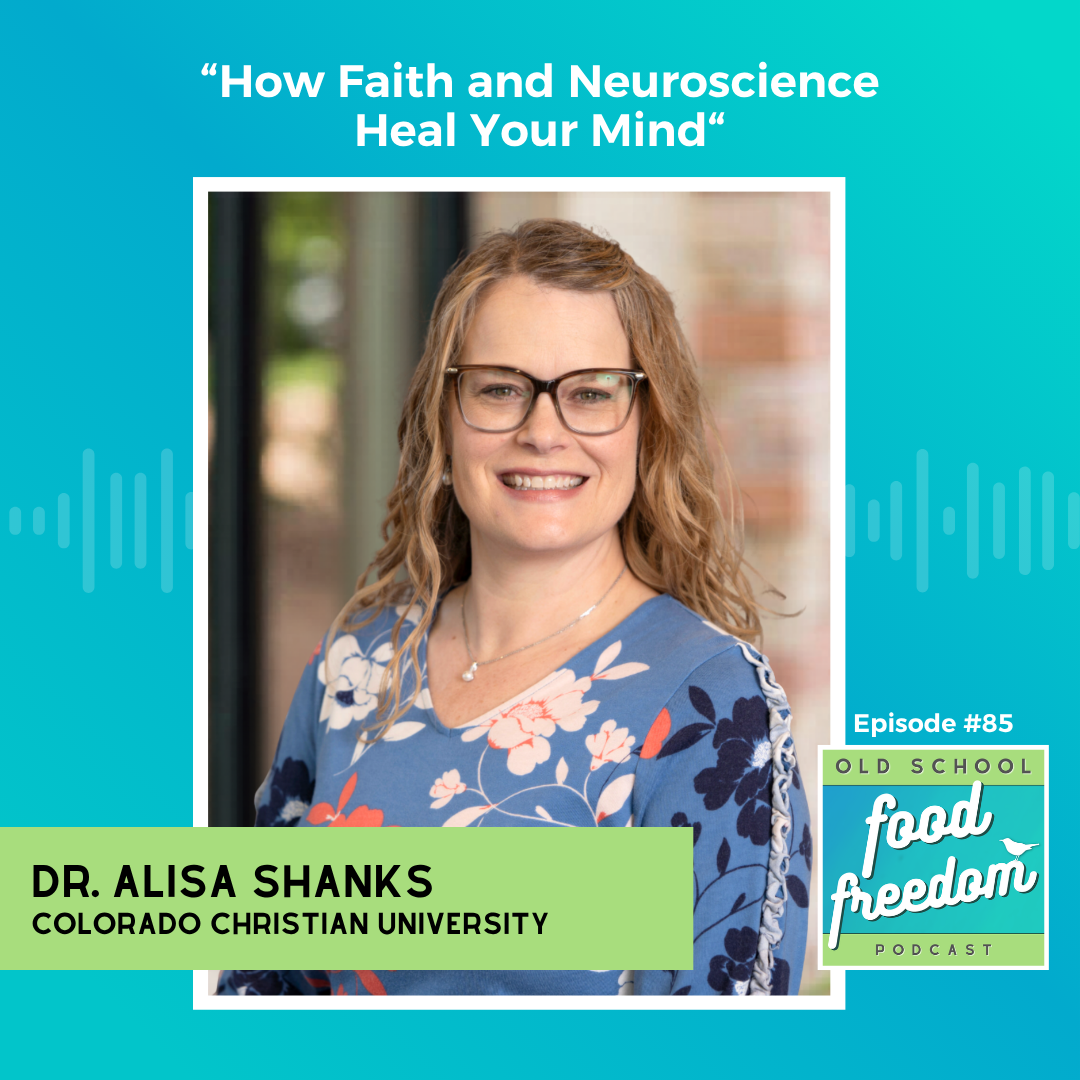
How Faith and Neuroscience Heal Your Mind with Dr. Alisa Shanks
"Gratitude practices measurably reduce depression symptoms by shifting the brain's focus away from threat and toward reward, thereby changing our neurochemistry."
You have been fighting your own mind. Trying to think, feel, and do better, only to end up right back in the same exhausting loops of impatience, resentment, and frustration that you vowed you were done with. And if you've been walking through eating disorder recovery or struggling with body image, those loops can feel especially relentless. Like the enemy has a favorite playlist and he keeps hitting repeat.
That's where we pick up today, because this is Part 2. If you haven't listened to Part 1 yet, head back to How to Take Every Thought Captive in Eating Disorder Recovery with Dr. Alisa Shanks first, then come back here. You'll want the foundation before you build the house.
Dr. Alisa Shanks is a licensed psychologist who loves Jesus and neuroscience, and in this conversation, she brings both to the table in the best possible way. Because here's what makes this episode something you'll want to return to again and again: the Word of God that we've had for thousands of years is being confirmed, point by point, by modern brain science. And when Alisa lays that out, it doesn't feel like a lecture. It feels like evidence of God's fingerprints everywhere you look.
Here's what we cover:
Why your brain is literally wired to run on joy, and what happens when the enemy hijacks that design
The neuroscience behind loneliness, anxiety, gratitude, and fear, and the scriptures that said it first
What neuroplasticity means, and why Romans 12:2 is one of the most scientifically accurate verses in the Bible
How chronic fear physically shrinks your brain, and why 2 Timothy 1:7 is not just theology, it's neuroprotection
The Ignatian spiritual practice of experiencing God's loving gaze, and why imagining His face turned toward you with adoration is profoundly healing
The Golden Memories exercise from The Other Half of Church is a simple, joy-building practice you can start today
Why feelings are indicators, not dictators, and how to let them speak without letting them drive
What it looks like to surrender the poisoned fruit of the enemy without straining or striving for it
Friend, if you have ever felt like getting free was supposed to be harder than this, like healing had to involve more effort, and white-knuckling your way toward the fruit of the Spirit, Alisa has something gentle and true to say to you. Cultivating joy, peace, and freedom in Christ is less like fighting the soil and more like folding back into the arms of Jesus and letting Him carry you there.
"I don't have to go and fight the soil to grow the fruit of the Spirit. I have to engage, take every thought captive, forgive, cultivate, connect, and stay rooted in the vine. But it's not like toil." - Dr. Alisa Shanks
The two practices Alisa walks us through in this episode, experiencing God's loving gaze and building your own list of Golden Memories with Jesus, are not complicated, nor are they clinical. They are quiet, sensory, and rooted in the truth that your brain was designed by a God who wants it to flourish. And the science backs that up.
Overcoming toxic thought patterns in eating disorder recovery doesn't always look like warfare. Sometimes it looks like closing your eyes, letting God's face shine toward you, and hearing Him say, "You are my beloved daughter, and I love spending time with you."
That is available to you. Right now. One golden memory, one surrendered thought, one moment of faith, and neuroscience working together, exactly the way God always intended.
If this episode blessed you, would you share it with a friend who needs to know that freedom doesn't have to feel like a fight? And if you've been wondering whether your own struggles with food are something you should get support for, take our free Eating Issues Check-In at findingbalance.com. It only takes about 10 minutes and connects you with Christ-centered resources matched to where you are right now.
We’d love to hear your thoughts, so please drop us an email at admin@findingbalance.com, send us a voice message via SpeakPipe, or you can also subscribe for more practical episodes coming your way.
More About Dr. Alisa Shanks
Dr. Alisa Shanks has been a licensed clinical psychologist in Colorado since 2004, having built her career around three deep passions: her faith, eating disorder recovery, and university mental health. She has served at Biola University and the University of Colorado at Boulder, and currently serves as Director of the Larry Crabb Center for University Counseling at Colorado Christian University in Lakewood. Dr. Shanks believes wholeheartedly in full eating disorder recovery and brings that conviction to everything she does. She also serves as Chair of the FINDINGbalance® Board of Directors and brings over two decades of clinical expertise to her role. Alisa has been married for 25 years and has 2 teenage sons.
Hello Freedom Community
Our Hello Freedom community is launched! This is a Christ-centered space to find connection, encouragement, and gentle steps toward freedom from food and body-image struggles. No pretending, no fixing yourself first, come just as you are. If you want in, your next step is to join us at findingbalance.com/community.
You were not meant to walk this alone. We're saving a seat for you!
Resources Mentioned
Book: The Other Half of Church: Christian Community, Brain Science, and Overcoming Spiritual Stagnation by Jim Wilder and Michel Hendricks
Book: Life Changing Art of Self-Brain Surgery by W. Lee Warren
How to Take Every Thought Captive in Eating Disorder Recovery w/ Dr. Alisa Shanks
Mentioned Scriptures
Genesis 2:18, Philippians 4:6, Proverbs 17:22, Romans 12:2, 2 Timothy 1:7, 2 Corinthians 5:17, 2 Corinthians 10:5, Psalm 46:10, 1 Thessalonians 5:16–18, James 4:7, Micah 6:8, Numbers 6:24–26, Zephaniah 3:17
Connect with Dr. Alisa Shanks
Christian Treatment Finder Profile
FINDINGbalance
Facebook
Instagram
SpeakPipe – Send us a voice message!
CHRIST-CENTERED RESOURCES TO HELP YOU FIND FREEDOM
The Daily Vitamin eDevo: A free devotional with bite-sized truth emailed 5 days a week
Community Groups: Find connection with prayer groups and our Hello, Freedom! community.
Christian Treatment Finder: Connecting you with Christian providers experienced in treating eating issues.
Lasting Freedom Online Course: A Christ-centered, non-diet course to work through false beliefs about food and weight so you can live free from disordered eating and body image issues.
CREDITS
Interlude music by “Hotham” – Morning Thoughts
Intro music by “MokkaMusic” – Old Jeans (Funk)
Wrap-up music by Jesse Quinn – Christian Instrumental
Production & Editing by Leah Bryant Co
The content in this podcast is for informational purposes only and is not intended to diagnose, treat, or prescribe a particular course of action. If you have, or suspect you may have, an eating disorder, please consult your healthcare provider. If you desire to receive faith-based care, visit ChristianTreatmentFinder.com to browse professionals with a Kingdom campaign against eating disorders.
More about the Old School Food Freedom Podcast
In today’s diet-culture society, food issues and body hatred have become the norm. But you were created to be FREE. Welcome to Old School Food Freedom, where we go back to the basics, God’s basics, for how we view food, our bodies, and our worth.
Hosted by FINDINGbalance Executive Director Chrissy Kirkman, this podcast features Biblically-sound experts, thought-leaders, artists, and everyday people who will inspire you to interrupt negative cultural soundtracks and rediscover God’s original design for your relationship with food and your body.
This show will deliver practical, faith-filled insights on how to break free from diet culture and body shame through the lens of scripture. If you’re looking for guidance on how to heal your relationship with food while deepening your faith, you're in the right place.
We’ll answer questions like
What does the Bible say about food freedom?
How can I overcome an eating disorder or disordered eating with Jesus?
What is the biblical perspective on diet culture?
How can I find peace with food as a Christian?
What does it mean to treat your body as a temple in relation to eating?
How can I break free from diet culture with Jesus?
How can I align my eating habits with biblical teachings?
What are the first steps to finding food freedom in Christ?
This podcast is for anyone ready to walk away from diet culture and into the freedom that Christ offers. Whether you’re recovering from an eating disorder, disordered eating, wrestling with body image, or simply craving a more peaceful relationship with food, this space was made for you.
If you want to experience true food freedom with Jesus, this podcast will give you the encouragement, truth, and tools to do just that.
The unedited transcript for this episode of Old School Food Freedom
Chrissy [00:00:00]: Hey, it's Chrissy. Did you know you can actually text me from the show notes? I read everyone. And here is the super cool part. I can now reply back to you personally. Listen, your voice matters here. So if you have a question, if you have a topic you're excited for me to cover one day, maybe you just want to tell me the old school item or experience you missed from back in the day or just want to say, hey, please do it. I would love to hear from you. You can also leave me a voice message and who knows, you might even hear yourself on a future episode.
Chrissy [00:00:32]: And if this podcast has meant something to you, if God has spoken to you personally through this show, would you please take a minute to leave a five star rating or review that helps more women find us and that matters so much more than you know. Head to the show notes to find all the links and in the meantime, I'll be over here rooting for you. Hey friends, welcome back to the Old School Food Freedom podcast where we are about to kick it as old school as it gets with how God created us to live and that is free. I'm Chrissy Kirkman and I am here with Dr. Elisa Shanks. And we are back to talk about the fruit of the spirit versus the poisoned fruit of the enemy and taking every thought captive. So at the end of our last episode, I was sharing something about my own personal struggles and we identified that the impatience, the restless, the irritable frustration, all of those things are the opposite — the poison fruit of the enemy versus patience, which is a fruit of the spirit.
The Fruit of the Spirit vs. Poisoned Fruit of the Enemy
Chrissy [00:01:42]: And so we were talking through that a little bit and now we're back today talking about overcoming the poison fruit. So with that set up, hopefully I really encourage you, if you haven't heard that episode, please go and listen to it first so you'll have all this foundation. You can come back and listen. Pick up right where we left off previously. Okay. So Elisa, overcoming the poisonous fruit.
Neuroscience and Scripture on Overcoming Negative Thoughts
Dr. Alisa Shanks [00:02:07]: Yes. So as I think about really overcoming the poisonous fruit, we talked about taking every thought captive, which is found in 2 Corinthians. And I'm an absolute nerd, my dear. And so one of the things that I think is so fantastic is when the word of God that we've had for thousands of years then is supported by neuroscience. So I think you've read The Other Half of Church. Yeah, and they talk about that. There was a gentleman out at USC and his name may or may not come to my mind right now, but he found that our brains are meant to run on joy. And it was a non-Christian guy, like, he was just studying our brains, and he's like, oh, look, brains are meant to run on joy like a car runs on fuel.
Dr. Alisa Shanks [00:03:00]: So that was a psychologist who was looking at our brains. And the truth of scripture is coming out in neuroscience. So today we're going to be talking more about what are spiritual practices that can help us root down deep into Christ and God and help build and cultivate that fruit of the spirit. So I found on Instagram — ironically, social media can occasionally be used for good.
Chrissy [00:03:29]: It can.
Dr. Alisa Shanks [00:03:30]: I found somebody had put together some scripture and then the scientific — like, we had the honest, true word of God, and now we have the science that backs it up. So I'm going to read you a couple of those. Genesis 2:18 says, it is not good for man to be alone. And then Brigham Young University found that loneliness is as damaging to health as smoking 15 cigarettes a day. And we live in a culture right now where loneliness is just a scourge. In our church recently, our pastor, J.T. English, was talking about, instead of looking for who can be a friend to me, think about who can I go and befriend? And that if you're looking for, well, who's going to be a friend to me, it might be hard to find those people. But if you're looking for who can I befriend? Who can I serve with my fruit of the spirit and my freedom, that there will be no lack of people that would be blessed by your friendship.
Dr. Alisa Shanks [00:04:33]: So we know that it is not good for man to be alone. And science has now supported that. Philippians 4:6 says, be anxious for nothing, but in everything by prayer and thanksgiving, present your requests to God. And it goes on to say that then the peace of Christ will fill your hearts and minds with the knowledge and love of Jesus. And in the Journal of the American Medical Association, they found that mindfulness — like meditation, prayer — those activities reduce anxiety by 38%.
Chrissy [00:05:08]: 38%. 38%.
Dr. Alisa Shanks [00:05:11]: So when we are grounded and breathing and cultivating the love, joy, peace, patience, kindness, gentleness, self-control, hope, humility, gratitude, forgiveness, all of that justice and mercy — that is good for our brains. That is good for our heart, minds and soul. And speaking of gratitude, Proverbs 17:22 says, a cheerful heart is good medicine, but a crushed spirit dries up the bones. We know that to be true. But Harvard Health, which was published in Positive Psychology research, said gratitude practices measurably reduce depression symptoms by shifting the brain's focus away from threat and toward reward, thereby changing our neurochemistry. And this has to do with neuroplasticity, which is the next thing.
Dr. Alisa Shanks [00:06:05]: Romans 12:2 says, be transformed by the renewing of your mind. And Norman Doidge, M.D. is talking about neuroplasticity being the brain's ability to rewire itself by forming new neural connections in response to thought, behavior, and experience at any age. There was a quote from The Other Half of Church where they talked about that our brain's capacity to grow in joy is one of the spaces in our brain that always has the opportunity to grow and regenerate across our lifespan.
Chrissy [00:06:41]: Wow. I mean, it's just proving the goodness of God and, like, his creation. Yes. And it's not just our brains working that way, because they work that way. Like it's intentional.
Dr. Alisa Shanks [00:06:54]: It's the fingerprints of God. Right. The DNA wants us to grow in joy. He wants us to have rich, healthy relationships and community. He wants us to not be anxious, to be filled with gratitude. And then the last one is 2 Timothy 1:7. It says, God has not given us a spirit of fear, but of power, love, and a sound mind. And neuroscience shows that chronic fear actually shrinks the part of our brain called the hippocampus and can impair memory.
Dr. Alisa Shanks [00:07:29]: So we do not have a spirit of fear when we are walking in Jesus. And when we're in chronic fear, that can impact literally the capacity of our brains. So I also think about 2 Corinthians 5:17, which says, if anyone is in Christ, he is a new creation. The old has passed away. Behold, the new has come. And that fits so beautifully with this neuroplasticity. So plasticity — not like plastic, but like growth.
Chrissy [00:08:05]: Right. So thank you for the clarification, because some of us don't know.
Dr. Alisa Shanks [00:08:08]: I got you. Yes. So neuro is your neurons, which is what our brain is made up of. And the plasticity has to do with capacity for growth. And so God has placed his fingerprints in our minds by allowing our brains to grow and change when we cultivate the fruit that he is providing for us, and where the Holy Spirit fills us to overflowing. So if we think about actual practices, the Bible supports those too.
Dr. Alisa Shanks [00:08:44]: So being present, being mindful.
Chrissy [00:08:47]: Right.
Dr. Alisa Shanks [00:08:47]: We all know Psalm 46:10, be still and know that I am God. And then the rest of that verse says, I will be exalted among the nations. I will be exalted on the earth. And we know at the end, every knee will bow, every tongue confess. When we think about being present to God, that is a spiritual practice of soaking and connecting. And I know that you use the Pause app. I've just reconnected with the Pause app through the Lenten journey.
Dr. Alisa Shanks [00:09:23]: And John Eldredge and his team have put together an incredible resource with the Pause app and his book Resilient and the different practices that are on the Pause app. So as we think about being present to God, the Pause app is a rich resource where they are giving you morning and evening devotions which are teaching really clear, beautiful concepts of soaking in the presence of God and thereby planting the seeds of really rich fruit. Another area, of course, like we talked about in the last episode, is with gratitude. 1 Thessalonians 5:16–18 says, rejoice always, pray without ceasing, give thanks in all circumstances, for this is God's will for you in Christ Jesus. So as I think about pop culture messages on this, it takes me to Elsa from Frozen and the Let It Go song. And you know, the reason that song was so popular was because it held so much truth. So if we're thinking about letting go of bitterness, unforgiveness, disappointment, regret — those poison fruit of the enemy — letting it go is really what Jesus is calling us to do as well.
Dr. Alisa Shanks [00:10:50]: And I remember you talking about the Holy and Whole Conference. Do you remember the song you guys were jamming to?
Chrissy [00:11:01]: Yeah. I'm So Free, I Got No Chains on Me. My favorite. I love it still.
Dr. Alisa Shanks [00:11:07]: Yes, yes. Right. So we want to be moving into a space where we aren't bound up by this poison fruit of the enemy, where we can dance around and fully declare, I'm so free, I've got no chains on me. And I know you'll link to that song in the show notes.
Chrissy [00:11:27]: Doing it now.
Dr. Alisa Shanks [00:11:28]: Yep. This is where we begin to take the steps to release the poison fruit of the enemy. And James 4:7 also tells us to submit yourselves, therefore, to God. Resist the devil and he will flee. And there's so much richness there. Resist the devil and he will flee. But there's also this.
Dr. Alisa Shanks [00:11:52]: Submit yourselves to God. And I think about submitting to God has to do with releasing our demand for justice this side of heaven. Releasing the shame that we experience, the unforgiveness we hold ourselves in and the unforgiveness where we hold other people, and the entitlement, where we feel like somebody must treat me a certain way because I deserve it. And sure, we do need to be engaging with all the others on this planet as image bearers. Whether they know Jesus or not, they bear the image of God. And that entitlement — that's not a fruit of the spirit. No.
Chrissy [00:12:37]: And because I've been there a lot, what has helped me is to constantly pause and remember, okay, maybe my experience, my upbringing was this certain way, and I was taught that you show you have manners and you say please and thank you and you hold the door for someone in need or even if they're not in need. You're polite and you're kind and you smile and you say hi. And if someone says hi to you, you say it back. I don't know. There is something in me about just rudeness. Just straight up, like, I smiled at you and you just looked at me like you want to kill me.
Chrissy [00:13:15]: And I'm like, how dare you. Just like there's something totally. And so what helps me with that is I have to say, okay, I don't know their background. I don't know what they're walking through right now. I don't know if that's uncomfortable for them. Maybe they have some kind of disorder that they don't pick up on social cues like this. I mean, there are so many things I have to be aware of — I don't know their story, I don't know what's going on. And maybe let's not take it so personally. I can really take things personally.
Chrissy [00:13:48]: And how about let me just be me and shine Jesus' light and not everyone's going to be receptive to the light of Christ. Right?
Dr. Alisa Shanks [00:13:56]: Yes. You know, maybe they had their AirPods in and they didn't even hear you, or maybe they didn't see that your smile was directed at them or they were away thinking about something else. It goes back to what we said last time, that everyone is doing the best that they can with the skills that they have. And of course, we want them to be courteous and kind and friendly and outgoing. And there are definitely, you were mentioning —
Chrissy [00:14:21]: Right.
Dr. Alisa Shanks [00:14:21]: People who are a little neurodiverse, where they may not even notice that you made eye contact and smiled because their brain doesn't perceive that social interaction the same way that yours might.
Chrissy [00:14:34]: So.
Dr. Alisa Shanks [00:14:35]: Right. When we think about people doing the best that they can with the skills that they have, there is when we go back to the loving, joyful, peaceful, patient — all of the fruit of the spirit. We want to manifest that mercy. Right. Micah 6:8 — do justly, love mercy, walk humbly with your God. And so of course it's kind and generous for people to say hello and smile back to you. And there are people who maybe just can't — maybe they are so poisoned by the poison fruit of the enemy that your beautiful, gracious Jesus-loving smile is like averse to them. The Bible talks about how salvation is foolishness to those who are perishing. There are people right now who are munching the fruit of hatred, bitterness, divisiveness, judgment.
Dr. Alisa Shanks [00:15:35]: And they may not want anything to do with your beautiful, joyful smile because they are just wallowing and cultivating the fruit of the enemy. So we as emissaries of Jesus, of course we want kindness and courtesy and whatnot. And we don't know what is eating people up — what's eating their lunch as they're eating that poison fruit.
Chrissy [00:16:04]: Oh, so true. And what if when we felt that rising up, what if we paused and said, okay, Lord, I want to pray for this person.
Dr. Alisa Shanks [00:16:14]: Yes.
Chrissy [00:16:15]: I just don't know even what they're walking through. But Lord, you see them and you know, be with them right now and help me to release that injustice I feel. It can be that simple.
Dr. Alisa Shanks [00:16:27]: And you are exhibiting mercy and humility when you are choosing to bless. Right. Even Jesus says bless those who curse you.
Chrissy [00:16:37]: Yes. Yeah.
Practical Tools and Spiritual Practices: Understanding and Rewiring Your Thoughts
Dr. Alisa Shanks [00:16:38]: So my best friend is reading a book that I haven't had a chance to read yet, but it is called The Life-Changing Art of Self Brain Surgery.
Chrissy [00:16:48]: Ooh. Okay.
Dr. Alisa Shanks [00:16:49]: It's by W. Lee Warren. He is a Christian man and he is incorporating faith and neuroscience. So as a nerd — and who loves a nerd? — in this book it is talking about how our thoughts create the neural pathways. And I think most people are familiar with this at this point, that the road that gets most traveled in your brain becomes a superhighway.
Chrissy [00:17:21]: Yes.
Dr. Alisa Shanks [00:17:22]: And then the way I talk about it in therapy is when it's time to forge a new path, you better get out that machete and you're going to be cutting down some branches and beginning to form a trail. Yeah, but your brain is like, oh, superhighway. I know the superhighway. That's the one I traveled. And you're like, no, no. We're going to create an exit over here and we are going to work together to create a new pathway. So this fits with that neuroplasticity — when we focus on our thoughts and we begin to shift our thoughts from the naturally negative towards the positive, the hopeful, the fruit that the Lord is bringing for us, we are forging new pathways, we are literally creating neuronal pathways in our brains with positive Christ-centered thoughts. And in this book he talks about that.
Dr. Alisa Shanks [00:18:16]: You can literally see it on MRIs.
Chrissy [00:18:19]: Wow.
Dr. Alisa Shanks [00:18:20]: Yes. And so by consciously reordering our thoughts — when we think about submit to God, resist the devil, and he will flee — we can actively influence our brain structure and function, leading to positive transformation in our mental, emotional, and physical wellbeing. And in preparation for this podcast, I looked into whether there is science that backs up forgiveness being healthy for your brain, gratitude being healthy for your brain, and hope healing your brain. I'm not going to bore you with which studies say what, but you can hop into Google and look up — there are studies upon studies where they are literally using functional MRI machines and they are showing positive growth and change when we are investing in forgiveness, gratitude, and hope.
Chrissy [00:19:19]: Wow, that's so interesting. Yeah, nice.
Cultivating Joy and Connection with God Through Prayer
Dr. Alisa Shanks [00:19:24]: Yes. So I want to use a little bit of our time today to teach two prayers — practical tools for cultivating our relationship with God and for growing in joy.
Chrissy [00:19:40]: Great. Yeah, let's do it. I'm here for it.
Spiritual Practice: Eye-to-Eye with God (Ignatian Tradition)
Dr. Alisa Shanks [00:19:42]: Okay, fabulous. So the first one is a spiritual practice that my spiritual director taught me, and it is rooted in the Ignatian tradition. So Saint Ignatius — this has to do with recognizing God's loving presence and engaging with God, like eyeball to eyeball in your imagination in order to deepen your prayer life. So there are two scriptures that support this because, you know, sometimes I'm a skeptic and I'm like, well, where in the Bible does it tell me to do this?
Chrissy [00:20:19]: Which is very good. You want to know what you're doing is in alignment.
Dr. Alisa Shanks [00:20:23]: Yes. Is solid. So in The Other Half of Church, Michael Hendricks and Jim Wilder talk about the importance of eyeball-to-eyeball connection and joy building. And so this spiritual practice roots way before them. But they also talk about these various scriptures where the Lord is like connecting with you. So Numbers 6:24–26 reads, the Lord bless you and keep you. The Lord make his face shine on you and be gracious to you. The Lord turn his face toward you and give you peace.
Dr. Alisa Shanks [00:21:03]: And another thing that they talk about in their book is that we had a hard time translating when we were shifting from the original languages into English. And there are spaces where it should be talking about the Lord's face shining on us, and they shifted the words. And so this is actually throughout the Word of God — it's just not throughout our English translation as consistently as it should be. Also, I love Zephaniah 3:17. And you'll love this too, as a singer. It says, the Lord, your God is with you.
Dr. Alisa Shanks [00:21:38]: The mighty warrior who saves. He will take great delight in you. In his love, he will no longer rebuke you, but he will rejoice over you with singing.
Chrissy [00:21:49]: Love it. Yes. So good.
Dr. Alisa Shanks [00:21:52]: So those are my foundational scriptures that support this practice as well as St. Ignatius, but I'm going to just walk you through it. Okay, so what this is, is literally imagining an experience where God is looking at you and you are looking at God, and it is with eyes of adoration. So I got to present this on a retreat this fall with some of our CCU students. And I said a little bit vulnerably, I love my mom and dad, and they were doing the best that they could, but my dad tended to behave in ways where I only felt like I was doing well if I was achieving or performing. And so it's really easy for people to then project that onto our heavenly Father — what they've experienced with their earthly dads. So we want to separate out your earthly dad, no matter how he behaved, from our heavenly Father. And when I imagine God looking at me, I have to not see eyes of expectation of performance and those kinds of things. So we want to really separate my earthly father from my heavenly Father and think about that.
Dr. Alisa Shanks [00:23:02]: He sees us as forgiven and free. So we want to become aware of God's presence. So think about really connecting with somebody that you adore and care for. You're going to imagine how God looks at you, and this is experiencing communion, etc. So I want you, Chrissy, to imagine — and our audience, obviously our listeners, if you're safe and you're not driving your car right now, I want you to close your eyes or just loosen your gaze and imagine God looking at you with eyes of adoration, with a desire to connect with you. Hear him make expressions like, you are my beloved daughter. I love spending time with you. I am so proud of you. I am grateful to be with you.
Dr. Alisa Shanks [00:24:06]: See his tender, gracious heart and smile as he is engaging with you with connection and adoration, with peace. God, of course, is the ultimate root of the fruit of the spirit. So he is bringing love and joy, peace and patience, kindness, goodness, gentleness. He doesn't need self-control — he's got all the control. But he's bringing mercy and justice, hope, humility, gratitude, forgiveness, all the fruit that we've been talking about. And his face is shining on you with love, admiration, adoration, connection. And you can stop and listen to any words that he has to say to you. Just experience the beauty of his presence.
Dr. Alisa Shanks [00:25:29]: I'll let you soak that up for a little bit more. And when you're ready, you can open your eyes.
Chrissy [00:25:38]: That was so good.
Dr. Alisa Shanks [00:25:41]: Have you ever done that before?
Chrissy [00:25:43]: I have. And I tie it in with my inner Eden. So that's immediately where I go and what I see.
Dr. Alisa Shanks [00:25:50]: Beautiful.
Chrissy [00:25:51]: And it felt new to me during that time. Yeah.
Dr. Alisa Shanks [00:25:57]: Yeah. So that is the practice of God looking at you and you looking at God, like sharing that beautiful eye contact. And that is so rich and healthy for your brain because it helps to build that peace and gratitude and just presence, that mindful presence that is so good for us.
Chrissy [00:26:21]: I love that. Thank you. And I think it would be great for us to come back to this section and do it again and again.
Dr. Alisa Shanks [00:26:29]: Yes. So in The Other Half of Church or with my spiritual director, they recommend opening and closing your day with spiritual practices. So we talked about those through the Pause app. But this looking at God, looking at you — it doesn't have to be at the beginning and the end of your day. It could be, you know, if you feel like the devil is grabbing you by the ankle or that you really need to just release some bitterness or entitlement or unforgiveness or resentment and just have God shine his loving face, shine his gaze upon you. That is a beautiful, beautiful thing. So that's one of the tools I wanted to introduce.
Chrissy [00:27:10]: Yay. If you've been wondering if your struggles with food are normal or if you need help, but you're just not sure where to start, we have created a brand new free Eating Issues Check-In just for you. So this is a confidential tool that helps you understand your relationship with food and eating. And when you're done, you'll get instant personalized results showing where you are now and what kind of support might help you. Plus we're going to connect you with Christ-centered resources that matched to your specific needs. So this just takes about 10 minutes and it could be the brave first step toward the freedom you're seeking. So if you are ready to find out where you stand, take the Eating Issues Check-In at findingbalance.com.
Gratitude Practice: Creating and Reliving Golden Memories
Dr. Alisa Shanks [00:27:51]: And then the next tool is — I think that actually Travis Stewart covered this in one of his podcasts with you, but I think it never hurts to reiterate. So this one is called the Golden Memories and it is also from Jim Wilder and Michael Hendricks in The Other Half of Church book. I'm going to give you the framework and then I'll walk you through it. So they also recommend starting in the morning and in the evening. And what I have done is I've opened a note on my phone, I've titled it Golden Memories and I've begun to make a list of these experiences. So what you want to do is think about a memory or an experience in your life that brings up a sense of joy or gratitude or beauty. Like just marvel at what you're seeing, what you're experiencing.
Dr. Alisa Shanks [00:28:46]: So it could be like I live in Colorado and I have had the blessing of getting to conquer several 14,000 foot mountains. And so I think about standing on the summit and having the full 360 degree view and being above the clouds. That is a beautiful moment. And I don't do those alone, so I'm always with some gal pals. It doesn't have to be big like conquering a 14,000 foot mountain. It can be simple like seeing a bird perch on a branch outside your window and just noticing the beauty of God's creation, or just a sense of calm and peace inside you. But the memories you want to look for are ones where you experience joy and gratitude in a really rich sensory manner. And then you bring up that memory and experience it. We're going to walk through this, but you bring that up, that memory, experience it.
Dr. Alisa Shanks [00:29:43]: Like think about the full sensory experience. What do you see? What do you hear? What do you feel in your body? What do you feel tactile in a sensory way, all of that. What do you smell? We usually leave off taste because most memories aren't necessarily associated with taste. But you're doing like a full five senses. And then you want to imagine Jesus joining you in that memory. So I have Jesus, you know, standing next to me and my gal pals, rocking out the fact that we just conquered a mountain. Or one of the ones that I really love was several years ago, my family was on vacation in Southern California, and we were just jumping waves in the ocean in San Clemente. And so I have Jesus in the ocean jumping waves with my sons and my husband.
Chrissy [00:30:32]: Okay. I didn't know you, Lord, a wave jumper, because you and I, that is my son and I, we jump waves for hours. Love it, love it, love it.
Dr. Alisa Shanks [00:30:40]: So you go into the memory, you experience the memory, you add Jesus in, taking joy with you, and then once you're done, come up with a little word for it. So I've got jumping waves is one of mine. I've got Handy's Peak is one of those. But you want to make a list of golden memories. I also used to work at a camp in Southern Missouri, and there were so many beautiful sunsets with the cross and whatnot. And so I have Camp Sunset as another one. You make this list of these golden memories, and then by going into those with your full sensory experience, you are activating these healthy, beautiful parts of your brain to build joy and gratitude. And so you can open your morning and close your evening or anytime you need it during the day with getting into these golden memories. And that is building your neurobiology in the right direction by experiencing joy and beauty and gratitude with the Lord.
Chrissy [00:31:47]: Love this. Yeah, I've done this process many times, and I'm already thinking of, like, six different ones. And it's like, which do I choose? Because they're all so sweet. I will say this has been a big deal.
Dr. Alisa Shanks [00:31:59]: Yes. It's such a gift. It's a joy-building exercise that helps you cultivate moving toward the fruit of the spirit and away from the fruit of the enemy. So I want you to think of a memory in your life for which you are grateful. It can be big or small, it doesn't matter, as long as you feel joy and gratitude when you think about it. I want you to go back into that memory and relive it for a minute like you're there. So soak up the experience. What time of day, the weather, the sunlight, the quality of the air.
Dr. Alisa Shanks [00:32:46]: I want you to think about what you see as you look around this memory, what you're hearing, what you feel in your body, what you feel with your hands and feet, maybe what it smells like in that location. And then I want you to add Jesus into this scene and experience Jesus taking joy in this memory with you. See his face shining, smiling, laughing if it's appropriate. Just notice what comes up for you as you go back into this rich memory. A time of beauty, a time of gratitude, a time of joy. Just soak up that time. Notice Jesus enjoying it with you. And if one memory feels complete, you can move into another memory.
Dr. Alisa Shanks [00:34:08]: That's part of the reason that you want to be building a list of these rich golden memories where God is right there with you in beautiful moments in your life. And when you're ready, you can open your eyes and come back to the day.
Chrissy [00:34:36]: So good. I actually thought of another memory that hadn't been on my list, which was so neat. Yay.
Dr. Alisa Shanks [00:34:42]: Okay, so can you name that new memory? What would you name that one?
Chrissy [00:34:46]: Kings River Swimmin Hole.
Dr. Alisa Shanks [00:34:48]: Love it.
Chrissy [00:34:50]: But it has to end before the snake comes slithering my way. It's like, oh no.
Dr. Alisa Shanks [00:34:55]: Yes, yeah, get on out. That's the whole point. We want to get out before the snake comes slithering our way.
Chrissy [00:35:02]: Oh man. One of my favorites. And I don't know why, but I call it trampoline. And it's 17-year-old me and my two best friends laying on my trampoline in the backyard at night. So this is west central Missouri in the country on my parents' 10 acres and they have a pond and so there's, I mean, almost deafening tree frogs and cricket sounds. It's night, there's a full moon, there's a gentle breeze. When you were saying the smell, I'm sure it was probably kind of moldy, but like night sounds and night smells and there's not music playing, it's just this chorus, the symphony of nature in the breeze.
Chrissy [00:35:47]: And we're just laying there talking. We're coming of age. Like there's not a lot of responsibility, maybe your first job or something. But just to imagine Jesus — there's going to be room for you, Lord. Like there's room for you to lay there and talk about the things in our lives and what we're learning and laugh with us. Because of course we're laughing and talking about boys and you know, I love it. That's one of my favorite ones because it's so relaxing and it's just.
Chrissy [00:36:13]: There's connection and he's with us.
Dr. Alisa Shanks [00:36:17]: Absolutely.
Chrissy [00:36:18]: I love it.
Overcoming Poison Fruit: Final Tips for Emotional and Spiritual Growth
Dr. Alisa Shanks [00:36:19]: Well, these are the antidotes that we have for this poison fruit. So taking every thought captive, engaging in forgiveness even when we don't want to — yeah, we have to use our I-don't-want-to-but-I'm-gonna. And then the looking at God looking at you spiritual practice, and the golden memories. So I hope that this has been a great follow-up episode for some practical tips for how to uproot that poison fruit. Remember, like we talked about before, the feelings will come.
Dr. Alisa Shanks [00:36:56]: We will have bitterness, resentment, anger, et cetera. So allow the feelings to come.
Chrissy [00:37:02]: We're human. Shame off you.
Dr. Alisa Shanks [00:37:15]:Yes.You can't let the feelings be the boss. I was actually speaking a couple of weeks ago on campus, and a fellow psychologist friend of mine, Dr. John Demos, talked about, like, listen to your feelings, but don't totally trust them. And so I thought that was interesting too. They do have a message for you, but that message is not without its own filters.
Dr. Alisa Shanks [00:37:41]: Right, so there are filters.
Chrissy [00:37:42]: Yeah, they're indicators and not dictators. Unless we allow them to be.
Dr. Alisa Shanks [00:37:46]: Oh, I love that. Indicators, not dictators. So feel the feelings, but don't plant the seeds when it's the fruit of the enemy.
Chrissy [00:37:53]: Yes. And you know, now that we're to the end of these two episodes, it's like, okay, those two practices that you led us through, that's so much simpler and not even as involved or as brainy. You know what I mean? Like, it's gentle, it's relaxing, it's kind of fun. Like, I have fun thinking about good memories and inviting Jesus into them. So what if it's not as hard as we want to think it is? What if it's more enjoyable and exciting?
Dr. Alisa Shanks [00:38:25]: And it's not up to us. Right. I don't have to go and fight the soil to grow the fruit of the spirit. I have to engage, take every thought captive, forgive, cultivate, connect, stay rooted in the vine. But it's not like toil. That's the fruit that God is already wanting to produce in us when we are in the vine. So it's not like hard, sweaty work. It's like surrender — which is hard, but it is.
Chrissy [00:38:56]: But it's surrender and showing up.
Dr. Alisa Shanks [00:38:58]: It's like folding back into the arms of Jesus and God and just letting him — he will carry you.
Chrissy [00:39:06]: Oh, I love. That's the perfect way to tie the bow of this gift of these episodes and this message. So thank you, Elisa, so much for being here again and bringing this. I know you put a lot of hard work and effort and there's so much rich scripture. And again friends, that's all linked in the show notes and we've got, you know, the different resources and books that she has mentioned. The Pause app, it's all linked in the bottom and also links to connect with Dr. Elisa Shanks. Thank you so much.
Dr. Alisa Shanks [00:39:38]: Thank you. Thank you for the opportunity and just having a space to talk about cultivating the ripe fruit and not being poisoned by this fruit of the enemy.
Chrissy [00:39:49]: Yes, we've got a choice. I pray that you will choose Christ-centered agency and use your voice against the enemy and walk with Jesus. Yeah.
Dr. Alisa Shanks [00:39:59]: Amen.
