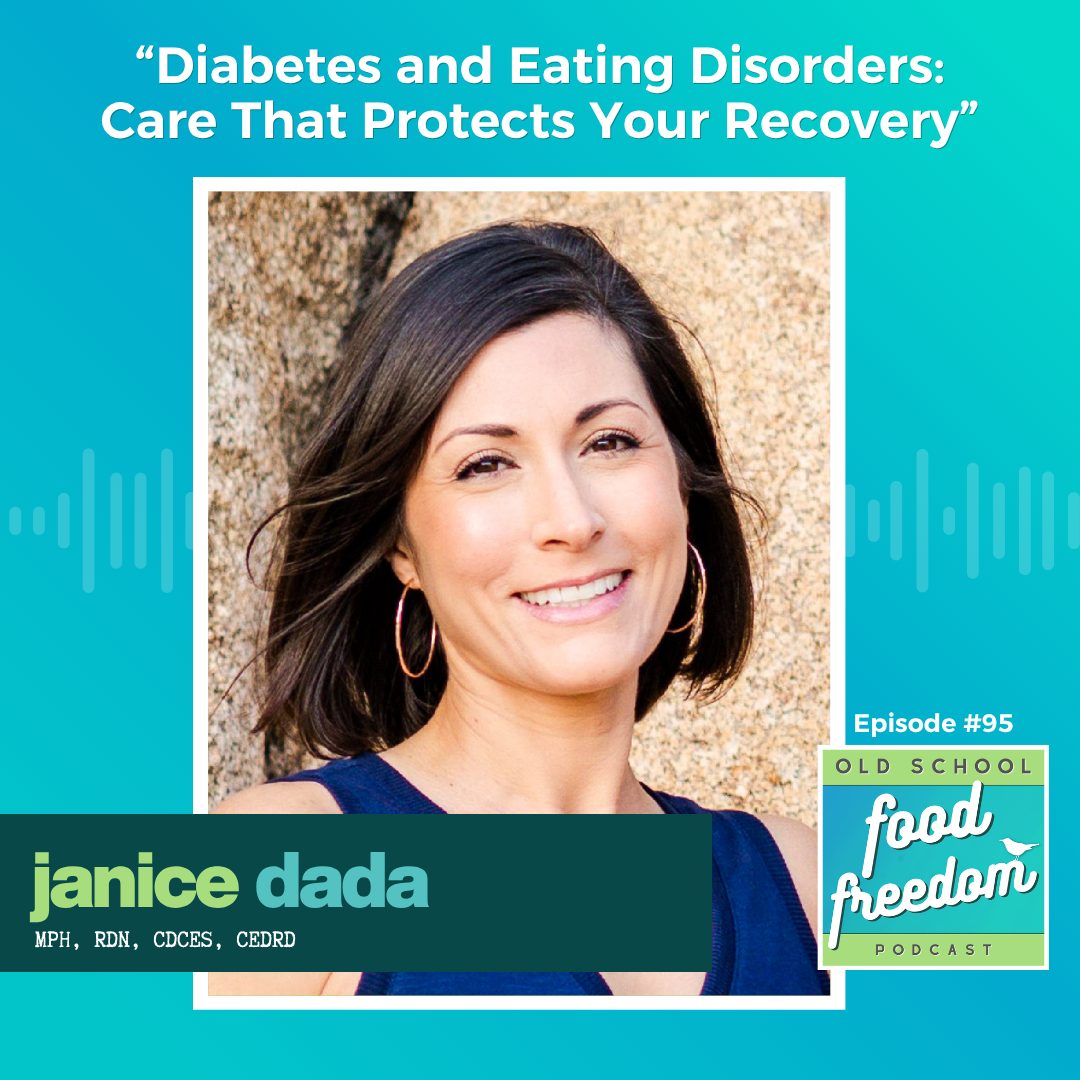
“We cannot bring our perfectionism to blood sugar data, because we can’t be perfectionists with diabetes.”
A diabetes diagnosis hits differently when you have an eating disorder history. Your mind goes straight to counting and measuring, the exact things recovery took years to undo, and the fear that food is about to be taken away comes right along with it.
Chrissy welcomes Janice Dada back for part two of their conversation on diabetes and eating disorders. If you haven’t listened to part one on intuitive eating for diabetes, go back and start there, because it lays the foundation for everything in this one. November is Diabetes Awareness Month, and Chrissy points out that over half of American citizens are living with diabetes or prediabetes, so if this is your story, you are far from alone.
Chrissy gets personal here. When her diabetes diagnosis landed, a new mountain of shame arrived with it and tangled itself up with the shame she already carried from her eating disorder. A continuous glucose monitor sounded like restriction all over again, and the pressure to be a “good girl” by keeping her numbers in range felt a lot like the performance and control she had worked so hard to leave behind. Janice speaks to that tension from her work with patients, and she gets practical about what actually helps.
Here's what we cover:
Why the fear of tracking, counting, and food restriction is so common for people with a disordered eating history who receive a diabetes diagnosis
How to look at continuous glucose monitoring data as a neutral observer, and why perfectionism has no place in blood sugar numbers
Why high morning blood sugar often has nothing to do with what you ate the night before, and what the middle-of-the-night hormone release has to do with it
How diabetes shame spirals start, and why blaming yourself for a number makes everything harder to dig out of
When carb counting and blood sugar checks serve as a real safety feature (insulin users, for example) and when you don’t need to count anything at all
A visual plate approach that keeps you out of measuring and weighing, rooted in intuitive eating
What weight-neutral diabetes care looks like in the exam room, from skipping the scale to dropping food lists labeled off limits
How to find a diabetes dietitian specialist or educator who also understands eating disorders, and why interviewing doctors until you find the right fit is fair game
What trauma-informed diabetes care looks like, from asking permission to giving a little information at a time instead of a fire hose
Friend, if you have ever sat in a doctor’s office feeling as if your body failed you, Janice and Chrissy both know that place. Janice offers a gentler way to hold it: grieve what you wished were different, then ask how you want to care for the only body you get. She compares it to a house that never quite matches the day you moved in, but you still keep it up and make it a place you can live. Chrissy adds that if you have done any eating disorder recovery work, you already own more tools for this than you realize.
Janice’s book includes a chapter on self-advocacy and a downloadable letter you can hand to a healthcare provider as written or use as a starting point for your own words. The idea grew out of Regan Chastain’s “what to say at the doctor’s office” cards. You can find the book in paperback, audio, and ebook, with all the links below.
“We can trust our bodies. Sometimes it’s a process of getting back to trusting our bodies.” - Janice Dada
One person with diabetes is not the same as another, so fix your eyes on Jesus as He moves with you in your own lane, focused on what your body needs. If this episode helped, send it to a friend who is sitting with a new diagnosis today.
We’d love to hear your thoughts, so please drop us an email at admin@findingbalance.com, send us a voice message via SpeakPipe, or you can also subscribe for more practical episodes coming your way.
More About Janice Dada
Janice is a weight-inclusive registered dietitian with a private practice in Newport Beach, CA. She is a certified intuitive eating counselor, certified diabetes care and education specialist (CDCES), and certified eating disorders specialist (CEDS). She is passionate about simplifying and destigmatizing the nutrition- and weight-based discourse around diabetes.
Hello Freedom Community
Our Hello Freedom community is open! This Christ-centered space offers connection, encouragement, and gentle steps toward freedom from food and body-image struggles. No pretending, no fixing yourself first, come just as you are. If you want in, your next step is to join us at findingbalance.com/community.
You were not meant to walk this alone. We're saving a seat for you!
Mentioned Resources
Book: Intuitive Eating for Diabetes by Janice Dada
Related Episode
94: Intuitive Eating for Diabetes: 10 Principles Without the Shame
Connect with Janice Dada
FINDINGbalance
Facebook
Instagram
SpeakPipe – Send us a voice message!
CHRIST-CENTERED RESOURCES TO HELP YOU FIND FREEDOM
The Daily Vitamin eDevo: A free devotional with bite-sized truth emailed 5 days a week
Community Groups: Find connection with prayer groups and our Hello, Freedom! community.
Christian Treatment Finder: Connecting you with Christian providers experienced in treating eating issues.
Lasting Freedom Online Course: A Christ-centered, non-diet course to work through false beliefs about food and weight so you can live free from disordered eating and body image issues.
CREDITS
Interlude music by “Hotham” – Morning Thoughts
Intro music by “MokkaMusic” – Old Jeans (Funk)
Wrap-up music by Jesse Quinn – Christian Instrumental
Production & Editing by Leah Bryant Co
The content in this podcast is for informational purposes only and is not intended to diagnose, treat, or prescribe a particular course of action. If you have, or suspect you may have, an eating disorder, please consult your healthcare provider. If you desire to receive faith-based care, visit ChristianTreatmentFinder.com to browse professionals with a Kingdom campaign against eating disorders.
The unedited transcript for this episode of Old School Food Freedom
Recap of Previous Episode & Setup
Chrissy Kirkman [00:00:36 - 00:01:26]: You are so welcome. Friends, episode 94, we started there. So I would love for you to listen to that one first. We set a lot of foundation for this episode. And the reason we're talking is that November is Diabetes Awareness Month, but diabetes happens all day, every day for a lot of people, over half of American citizens are struggling with diabetes or prediabetes. And so you're not alone if this is you, but please go back and listen and then come back and listen to this episode. So we're just going to go right in there, Janice, for someone who has an eating disorder history. I know for me, but I'm going to ask you in your world, like, what does it feel like when that diagnosis lands? for your patients? What do you hear them saying?
The Emotional Impact of Diagnosis
Janice Dada [00:01:27 - 00:01:43]: Yeah, I think there's a lot of fear that maybe food will be taken away, that they'll have to start counting things, measuring things, essentially a lot of the things that they worked so hard to get rid of in their eating disorder, that they would have to bring that back. And that could be very triggering.
Personal Story: Shame and Triggers
Chrissy Kirkman [00:01:44 - 00:01:58]: Yeah. So let me just share a little bit about my story. Um, after receiving that initial diagnosis, like we've talked about, I immediately felt shame. So that shame that I felt Also connected to shame I felt with eating disorder struggles.Janice Dada [00:01:58 - 00:01:59]: Mm-hmm.
Chrissy Kirkman [00:01:59 - 00:02:52]: You know, when it was suggested that wearing a continuous glucose monitor might be helpful for me, I was still in a shame mode feeling like, oh man, that's restriction. And like, I got rid of fitness app trackers and, you know, like calorie counting app trackers and, you know, logging everything I ate. That was so disordered. It felt like, oh, I'm going to get back into that. And how, how am I possibly going to be able to find balance in that way? Because it kind of connected into the performance and achievement and control. And I've got to be a good girl, quote unquote, by keeping my blood sugar in a certain range. But oh my gosh, I'm doing everything I can, things that I think I'm supposed to do right. Based on whatever, and I'm still having these spikes and, oh, it was a lot.
Chrissy Kirkman [00:02:52 - 00:02:53]: Took a lot of time.
Janice Dada [00:02:53 - 00:02:53]: Yeah.
The Importance of Support and Teamwork
Chrissy Kirkman [00:02:53 - 00:03:16]: It took a lot of grace. I had to trust the process, trust my body, trust my dietitian and my doctor working together as a— it was really supportive for them to share information back and forth with my permission and, and to know I had these people in my corner as a team helping me. Work through those things. It was very challenging.
Recommendations for Diabetes Care and Eating Disorder Support
Janice Dada [00:03:17 - 00:04:25]: Yeah. I mean, I think definitely I'd recommend having a diabetes educator who's also versed in eating disorder, whether they have additional certification or not, but that would be ideal for somebody to not look at these numbers alone or, you know, only be, you know, seeing their doctor every 3 months and getting the 15-minute kind of download. Because I think it requires a lot more processing than that. There are therapists also who work specifically with people who have diabetes as well, which I think could be a great resource. Again, if, I mean, those are nice to haves, but if it is an option, I think that would be great. And the other thing that I mentioned in the last episode was sort of the idea of being a neutral observer. And so looking at CGM data, we've got to just be neutral observers, right? We cannot bring our perfectionism to blood sugar data, because we'll, we can't be perfectionists with diabetes. There are like 42 factors that could be responsible for a blood sugar rise, and it's not only about the food, right? It could be about stress.
Blood Sugar Data and Perfectionism
Chrissy Kirkman [00:04:25 - 00:04:29]: Thank you for saying that. Yeah. Oh my, oh yes. Ugh.Janice Dada [00:04:30 - 00:05:05]: Yeah. So many factors. But you know, when people are looking at their data, they're often like, but what did I eat? And this especially happens when people wake up in the morning and have high blood sugar. They're like, but I only ate this last night. I'm like, that has nothing to do with your evening meal. This is completely separate from that. Your meal is long digested after you've woken up in the morning. So unless you're sleepwalking and eating, there's nothing that your food is doing to your blood sugar, but rather it's probably all of the hormones that we know release in the middle of the night, cortisol and other stress hormones, which they're responsible for helping us to wake up eventually.
Understanding Morning Blood Sugar
Janice Dada [00:05:06 - 00:05:30]: But they also release glucose. We need glucose while we're sleeping. And if we have some insulin resistance, that might mean that our blood sugar is high in the morning. So rather than it being a food issue, it might be more of a medication issue. And so there's a variety of different ways that we can kind of observe our blood sugar, but when we're blaming ourselves for it being high, it's going to end up in a shame spiral that will be hard to dig out of.
No Shame, No Blame Approach
Chrissy Kirkman [00:05:31 - 00:06:07]: And you're all about no shame, no blame, and even just When you were talking about insulin resistance, I'm like, oh yeah, I have that. Whoops. I forgot about that. Maybe I should stop blaming myself. It's really hard to unclench your fists and release control. And so just know, friends, that it takes time. Like when you're talking about like having a therapist, like I think it was really helpful to hear just a reminder of like, make sure that you have someone who's, you know, specializes in this diabetes care because That really is a game changer. Someone who understands it from this perspective, it can be very freeing.
Seeking the Right Medical Team
Chrissy Kirkman [00:06:08 - 00:06:34]: And for your doctor to be on board in that way, and that is maybe a little more challenging to find. It's almost like interviewing and, or like dating, you know, like date a few doctors to figure out which one is going to really be supportive and do things with the understanding that you have an eating disorder history. And so navigate it with care. And let's talk about You know, what are other ways that where weight loss isn't the number one treatment prescribed?
Advocacy and Navigating Medical Appointments
Janice Dada [00:06:35 - 00:07:37]: Yeah. And in my book, I do have a chapter that's all about your own self-advocacy. And for those who live in an area where you can shop around for a doctor who will, you know, really take your requests seriously, I think that would be definitely a great move. I do also have a letter as part of the book that you can download and you can share this as it's written with a healthcare provider, or you can use it as sort of a jumping off point for your own communication. But it kind of gives an idea. And it, the idea comes from Regan Chastain, who for years has had these little what to say at the doctor's office cards, which I think are really great self-advocacy tools because they just, you know, use some important questions like, well, what would you prescribe for somebody who was in a thin body? Right? Like, Yeah. Give me that treatment plan when we feel like there's some weight-based discrimination happening in the medical office. So yeah, you know, being an advocate for what kind of care you need.Janice Dada [00:07:37 - 00:08:00]: Look, I have an eating disorder history. I don't expect you to know everything there is to know about eating disorders, but here's what I am telling you I need because of my history. I need no scales, don't recommend weight loss. I need you to not tell me that certain foods are off limits. And what I'll do is go find myself a eating disorder specialist dietitian who also can help me with the diabetes component.
Diabetes Care Involving Tracking and Its Risks
Chrissy Kirkman [00:08:01 - 00:08:27]: So good. Yes, yes, yes. And so standard diabetes care sometimes involves a lot of monitoring, um, blood sugar and carbs or, you know, food logging. So if someone has an eating disorder history, how can that kind of tracking become a problem even when a doctor is recommending it? I mean, I know how it was for me personally, but Are there other ways that you've seen that and how could someone navigate those potential landmines?
Adaptations in Tracking for Eating Disorder History
Janice Dada [00:08:28 - 00:09:53]: Yeah, we could use different strategies based on probably the, the type of diabetes and the type of medications that are being used. So for somebody with type 1 or somebody who is using insulin, which could be type 1 or type 2 or gestational, right? People can use insulin with any type of diabetes, but insulin is a medication that has the risk of a low blood sugar. So Checking blood sugar or having a CGM can actually be very helpful and be a safety feature for somebody who's using a medication that can have the potential to cause a low blood sugar. In addition, if somebody is dosing their insulin based on the amount of carbohydrates that they're using, often referred to as like a carb-to-insulin ratio, it's helpful to know how many carbs are in their food. There are so many ways to get this information now though, you know, you could— certainly utilize the internet, or if somebody's using a pump, there's like a whole database, but it does require us to at least estimate how much, you know, rice or bread or whatever it was that we had so that we can give a carb amount so that the correct amount of insulin can be delivered. For somebody though, who's not using medication or who is using an oral medication that does not run the risk of a low blood sugar, We really don't need to be counting. It's not necessary. I often like to use a visual approach for that.Janice Dada [00:09:53 - 00:10:08]: It's just allowing us to ensure that we're getting all food groups at the meal as much as we can, right? It's not going to be perfect. It's not going to be all the time. In that way, we can see our plate and see that we have, you know, what we need, but not have to count or measure or anything like that.
Diagnosis, Body Trust, and Healing
Chrissy Kirkman [00:10:08 - 00:10:31]: Yeah. Yeah. That's good. That's helpful. So in our previous episode, you know, we discussed that like a diagnosis can send the message that your body has failed you. I certainly felt that way, but for someone who was already struggling to trust their body, you know, with an eating disorder history, how can that impact the healing process? Like, and what could someone do? Yeah.
Grieving and Acceptance in Managing Diabetes
Janice Dada [00:10:32 - 00:11:23]: I mean, I think it makes sense to be a little bit upset with our bodies when they don't do things the way we want them to do. Can we have that moment of grief and then kind of try to find a path forward from it? Right. So yeah, I wish I didn't have this diagnosis. And how am I going to take care of the diagnosis that I have? Like what we know about human bodies is that they're never gonna function perfectly for our whole lives, right? We are sort of in a process of slowly changing over the course of our lives. And, you know, it's a privilege for us to continue to get older every year. And what that means is that things are gonna look different. Things might not work as well. And it's, it's kind of like taking care of a house, right? It's like, or the place that you live, like it's not gonna be exactly the way it was when you first moved in, or maybe it even wasn't as you wished it to be when you first moved in, but you're gonna take care of it anyway, right? You're not gonna like throw your trash on the floor.Janice Dada [00:11:24 - 00:11:51]: You're going to make it the way you want to enjoy it. And so for our bodies, what can we do to just take care of it and, you know, help us to feel as comfortable as we can, whether it's arthritis or whether it's sugar or it's wrinkles or it's thinning hair. Like it might be aesthetic or it might be functional, but regardless, these are like the only body we get. And so we've, we've got to figure out how are we going to accept and continue to trudge forward.
Lament and Using Recovery Tools
Chrissy Kirkman [00:11:52 - 00:12:39]: So good. And there really is a grieving process that we have to do, or we don't have to do it, but it's helpful to really kind of lament of, you know, Our expectations that we thought, just like within eating disorder recovery, I didn't expect to have to deal with this. I didn't want to whatever, fill in the blank. And it's that both/and. I didn't want that. And this is what it is. And how do I want to proceed forward? Especially if you've been doing eating disorder recovery work, there are so many tools that you have. At your disposal, like, you know, that you can access that really just lend wonderfully right in here with a diabetes diagnosis.Chrissy Kirkman [00:12:39 - 00:13:10]: So that's when I got to that place where I could actually see that and remember that it felt really helpful. And I'm, I started kind of changing my tune and changing my thoughts about how I wanted to proceed. I don't know if that helps someone, but it really helped me. So Janice, As we wrap up, I want to know, what do you wish that more doctors and clinicians understood about their patients with an eating disorder history? And what does maybe trauma-informed diabetes care actually look like?
Trauma-Informed and Person-Centered Care
Janice Dada [00:13:11 - 00:14:10]: Yeah, well, I mean, I will start by saying, I think people become physicians or clinicians in any form because they care about people. And I don't think that anybody intends to to do harm, you know, however, many clinicians only have 15 minutes. Many medical doctors have like 15-minute appointments. And so they have very little time. And I think what sometimes happens is that it's sort of like a fire hose effect and they wanna give all the information because they feel like maybe I haven't done my job if I haven't provided everything, but almost one of the better things to do might be to say, I'm gonna give you a little bit of information and then I want you to come back. Yeah. Because there's a benefit to asking permission and using open-ended questions and not making assumptions. Because sometimes when we download a whole bunch of information to somebody, what it feels like to the person who's receiving it is they have assumed that I eat too much this, or I don't do this, or I, you know, all these things because they're telling me to do them.Janice Dada [00:14:11 - 00:14:47]: Whereas if they're asked, hey, tell me about your physical activity level, or Tell me about what you usually eat in a day. It comes off a lot differently. And so I think for a trauma-informed approach, it includes asking permission. Would it be okay if we spent a little time talking about food today, or would you like to come back and talk about it? Or would you like me to refer you to somebody who will be able to sit down with you for a longer period of time? And then I think the medical doctor, whoever they're seeing, can feel like, okay, I've done my part in Saying, hey, this is an important piece, but I haven't rushed it and I've asked permission.
Chrissy Kirkman [00:14:48 - 00:14:49]: Oh, that's so good.
Janice Dada [00:14:50 - 00:14:50]: Yeah.
Episode Wrap-Up and Final Encouragement
Chrissy Kirkman [00:14:50 - 00:15:01]: So wonderful. I'm really sad that this was such a short episode because we're trying to pack so much into it. But Janice, is there anything you'd like to say at the end to kind of package it all together?Janice Dada [00:15:02 - 00:15:36]: I said a lot of it in my book. So, um, if you do have diabetes, I would love for you to use the book as a resource. You can get it. in paperback or in audio form or in ebook form. The thing that I really wanted to communicate through the book and the intuitive eating principles is we can trust our bodies. Sometimes it's a process of getting back to trusting our bodies. If there's been a disconnection, I think it's important for us to learn how to advocate for ourselves. And in order to know how to do that, we also have to trust our bodies and trust our own wisdom so that we can know, like, what is it that I need?
Chrissy Kirkman [00:15:36 - 00:15:36]: Yeah.
Janice Dada [00:15:37 - 00:15:59]: And also, you know, if you do have diabetes diagnosis, like one individual with diabetes is not the same as another person. And so just like with, you know, eating in a general context, like everybody's food needs are different. Everybody's interests are different. And so if we can kind of keep it in our own lane and just focus on our, our own needs, that will, I think, take us far.
Resources and Show Closing
Chrissy Kirkman [00:16:00 - 00:16:23]: Oh, love, love, love it. Well, Janice, thank you again so much for being here. Friends, I'm telling you what. If this is where you find yourself, please get Janice's book. It's so, so good. It has helped me so much. It goes right along with everything that Finding Balance stands for in our beliefs, you know, how we view like no diets and no shame. It's wonderful.Chrissy Kirkman [00:16:23 - 00:16:33]: So, um, you can find all the links you need in the show notes to connect with Janice or to get her book. So thanks again, Janice, for being here. I hope you can be on again. Yeah.
Janice Dada [00:16:33 - 00:16:35]: Yeah, I would love to. This was fun. Thank you so much.
Chrissy Kirkman [00:16:36 - 00:17:19]: Yeah, you're welcome. Thank you for listening to the Old School Food Freedom Podcast. For over 20 years, Finding Balance has been helping people walk in freedom by discovering where Jesus fits into their struggles with food and body image. If you want more biblical truth and encouragement, head on over to findingbalance.com and subscribe to our free daily vitamin devotional. While you're there, explore our Christ-centered Lasting Freedom online course and small group tools. You can help keep this ministry going by donating today at findingbalance.com. See you next time. The content in this podcast is for informational purposes only and is not intended to diagnose, treat, or prescribe a particular course of action.
Important Disclaimer
Chrissy Kirkman [00:17:20 - 00:17:33]: If you have or suspect you may have an eating disorder, please consult your healthcare provider. If you desire to receive faith-based care, visit christiantreatmentfinder.com to browse professionals with a kingdom campaign against eating disorders.More about the Old School Food Freedom Podcast
In today’s diet-culture society, food issues and body hatred have become the norm. But you were created to be FREE. Welcome to Old School Food Freedom, where we go back to the basics, God’s basics, for how we view food, our bodies, and our worth.
Hosted by FINDINGbalance Executive Director Chrissy Kirkman, this podcast features Biblically sound experts, thought leaders, artists, and everyday people who will inspire you to interrupt negative cultural soundtracks and rediscover God’s original design for your relationship with food and your body.
This show will deliver practical, faith-filled insights on how to break free from diet culture and body shame through the lens of Scripture. If you’re looking for guidance on how to heal your relationship with food while deepening your faith, you're in the right place.
We’ll answer questions like
What does the Bible say about food freedom?
How can I overcome an eating disorder or disordered eating with Jesus?
What is the biblical perspective on diet culture?
How can I find peace with food as a Christian?
What does it mean to treat your body as a temple in relation to eating?
How can I break free from diet culture with Jesus?
How can I align my eating habits with biblical teachings?
What are the first steps to finding food freedom in Christ?
This podcast is for anyone ready to walk away from diet culture and into the freedom that Christ offers. Whether you’re recovering from an eating disorder, disordered eating, wrestling with body image, or simply craving a more peaceful relationship with food, this space was made for you.
If you want to experience true food freedom with Jesus, this podcast will give you the encouragement, truth, and tools to do just that.
